
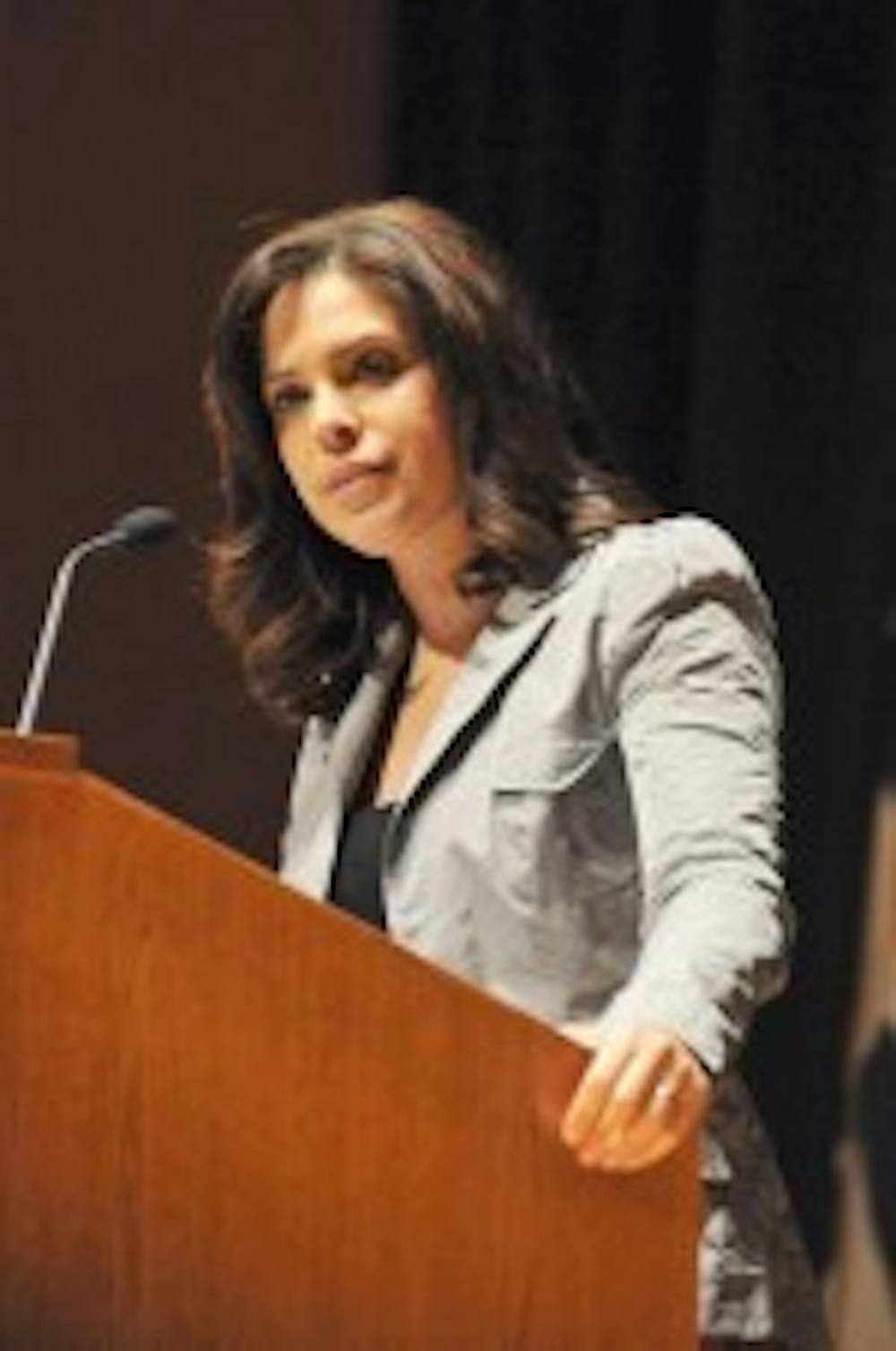
Soledad O'Brien is a woman who loves to tell stories.
At only 45 years old, O'Brien has worked on 25 documentaries for CNN – she's won numerous awards, traveled across the globe to give a voice to the unheard, and has even extensively researched Martin Luther King Jr.'s private libraries and speech manuscripts.
This past Thursday, O'Brien spoke to a sold-out crowd – full of more than 80 religious, student, and community groups – at Kleinhan's Music Hall as a part of UB's 25th-annual Distinguished Speaker Series.
The speech was also the 36th installment of the university's Martin Luther King Jr. Commemoration Series. Forty-five years ago, King spoke on the same stage as a guest at UB – just five months before his assassination.
O'Brien used the night to urge audience members to become catalysts for change in a world that's filled with social injustice. Instead of desecrating King's memory and legacy by practicing indifference, O'Brien asked the audience to become outraged.
The Spectrum sat down with O'Brien before her speech to talk about King's legacy and why it is still relevant today.
A look into King's legacy
In 2003, O'Brien joined CNN as a special correspondent. In 2007, she left her anchor position on American Morning and shifted her focus to more in-depth documentaries.
In 2008, the 40th anniversary year of King's death, O'Brien was given the chance to explore King's private libraries and first drafts of his speeches. She most-notably worked on the documentary Words That Changed a Nation, an incisive look into King's speeches, in which O'Brien read each document word-by-word and line-by-line.
"I think he's one of those people, sort of, the more you read, the more you get sucked in," O'Brien said. "Taking the speeches and seeing what words he changed…and going through his personal library to see what words, in his own books, did he think were interesting. It was fascinating."
O'Brien raised the question, if you were King and "X-ed" out a word, what would you replace it with? What significance did those marks hold?
But, the most interesting thing O'Brien found: the renowned "I Have a Dream" speech was not named after any sort of "dream" – it was actually entitled "Normalcy Never Again," and dreams were not at all included in the original drafts.
"He ad-libbed that [the dream]," O'Brien said. "And you could see in his writings, the previous years, how he was kind of working out the dream in various speeches that he gave and sermons that he gave."
The speech was harsh – it began with the phrase "the negro has been delivered a bad check." O'Brien noted that the speech was written to emphasize the point that black people had been "screwed." He was given five minutes at the end of the program – a ploy to keep King off of the night's newsreels – and he instead spoke for nine minutes.
Toward the end of the speech, King looked into the crowd and saw Mahalia Jackson, an American gospel singer and civil rights activist. She yelled, "Tell them about the dream, Martin!" and he flipped over his papers. The rest is history.
"She had been in church when he talked about having this dream," O'Brien said. "There is no ‘I have a dream' on the hand-written speech. The speech is known for that. Little details of history, like that, are all you know from not only interviewing people, but from examining the actual page."
Why King is still relevant
Forty-five years later, O'Brien argues that King's legacy is more relevant than ever. Every Martin Luther King Jr. Day, the nation stops and focuses on him – what would King think about where we are as a nation, what are we still fighting for, and what would he do to change injustices he would find?
"I think [King is still relevant] because of all the things that America still does not do for the people he was fighting for," O'Brien said. "I mean black people, I mean poor people. Many people thought he was radical and communist, and now people trip over themselves to be able to quote him – on all sides of the aisle."
O'Brien stressed that King is no more radical or controversial than he was 45 years ago – he didn't change and history did not change; we changed as a society. He was not "Jesus Christ come to earth"; rather, King was a regular man who believed the poor deserved to be fought for. O'Brien believes this is still true today.
She connected King's fight for the poor to an interview she had with Mitt Romney earlier this month. In the interview, Romney said, "I'm not concerned about the very poor. We have a safety net there." O'Brien interjected in the interview and asked Romney to repeat himself and asked if he really meant that he was not concerned about poor Americans.
"I think there are a lot of very poor people in dire circumstances that would take tremendous exception to the idea that there really is a perfectly fine safety net and that they should shut up and stop complaining about it," O'Brien said. "So really, nothing has changed. That's a conversation that I think [King] would have had 40 some odd years ago."
Beyond the documentaries
O'Brien is the daughter of a biracial, immigrant marriage – her mother is black and from Cuba; her father is white and from Australia. The couple married in Washington, D.C. because interracial marriage was outlawed in their home state of Maryland. The couple raised six children together, and all of them graduated from Harvard.
When trying to find her first jobs, O'Brien was told she wasn't "black" enough; she was asked to change her name (not an option; her full name is loosely translated to "Virgin Mary"), and she was told she couldn't fit in and was not "right" for positions.
O'Brien is connected to King's teachings and hopes her audience on Thursday night could learn from his legacy and become catalysts for change.
"What can a room full of students and others know what matters – what would you die for, what do you care about that's worth standing up for?" O'Brien said. "I'm not sure I can answer that, but I sure can pose the question."
Email: news@ubspectrum.com



