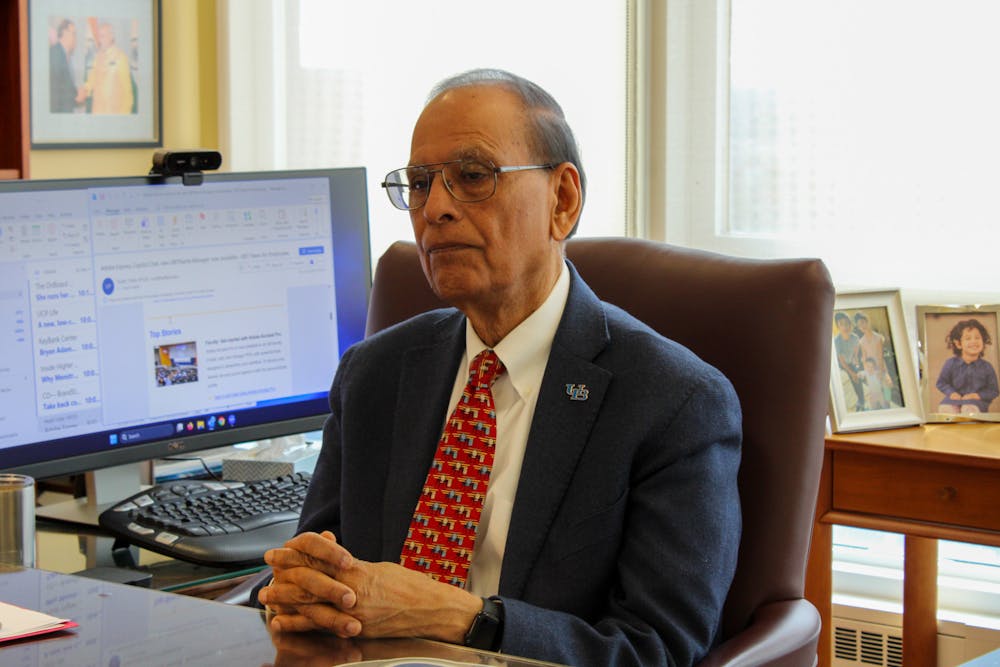
UB President Satish Tripathi told The Spectrum last spring that a “day will come” when he would step down.
That day will come in July, where he will end a 15-year-long term: the longest any UB president has done since William Greiner’s tenure of 13 years.
Under Tripathi’s watch, the university had expanded the School of Engineering and Applied Sciences, became a leader in artificial intelligence research and oversaw the construction or modernization of several buildings — all under its ambition to become one of the top 25 research universities.
Tripathi’s term hasn’t passed without criticism. He went under several months of public backlash — along with a lawsuit — due to UPD’s forceful handling of a pro-Palestine protest in May 2024.
Many students had also criticized his neutral standpoint in controversial issues: the refusal to cancel conservative speaker Michael Knowles’s visit to campus, rebuffed calls on transparency surrounding the UB Foundation’s investments and the lack of criticism on the actions of U.S. Immigration and Customs Enforcement.
The Spectrum sat down with Tripathi for the final time Thursday morning, where he spoke about UB’s growth, what he’s done throughout his term and what he will be doing next.
Tripathi wouldn’t do any part of his term differently.
“I can’t go back and think, ‘If I did it this way, I will be doing better,’” Tripathi said. “We won’t get any results on that. I feel pride that I was given the chance to be UB’s president.”
The interview has been edited for length and clarity.
The Spectrum: It’s undeniable that you had a massive impact on UB as a research university. You’ve overseen the near double enrollment in the School of Engineering and Applied Sciences, countless building renovations — including the Jacobs School of Biomedical Sciences which heralded the return of the medical campus back to downtown Buffalo — and UB becoming one of the top leaders in artificial intelligence research. Out of all these things, and many more not mentioned, what is the one thing you want to be known for?
Satish Tripathi: I’m most proud in three different areas, which is what a research university should be. The work we have done to provide first-rate education for students to be successful — that’s the prime mission. The rest of this we create so that we can provide that education that the students deserve. And so, we always have been improving the quality of research, quality of education that we provide to the students that are successful.
Number two is to provide the facility, environment and resources for our faculty to be successful as a researcher. Not just doing research for research’s sake but what impact do they make? The impact to the local community, to the state, to the nation. It’s improving the institution for the students and faculty so that they can make an impact in their lives and in the community. In order to do that, we need resources. We need to think about how to plan. We need to have good facilities. We need to have good classrooms. We need to have good labs. And we need to renovate buildings, we need to have an ecosystem for startups, so we can make an economic impact.
TS: AI is becoming a growing presence on this campus; and the more prominent it is, there’s increased risk. AI brings an environmental impact, a tendency to promote misinformation and bias and students are increasingly dependent on it for education. How does UB continue to use AI as a strength while balancing out the pitfalls that come with it?
ST: It’s not just UB, but the entire world is trying to address that question. The Department of AI and Society is created to address some of the societal questions. If we just did the technology, we’ll miss out on what happens with the biases AI produces. Because AI is going to take the data given, do the computing and give you some answers. Questions of how it impacts society and biases, we have faculty here addressing that.
We are in a place where we have hydropower. So we are lucky, and that’s one of the reasons we can sustain the power consumption for the new Empire AI system. There’s also a lot of research going on to think about. Do we need those kinds of large language models? Can we do smaller ones? Can we decrease their power consumption, but also can we produce computers that use less energy? It’s coming from multiple prongs: the kind of hardware one has, kind of software one has and the models that one uses.
It’s going to impact students and teaching; definitely is going to have an impact and we have a very strong group of faculty that’s looking into it. Everybody’s using it. The question is how do we assess that students are learning? They use it because when they get out of here, they’re going to use it. You want people to be able to use it in a way that’s helpful for their careers, their research.
TS: You are the first international-born UB president and you came to Canada as an international student. International students face a lot of difficulties, which have been only elevated by the Trump administration. Seventeen UB former and current students got their visas revoked and returned last spring; and recently, a UB student — whose immigration status was not disclosed to us — is currently detained in an ICE facility. From your perspective as someone who was an international student, how do you feel about all of this?
ST: When I came as an international student to Canada, there was no internet. There was no telephone connection. So I did not know where I was coming, where I’m going to stay. So that part was very hard as an international student. We didn’t have the immigration issue at the time but the first part to come and settle. But people were very welcoming and everybody was very helpful. So, as international students, there was a lot of support for all of us to do it. Right now, when international students come, they know where they’re going to stay. They’re connected with roommates and all that; so the first part is easier for them.
It’s what has happened in the past few years and our role is to provide all the information to the students, try to get them as much support as we can get. We are, all the time, in touch with the students who are impacted, but also provide them with the information we have. We have been supporting the students with all the ways we can support them. There are issues all the time, sometimes it’s heightened, and our goal is to provide the support. That’s all we can do. Every international student has a very different experience based on where they came from, based on their expectations, based on their willingness to integrate all kinds of it. It’s not just one aspect of being an international student.
TS: UB had forcefully handled a pro-Palestine protest on May 1, 2024, which resulted in several months of protests, public backlash and changes to the university’s mutual aid and student assembly policies. Do you think UB should have done anything differently on that night?
ST: We had a policy about all these things. It was never tested. We implemented the policy but it needed more clarification. I convened a group of faculty, staff and students. I gave them the policy, what we did, interpretation of the policy and asked them to clarify the policy further. And that has been done. If we did go and examine it, it’s not that we did anything wrong, it’s just that the clarity wasn’t there.
That happens all the time. If you had a policy and it had never been tested before, that’s where a collective group of people — the students, faculty, staff, everybody — come together, saying, “Let’s look at this, and how can we clarify more?” So, I think we have learned from that. And learning is to clarify the time, place and manner policy, which is what we did.’
TS: Students have called on UB to advocate for a specific side on polarized issues: whether to allow conservative speaker Michael Knowles on-campus, the Israel-Palestine conflict, etc. The university is for everyone to attend despite conflicting perspectives; how do you balance that with advocacy?
ST: We have to have empathy but we have to be neutral. It’s a place where all kinds of ideas, all kinds of views are present here and it’s a place for discussion. Universities are a place for discussion. It’s not my role to tell people what’s right and what’s wrong. So we have been very careful taking a neutral view but providing an atmosphere where different ideas can be debated. People want us to take this view or that view or this. No, our role is to provide an atmosphere for students to talk about their views, be respectful to others and the university. Whenever a view is needed, which is neutral, we always say that empathy is something we have but not necessarily a side to one or the other.
TS: As we enter the digital age, there are calls for everything to become more and more transparent — especially with how the university spends its money. Under your leadership, how transparent do you think the administration has grown?
ST: As a public university, we’re all very transparent. That’s expected. Our books are transparent. My life is transparent. Transparency is very critical actually because we are responsible for public resources. We are public servants. So, that part, we understand very well. Information, without giving the privacy of individuals, is always important if somebody wants or needs it.
TS: How is it like to leave the spotlight after being in it for so many years?
ST: It’s normal. The only spotlight would be when I step down, people say, “He hasn’t done a bad job.” I’ve got a lot of friends. I’m getting a lot of “thank you” from the students. It’s gratifying to see that’s happening, but in four years, they’re gone right? The new students come in, they won’t know my name. But that’s okay. That’s the job. I would still be Tripathi. I would be a faculty here so I’m not going anywhere. I haven’t been in that situation so I don’t know how I feel, to be honest, but I’m not expecting anything. It’s just that I feel good right now that they stop me and talk to me.
TS: On that note, you said during the press conference in the fall that you were still figuring out what you want to do as a faculty member.
ST: I’m still figuring it out. There’s one thing certain: I’m going to go faculty. I’ll teach. I get a year off, actually, because I have not had a single day off in the 22 years I’ve been here. So I get a year out to prepare. I’ve forgotten my computer science, a lot of it. 22 years: it’s three generations of computer science that have gone by. So I need to learn some and see what I would like to teach and what I might want to write. And so, I get time for reflection, and time to learn, to see what that would be.
Mylien Lai is the senior news editor and can be reached at mylien.lai@ubspectrum.com.

Mylien Lai is the editor-in-chief at The Spectrum. Outside of getting lost in Buffalo, she enjoys practicing the piano and being a bean plant mom. She can be found at @mylien.lai on Instagram.

 Photo: Wikimedia Commons | Courtesy of Quintin Soloviev