
The University at Buffalo continues to extend its international reach.
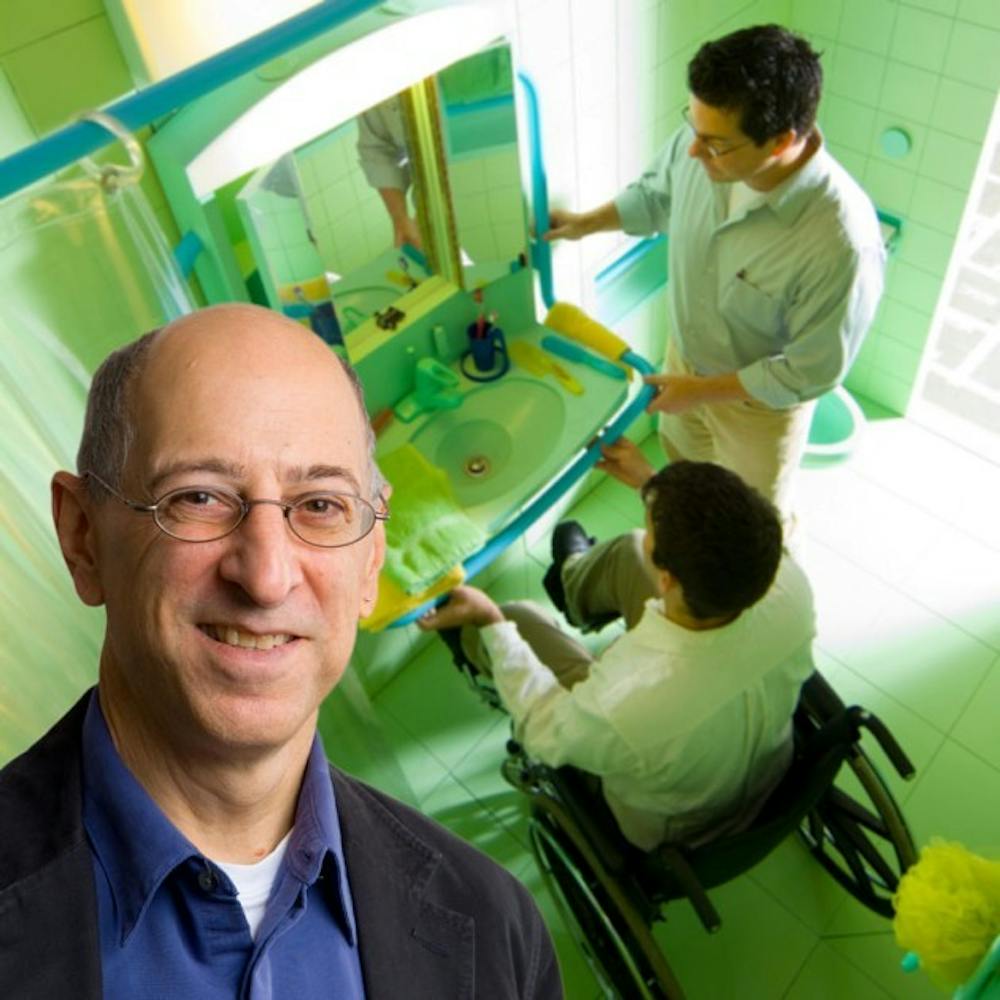
UB's Center for Inclusive Design and Environmental Access and the Toronto Rehabilitation Institute are partnering to research and change the accessibility of housing, public buildings and outdoor spaces able to accommodate people of all abilities and ages.
Through a five-year, $4.75 million grant that launched on Oct. 1, UB researchers and the Toronto Rehabilitation Institute will be working together to make products simpler and easier to use for every person of any ability.
This is the third five-year grant UB has been awarded, reflecting the long-term commitment and success of UB researchers in this field.
Edward Steinfield, the principal investigator for the project, professor of architecture, and director of UB's Center for Inclusive Design and Environmental Access (IDeA Center), is working alongside co-principal investigator James Lenker, assistant professor of rehabilitation science, on the initiative.
Steinfield and Lenker are co-directing the new RERC with Jordana Maisel, director of the IDeA Center's outreach and policy studies, and Geoff Fernie, vice president for outreach at Toronto Rehabilitation Institute.
"[This initiative] is giving an opportunity for students from different departments to come together and work with nationally recognized researchers," Lenker said. "It's a good chance for students to work with people from different disciplines [and] make a relevant and positive societal benefit."
Most of the laboratory testing is being completed in state-of-the-art facilities in Toronto. In these labs, there is a chamber that controls weather conditions such as rain, severe wind, white out conditions, and anything else Mother Nature throws our way, can be simulated.
Through these laboratory experiments, researchers can test out different surface materials, including sidewalks, stairs, curb cuts and other pavements, to see how they stand up to various weather conditions and how people with all different abilities can handle them.
The laboratory research being conducted in Toronto goes hand in hand with field research being conducted here at UB.
UB faculty and students are working on Greiner Hall, which is currently under construction, and converting it into another newly built dormitory that implements universal design.
After renovations and research are completed, a UB research team will invite people with disabilities to navigate and tour Grenier Hall and compare the experience to buildings that have not incorporated universal design. This will help researchers learn how to make buildings and public spaces useable for the greatest amount people of different ages and abilities.
Other projects include reassessing over 450 home modification projects completed by the IDeA Center since 1996 and other projects completed nationally to study what works in universal design and what does not.
The IDeA Center is also teaming up with colleagues at Carnegie Mellon University to begin a five-year RERC project that advances public transportation for those with disabilities.
"[We hope] to make buildings usable for the greatest number of people of all abilities," Maisel said.
Universal design controls products across a broad spectrum. From public transportation to shower controls and from building designs to bottle caps, universal design tries to work to make products simpler and easier to use for everyone.
"We don't give these things a single thought, but [these things] come in play with people who are older and disabled," Lenker said. "[Universal design] calls attention to these needs and designs for everyone."
For more information on this initiative and the IDeA Center, visit http://www.ap.buffalo.edu/idea.
E-mail: news@ubspectrum.com



