
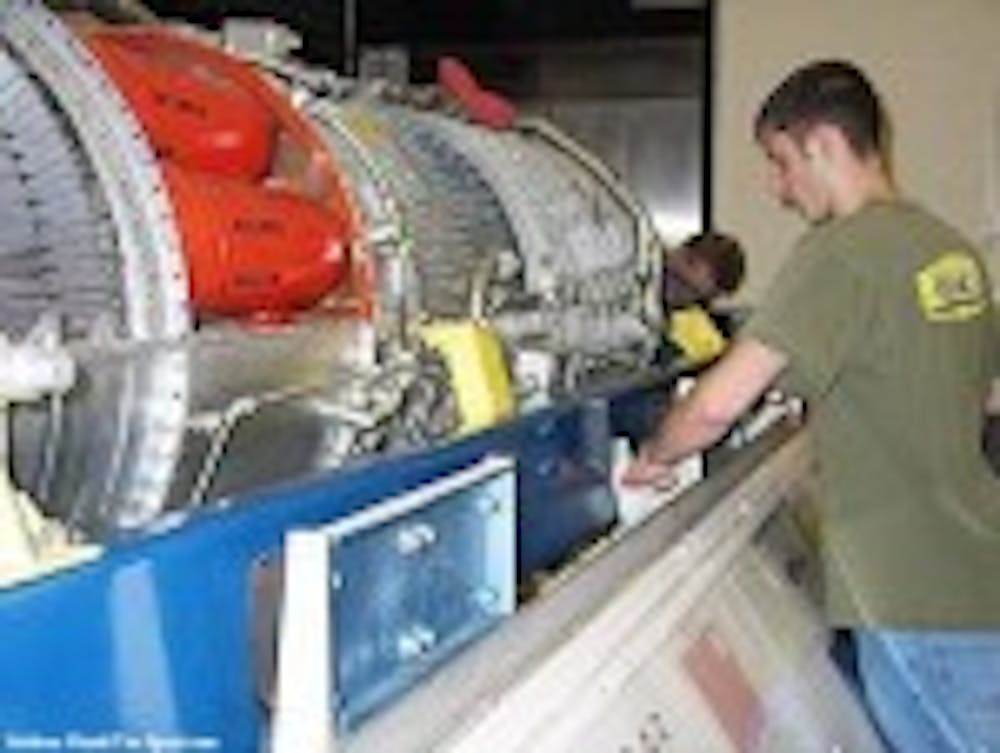
Members of the American Institute of Aeronautics and Astronautics gathered Saturday, sponges in hand, to clean the J79 turbojet engine that sits in the lobby of Furnas Hall.
Under the portrait of Clifford Furnas, UB's ninth chancellor and first president, nearly 20 members of the group listened to mechanical and aerospace engineering professor Paul Desjardin explain the science behind the engine before giving what used to be the driving force behind the F-16 a scrub in time for next week's open house.
The engine, manufactured by General Electric, found its way to UB after being secured from the surplus scrap heap by an alumnus serving in the U.S. Air Force several years ago.
The two-ton engine creates 18,000 pounds of thrust that propels an F-16 aircraft to a maximum speed of mach 2.4 - approximately 1,800 miles per hour, according to AIAA member Joe McManaman, a first year graduate student in mechanical engineering.
The AIAA, which has been a fixture at UB for more than a decade, has become significantly more active in recent years, according to Frank Centinello, the group's president and senior aerospace engineering major. He attributed the event's large turnout and group's positive momentum to a motivated freshman class.
Membership in AIAA does not hinge on one's major, according to McManaman, and all active members are welcome to participate in trips and events in which the group participates.
One project currently being pursued by the aeronautics group is the drafting of two proposals to conduct microgravity experiments at NASA Houston on board a KC-135, better known as the "vomit comet."
The experiments involve the question of whether the human body has evolved because of Earth's gravitational environment.
The first experiment will test the speed of enzymatic reactions in microgravity and second will research the brain's equilibrium maintenance while under the influence of virtual reality programs.
"Our brain is accustomed to gravity," McManaman said.
The association is also building a 4-foot rocket that will go 2,000 feet in the air at 200 miles per hour, which actually will force the group to get clearance from the Federal Aviation Administration.
The group also plans to build a remote control airplane to carry and drop four liters of water in a "firebombing" exercise used to fight forest fires.
When the group currently is not entering competitions and expositions, they participate in fundraising for charity and work in inner city schools.
This year the association raised $850 for Light the Night, a project run by the Leukemia and Lymphoma Society. They also visited urban Buffalo schools where they explained engineering and encouraged student interest.
"We went into inner city classrooms to open up their eyes to engineering," said McManaman.
Centinello, the group's president, said he first became interested in aerospace sciences as a child.
"My mom got me a book about space when I was 7 years old," said Centinello, "and I've been hooked on flying ever since." The book's title, which he still remembers, was "My First Space Book."
McManaman echoed his sentiment, saying that airplanes fascinated him from early on. He said friends and family would joke that he would go to airports just to watch the planes.



