
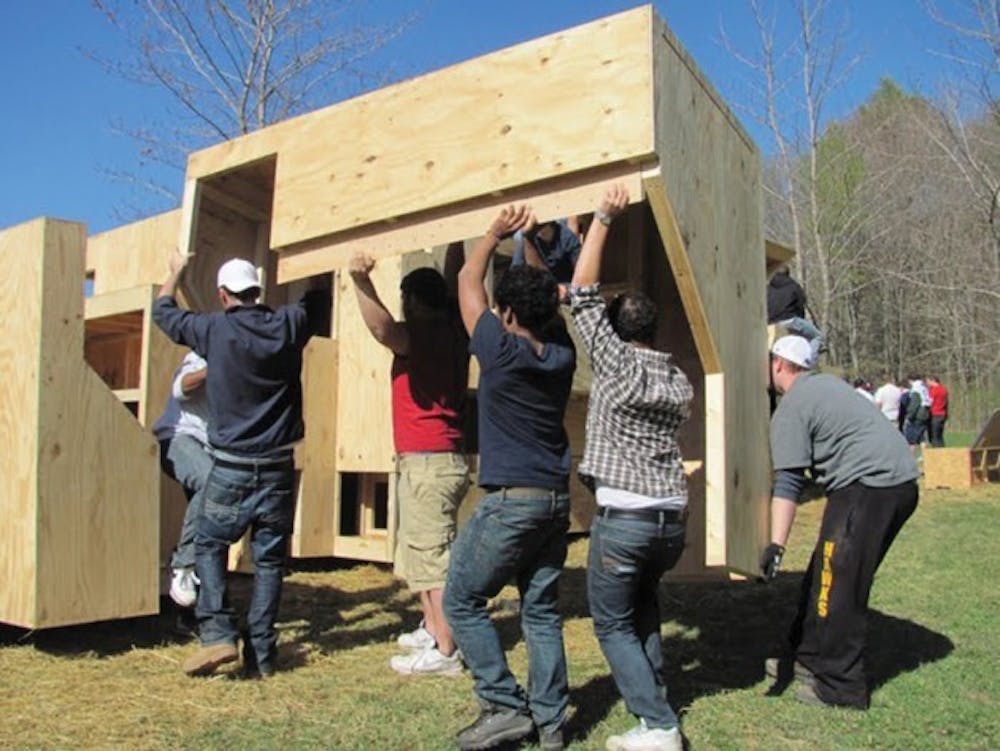
From simple sketches to an intricate span of wooden modules, first-year School of Architecture students have taken their designs from paper to reality with "The Living Wall."
"The Living Wall" is the culmination of a yearlong project in which 80 first-year architecture students have designed and built their own living modules. Not only have students brought their designs to life, but they will have the chance to spend 24 hours testing the functionality of their work in this second-annual project.
"[The term] ‘living' is often times thought about as interior or private in a domestic space," said Nicholas Bruscia, adjunct instructor in the School of Architecture and one of the four faculty members overseeing the project. "What we were doing is challenging that a bit [and] opening up opportunities for multiples or crowds to actually be socially engaged by the less private and more open spaces."
Students designed and built these modules in the architecture department's materials and methods workshop on South Campus. They were given 48 square feet to work with; a 6 by 6 by 8 feet rectilinear space that needs to house up to seven people.
"There are different ideas about public space and private space and how that's going to be divided amongst the teammates," said Christopher Romano, clinical assistant professor in the School of Architecture. "It's a really, really small space that has to fit a lot of program, so they have to get really creative with how they fragment and transform the rectilinear volume so that they can all occupy and meet these programmatic requirements that we give them."
Within the limited volume, students must also incorporate an entrance, access to daylight and ventilation, enough space to stand up and move around, and sleeping spaces for up to seven people.
"One of the overarching ideas of the programs is that the amount of spaces, entrances, windows, sleeping spaces, and circulation spaces is larger than the initial volume we give them," Romano said. "They have to cut up this volume and begin to shift things up and shift things out to basically enlarge the space so they can actually occupy it. "
Once the modules were completed, students transported their works to the Griffis Sculpture Park in Cattaraugus County. The dwellings were then assembled and on Friday, April 29, the students will spend 24 hours inhabiting their living spaces.
This 24-hour period is a test of how well the students planned, designed, and built their structures. Students will learn firsthand how well they deal with the notions of shelter, enclosure, insulation (or lack of), and space through this "post-occupancy evaluation," according to Romano.
"[This project] gives students a chance to really understand what was good about their project and what really worked [and] some things they might want to improve. It's kind of this year-end testing of performance," Romano said.
The 12 modules come together at the park to form a "wall," or a 100-foot long chain that spans the hill on the site. The modules vary greatly in geometric shape, ranging from simple rectangular models to more complex curved and pyramidal forms.
Some of the modules that make up the cascade hit heights of up to 12 feet—a significant difference from last year's model. Each structure must work with its surroundings, forming a mini-city and community in which each structure plays off or builds upon its neighbors.
This project is also exclusively for first-year architecture students. UB has a tradition of having second-semester, first-year architecture students complete a design-build project, according to Bruscia. Typically, this project has always been a short project at the end of the year, but the four faculty advisers wanted to inflate the project and make it more comprehensive.
"We wanted to introduce first-year students to real issues, things like following deadlines, how to work in groups, how to find leadership, and how to put together and manage a project of this scale," Bruscia said. "This is when we teach."
The students are thrown into this project and many are experiencing what will be done in their future professional careers for the first time. They are given the opportunity to come up with a design and actually construct it, a privilege usually given to upper-class students.
"The amount of work and detail that goes into just some of the simplest steps and figuring out how everything works and then actually creating it was something I never had done before," said Andrew Durkee, a freshman architecture student involved in the project. "Going from just dealing with mainly scaled models to actually seeing the full scale, it's pretty incredible."
"The Living Wall" is on display at the Griffis Sculpture Park, located at 6902 Mill Valley Rd., East Otto in Cattaraugus County, starting April 29. After the inaugural 24-hour period in which the students inhabit their creations, the project will be on display for 18 months. The project becomes a public art piece; community members are encouraged to visit, climb though, and explore the modules.
"It's a really huge project to be doing for anyone, but for first-year students to do something this comprehensive, this complex and keep it in a fun and playful way, it's how we pull the project off," Romano said. "It's how it works."
Email: news@ubspectrum.com



