
New York State budget cuts have put UB2020 in a critical situation.
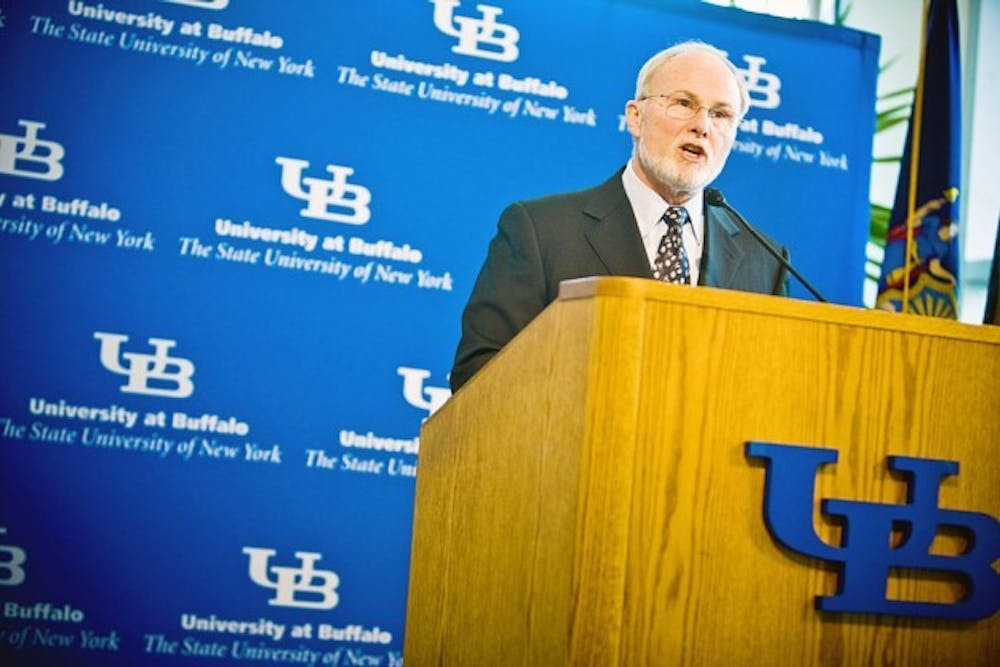
In a press conference held on Monday, President John B. Simpson revealed that due to a lack of state support, the entire project is in serious need of additional funding to remain feasible.
"Our ability to complete UB2020 is in serious jeopardy, and with this, the future of Buffalo and western New York is in jeopardy," Simpson said. "And make no mistake – business as usual simply will not allow us to complete UB2020."
The proposed solution to the problem of funding is a collection of major policy changes that will grant UB more autonomy from the state. Collectively, the reforms are known as the Public Higher Education Empowerment and Innovation Act (PHEEIA).
"We need our elected officials in Albany to change policy, to let UB live by the same rules as virtually every other major public university in the U.S.," Simpson said. "These are nothing more than common sense reforms."
While the reforms were included Governor David Paterson's Executive Budget Bill and the budget resolutions put forward by the Senate, they were cut out of the resolutions put forward by the Assembly.
Although the act purports to be a "high-impact, zero-cost solution" to the problems of public university funding, the implications of the policy changes would be wholly financial.
The legislation would grant UB and every other SUNY school the ability to control student tuition without state interference, raising and lowering tuition as each campus saw fit.
"[The reforms will give us] a predictable tuition plan that rightly differentiates the cost and quality of education at our research universities, like UB, and keeps the tuition our students pay right here in Buffalo," Simpson said.
In addition to tuition control, the reform will allow UB to enter into partnerships with private companies and organizations as a means of acquiring additional funding and promoting economic growth in the area.
Though Simpson warned that future tuition increases are unavoidable, with or without this legislation, some students worry about giving UB complete control over tuition. Amy Hilburger, a sophomore psychology major, thinks it will likely lead to unfair increases.
"I don't think they'd act in the best interest of students." Hillburger said.
If passed, projections of the act for UB include a 6000-person increase in student enrollment, 660 new faculty members, 8550 new constructions jobs, and $1.5 billion in new construction.
Simpson emphasized the gravity of the situation and the short timeline during which the reform's fate will be determined.
"I think the next few weeks are crucial… to getting this legislation passed," Simpson said. "If it passes then I think we'll be very much on the road to building UB2020."
Considering the plans of UB2020 are vital not only to the university but also to the entire area's economy, Simpson called on the community at large to do its part in voicing their support for the legislation.
"I see this plan as crucial for the future of Buffalo and western New York," Simpson said. "I think this is a community effort and we need to get this done as a community. What follows from that is that everybody needs to tell, by whatever means they have, elected officials of all kind that this is critical for our future. All of us need to do this."
E-mail: news@ubspectrum.com
More bad news for UB2020
More



Comments
