
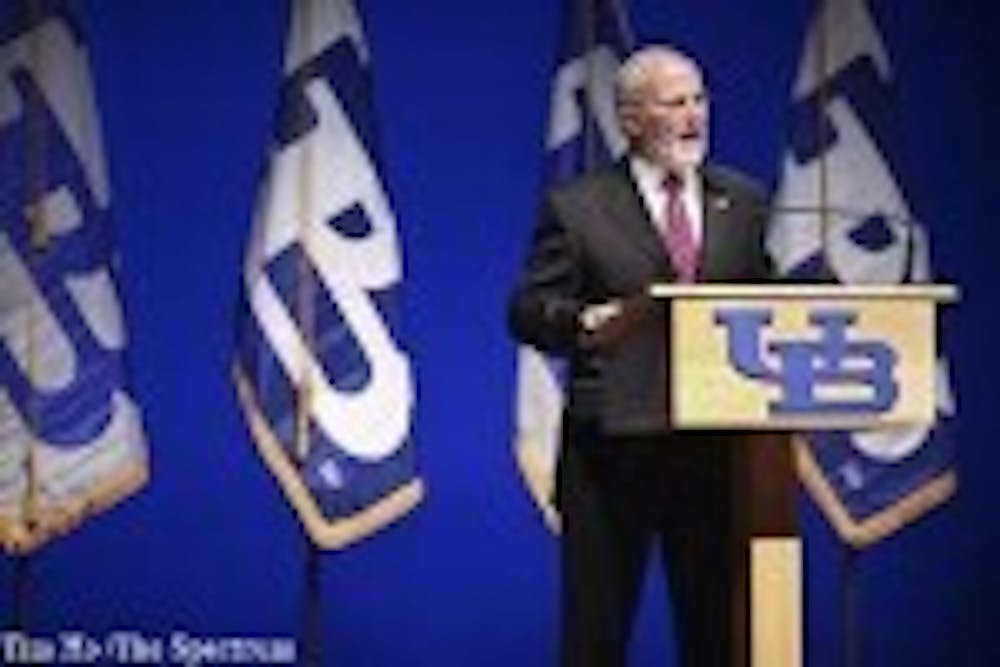
The plan to propel the University at Buffalo into the 21st century was unveiled to the public on Tuesday, with an ultimate goal of uniting all three of Buffalo's campuses.
The plan, known as UB 2020, will be used to guide UB to evolve into a model 21st-century university by increasing enrollment. The plan calls for 10,000 more students and 6,700 new faculty and staff members.
'It's designed to make UB bigger, better and a more livable place to attract talent,' said President John B. Simpson. 'It will help many realize the vast potential of the University at Buffalo.'
According to Jeremy M. Jacobs, chairman of UB Council and chief executive officer of Delaware North Companies, UB is the most influential institution in Western New York.
'The University at Buffalo is the head of the Buffalo-Niagara region,' he said. 'This plan will make the heartbeat stronger.'
The plan calls for each of UB's campuses to have their own distinct environments while becoming better connected with each other.
According to the plan, North Campus will evolve from a campus designed for the '70s to a community connected rather than isolated. It will be home to UB's main libraries, the College of Arts and Sciences, the School of Engineering and the School of Management. In addition, there will be other minor changes throughout the area.
UB Athletics will gain a new field house and tennis center directly between UB Stadium and South Lake Village, with the hopes of attracting top-quality talent to the athletics program.
Also, with an increase in students attending UB, new forms of housing will appear throughout the campus. The plan calls for housing to appear north of the Natural Sciences Complex, as well as along Lee Road between the Student Union and the Ellicott Complex.
Along with the housing will come a recreation and wellness center, as well as a hotel in walking distance of the Student Union, located where the University Bookstore currently calls home. Next to the recreation and wellness center will be a green space known as 'The Oval,' which will replace The Commons. This area will be a gathering place for students, and also the hub to boating and ice-skating on Lake LaSalle.
'The North Campus lacks soul now, but the plan will create fabulous social spaces on the Academic Spine, Lake LaSalle and a new ‘Main Street' leading to the Ellicott Complex,' said Fredrick A. Bland, managing partner for Beyer Blinder Belle Architects & Planners.
South Campus will become the home for professional education, bringing in the Law School, School of Education, School of Social Work and School of Architecture and Planning. It will also build three new housing complexes near Goodyear Hall to accommodate new students. Goodyear Hall will also go under a partial conversion toward graduate student housing.
'It demands a high standard of design excellence,' said Robert G. Shibley, senior adviser to the president for campus planning and design.
Finally, the Downtown Campus will aim to be a world-class academic health center. Unlike its sister-campuses, the Downtown Campus's shape is questioned at this point, but UB's administration plans to move the School of Medicine and Biomedical Sciences, the School of Dental Medicine, the School of Nursing, the School of Pharmacy and Pharmaceutical Sciences and the School of Public Health and Health Professions to the location.
The move will bring 13,000 new jobs to the Buffalo Niagara Medical Campus, according to James A. 'Beau' Willis, executive vice president for university support services.
Simpson feels the move should bring in people from across the world to Buffalo for medical treatment instead of places such as Pittsburgh or Cleveland.
'I want people to say, ‘If I have health problem X, I'm going to Buffalo for treatment',' he said.
One major goal for all three campuses involves transportation. The plan is pushing for parking garages throughout each of the campuses, in hopes of fixing the parking problems that plague students and faculty today. In addition, the plan gives way for the NFTA Metro Rail to connect the City of Buffalo to North Campus, a plan that has been kicked around for years.
The plan calls for approximately $2.9 billion in state funds to build core academic facilities, in addition to $2.1 billion of UB funding, through private partners, philanthropy and other sources. While the plan itself is very attractive to many, there are many people skeptical of the chance of it actually being implemented due to the financial crisis plaguing New York this year.
'I don't anticipate that we will deal with this for two decades,' Simpson said. 'God help us if we [still] are. I anticipate we'll build this. We can act as a catalyst for the economy in Western New York.'
Willis shared the same sentiment.
'Contrary to the thinking in some quarters, dollars for UB's comprehensive physical plan and UB 2020 is not spending, it's an investment,' Willis said. 'According to calculations, from UB's Regional Institute, each one-time investment of $250 million by UB and its partners – one year's worth of projects – will return a recurring $100 million in economic activity to the region every year as UB grows and becomes a much bigger institution.'
Currently, some aspects of Phase One of the plan have already taken form. The Child Care Center on North Campus has been expanded, while Lee Road is being repaired and updated so it can soon connect to the Ellicott Complex. On South Campus, Kapoor Hall has begun to be renovated.
Executive Editor Keeley Sheehan and Senior Managing Editor Ren LaForme contributed to this report.
E-mail: news@ubspectrum.com



