
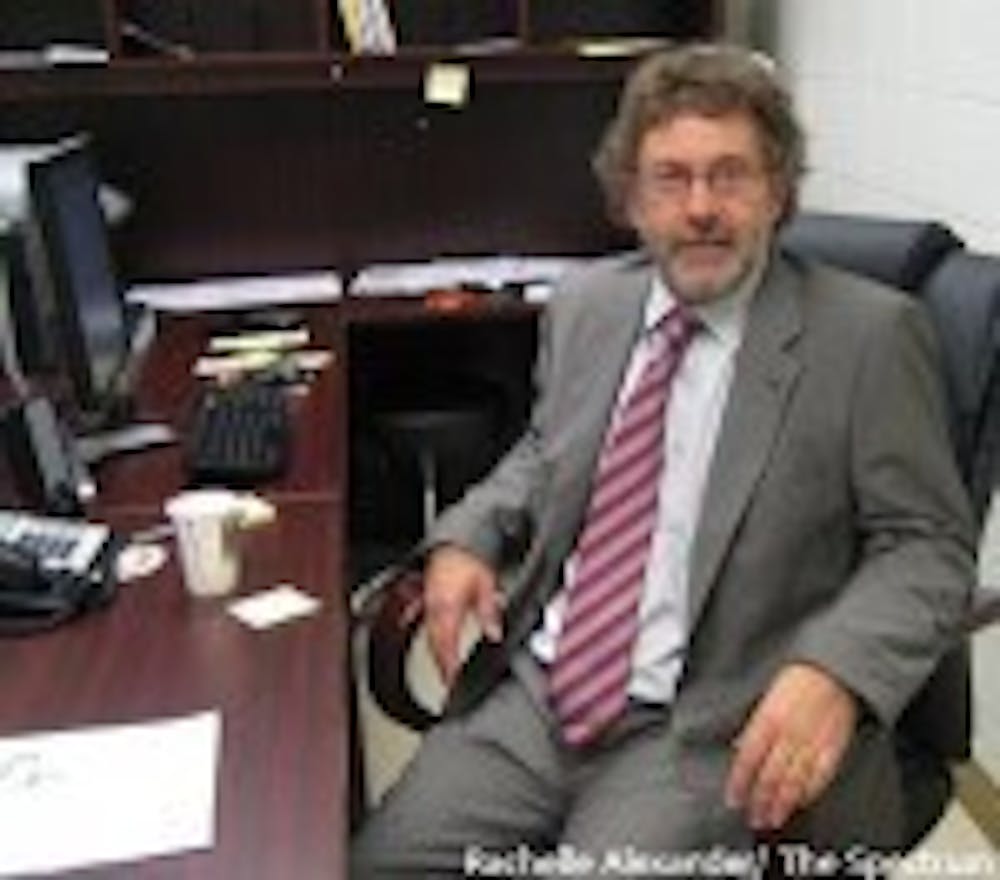
Gottfried Strasser, a well-known Austrian researcher, joined the UB faculty six weeks ago to take advantage of a $750,000 grant from the New York State Office of Science, Technology and Academic Research (NYSTAR).
A professor of physics and electrical engineering, Strasser developed a reputation as a world-class researcher while he was an associate professor at the Solid State Electronics Institute at the Technical University of Vienna, Austria.
"Famous Austrians include Mozart and Arnold Schwarzenegger," he said. "I am not famous in that sense, but I have published over 400 articles in various respected scientific journals. That is how people in my field know me."
The focal points of Strasser's research are somewhere between the fields of physics and electrical engineering. In his work, he plans on combining relevant concepts from both fields.
"In reality, my research draws from both disciplines. You should not regard these two fields as so sharply divided," he said.
According to Strasser, his research seeks to perfect the laser technology that has already become an integral part of life in first-world nations like the US.
"Lasers have a wide range of applications right now from cell phones, to computers, to optical drives and storage devices," he said. "My goal is to make them better, faster, cheaper and more functional than ever."
He explained that his research has helped to establish a foundation of knowledge from which many everyday technologies derive.
"I developed a variety of devices: new lasers, new records in temperature, power and stability. I invented new concepts of coupling light that are used by other labs as well as industry," he said. "The research that I am working on today could be used in ways that we cannot imagine."
The professor classified his research into two categories, the first of which relates to the familiar technology of today while the other holds much promise for the future.
"I am interested in opto-electronics in lasers, detectors and other devices that function between the mid infra-red and visible frequencies," he said. "But I am also a material engineer. I work on quantum dots and low dimensional structures."
Strasser believes that his work in nanotechnology will lead to technological breakthroughs that even the most prophetic cannot foresee.
"Think about computing and the Internet. Ten to 15 years ago, many people did not have them. Nobody predicted that they would become as important as they are today," he said. "The same is true for my work with quantum dots."
The professor speculated that three technologies - quantum dots, spintronics and carbon nanotubes - will transform the electronics landscape of tomorrow.
"We don't know which of the three will prove useful. So we are working on all three right now," he said. "With this kind of technology, we can build transistors that are incredibly small and incredibly fast. But the main point is that I don't know where it is going to lead us. The major application of this knowledge can very well be something completely different."
Strasser plans on collaborating with UB faculty from both the department of physics and the department of electrical engineering. Hong Luo, professor of physics, looks forward to working with Strasser.
"He and I have similar research interests, and I definitely plan to work with him in the future," Luo said.
Strasser hopes to continue making discoveries with the assistance of the grant at UB.
"The academic environment in the US is very similar to that in Austria, and I haven't had trouble adjusting. So far, so good," he said.



