
Much like an exotic dish, the enjoyment of classical music typically falls into the two categories of complete love and utter distaste.
At the beginning of Tuesday night's faculty recital at Slee Hall, there were representations of both categories in attendance.
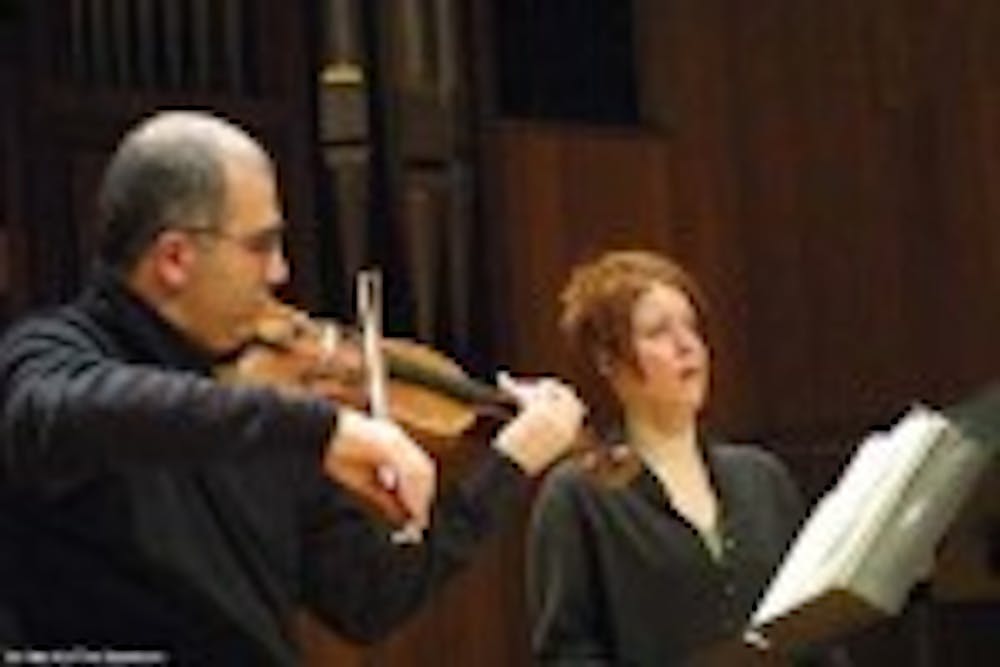
Slowly, as the music progressed, the crowd thinned and only the enthusiasts remained. Once this occurred, the performance of violinist Movses Pogossian and soprano Tony Arnold seemed to gain a higher level of intensity.
The focus of the recital was Gy?\0xA6rg Kurt?Ae?g's, "Kafka Fragments, Op. 24." This work, which is composed of 40 short movements placed into four sections, is inspired from the journals and letters of existentialist author Franz Kafka.
"It is an encyclopedia of human emotion. Every range of human emotion is there in the music," Pogossian said about the piece in a lecture preceding the recital.
After listening to each of the four parts, Pogossian's statement became entirely certain. Arnold's voice and Pogossian's violin communicated thoughts ranging from love and life to desperation and death.
At many points, the connection between the tone and tempo of the music and the feeling surrounding the lyrics could only be described as seamless.
The song "In Memoriam Joannis Pilinszky," exemplified this connection. The lyrics speak of a child's first steps, and between the awkward hesitation of the violin and curious anticipation in Arnold's voice, the moment was fully captured.
Similar to the title of the work, the music had a feeling of fragmentation. Rarely did the movements flow into each other and even within each piece there was a feeling of staccato rhythms and sudden shifting.
Perhaps this can be attributed to the overall feeling of the "Kafka Fragments, Op. 24." Although a variety of emotions are explored, taken as a whole, the music conveys a feeling of urgency and underlying tragedy.
"Out of despair comes hope. There is something bigger than us, so many of these songs have that feeling," Arnold said.
This thought became clear as the recital came to a close. Looking around Slee Hall, it was clear that the audience had just experienced something that was psychologically intense.
However, as Arnold said, it did not appear that the audience was left in despair by the music. Instead, it seemed that each person had simply been affected.
Kurt?Ae?g's composition and the remarkable talent of Pogossian and Arnold served to trigger this effect on the audience.
Both musicians have won international awards and have resumes that correspond to the level of acclaim they received from the audience at Slee Hall.
From a silence during the performance that made crossing and uncrossing legs sound like the operation of heavy machinery, to multiple curtain calls at the recital's end, the audience showed great appreciation for the performance of the two musicians.



