
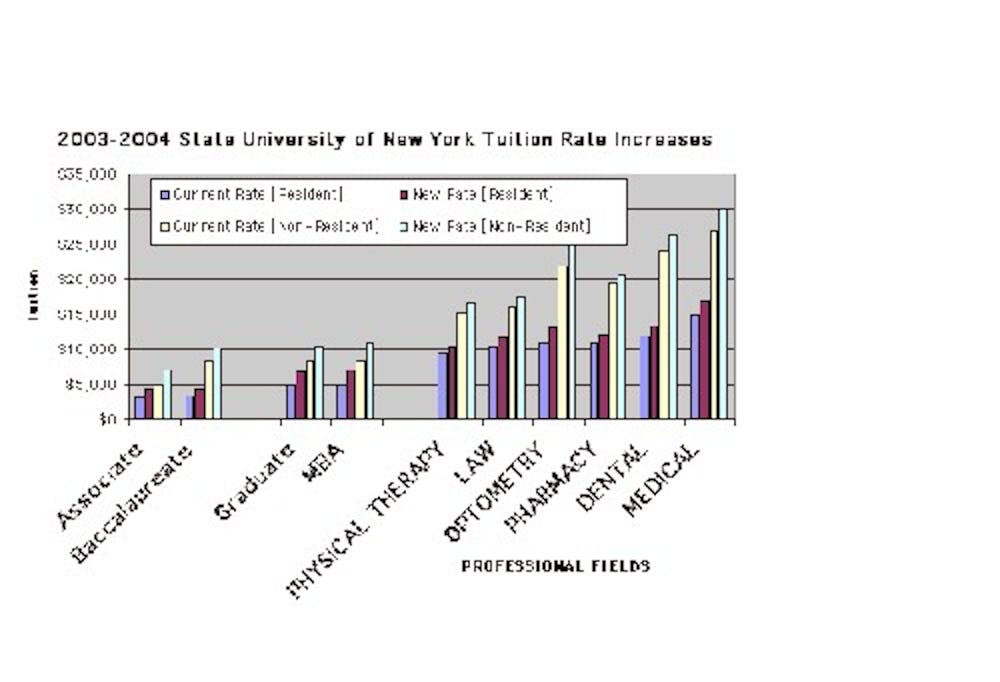
The State University of New York board of trustees ended a heated debate that has sparked student protest and criticism across campus in recent months, with the adoption of the first SUNY tuition increase in eight years.
Beginning in the fall, students will pay an extra $950 - bumping tuition from $3,400 to $4,350 - per semester, after an 11-1 vote from the SUNY Board of Trustees.
The only negative vote came from the student representative, Oneonta State's Stephanie Gross, who said the tuition hike would drive students away from a SUNY education.
Yet, it appears as though the end to the speculation surrounding the tuition increase does not necessarily mean an end to the debate and the criticism.
Miriam Kramer, higher education coordinator for the New York Public Interest Research Group said Gross made the right decision in voting against the increase, and said NYPIRG's main concern presently is the possible loss of students.
"I think it's appropriate that the representative of students voted against the increase considering the impact that the decision will have on students and their families," said Kramer.
Current Student Association President George Pape, who served as the board's student representative in 2002-03, said he has disagreed with not only the increase, but also Gov. George E. Pataki's original proposal calling for a $1,400 increase.
"They never really looked at the ramifications of what it would do to the universities and, more specifically, to the university centers," said Pape, calling the increase "irresponsible."
Until now, SUNY had boasted a steady tuition rate since 1995's $750 tuition hike, which Pape said means little now.
Instead the board should have been increasing the cost according to the Higher Education Price Index, a tool to calculate the changing prices in colleges and universities, instead of "having today's students pay for yesterday's students."
"I think the students would be behind a rationally-based tuition increase," said Pape.
Kramer said she worried that low-income students will not be able to afford the cost of education this fall despite full restoration of the Tuition Assistance Program and Educational Opportunity Program.
"In 1995 when there was a $750 increase, nearly 30,000 students dropped out of the public education institutions - But that was 1995," she said.
Kramer said NYPIRG - which does not have scholarship or tuition assistance programs to help out needy students - will be devoting its energy to informing students about the increase and its possible ramifications. She said she worries the only result coming from the increase will be fewer low-income students sitting in UB classrooms in the fall.



