Skip to Content, Navigation, or Footer.
The independent student publication of The University at Buffalo, since 1950

Jessica Tufte


NEWS

Relay for Life brings relief to UB students

Since 1985, the Relay for Life has raised money, spread cancer awareness and given communities across the nation the opportunity to celebrate life. The University at Buffalo hosted a relay event from Mar. 27-28 for the sixth straight year, and for the fourth straight year, senior Cristina Simonow was a leader among activists. Simonow, a senior psychology major, captained her Relay for Life team for the second consecutive year. But this time, the relay had an added importance to her. Simonow was the relay's top fundraiser. "I relay so that one day people will be able to say, ‘I don't know anyone who has had cancer,'" Simonow said. "[I don't want] kids [to] lose their parents. [I relay] so that people no longer have to lose people so special and important to them." Simonow's grandfather died of lung cancer when she was a freshman and other family members – including her grandmother, mother and father – have felt the effects of the deadly disease. Even her boyfriend is a cancer survivor. When Simonow was a senior in high school, her best friend died from non-Hodgkin's lymphoma. "He taught me to fish when I was little…I was in his wedding party," Simonow said. "Greg died only a few weeks before the birth of a baby whose mother had agreed to donate the cord blood for the stem cells as a treatment. He left behind a wife and kids. I know they're growing up without him and that kills me, too." Simonow's favorite part of the Relay is the Lumineria lap – a single lap walk in honor and remembrance of those that have lost the battle and those who are still fighting. Every year, the walk has brought Simonow to tears because of the painful memories. This year, the relay honored 35 cancer survivors and recognized six American Cancer Society funded researchers who currently work at UB. The event amassed 150 teams that equated to 1,300 participants. Thus far, participants have raised nearly $60,000 and are within $7,000 of the campus's record amount of donations. "Each person who shares the relay experience can take pride in knowing that they are working to create a world where this disease will no longer threaten the lives of our loved ones, or claim another year of anyone's life," said Stacie Waddell, the director of special events with the American Cancer Society. As depressing as cancer is to think about, the Relay for Life is not meant to be a sad experience. "It's about bringing hope and celebrating the survivors and their families. It's supposed to be a fun night, and it always is," Simonow said. The top fundraisers all have very personal reasons to want to participate in the relay. Fred Rich, a first-year education graduate student, takes pride in the event. "This year's event meant that I had to fundraise like I had never fundraised before because I lost an aunt who I loved very much on Feb. 27 to pancreatic cancer," Rich said. UB's Relay for Life will contribute its earned funds to programs intent on one day finding a cure to the life-threatening disease. "The relay is a really positive event with a positive message. We can work together to make a change. We can bring comfort to those fighting cancer. We can help women deal with the repercussions of losing their hair and we can provide transportation for people who need treatment. The relay is a way for regular people to make a difference." E-mail: news@ubspectrum.com

NEWS

Taxing junk food reduces purchases

These days, it seems like there is talk about taxes on many commodities that were never thought of as taxable. Some taxes, however, might be beneficial to the general public's health. Dr. Leonard Epstein, a distinguished professor of pediatrics and social and preventive medicine at UB, has found evidence that when junk foods are taxed, mothers tend to buy less of them, which could result in some degree of prevention of childhood obesity. The study Epstein conducted had various mothers go grocery shopping in an analog grocery store where the prices of products were altered in one of two ways: food considered to be junk food was taxed by either 12.5 percent or 25 percent, or the food considered to be healthy was subsidized by either 12.5 or 25 percent. "People bought fewer junk foods with less fats, less carbohydrates and lower calories," Epstein said. "When you tax, people buy less. It's common sense." A less expected result occurred when the healthier foods were subsidized. "When the healthy foods were subsidized, we found that there were more healthy foods [in their baskets], but there was also more junk food," Epstein said. People like subsidies since it's like being rewarded with money rather than having to pay more, as in the case of taxes. "Subsidies are always looked at as a great idea … people might have the idea that they spend $100 on groceries a week and then with a subsidy, they think it's extra money towards that and want to buy more Oreos," Epstein said. The public has seen the result of what happens when the government has taxed something unhealthy. Once cigarettes began to be taxed, people bought less. The same would be true for things like candy bars and soda pop if the government ever decided to tax such unhealthy items. "The reason for doing this [study] is to inform public policy," Epstein said. Other measures, in addition to a tax, could have an effect on the types of food people buy. Another implementation that has become more common is that the nutritional facts are posted for consumers to see. This policy has had an effect on consumers' buying habits, but not universally. At Starbucks, for example, "customers with higher incomes were influenced by the number of calories in a product and people with lower income were influenced less," Epstein said. This means that when people have the wiggle room associated with having plenty of money, they are willing to pay more for the product that is healthier. Something customers can be aware of to reduce the amount of unhealthy foods they buy is the variable of shopping while hungry. It is not the best idea to shop for food while hungry because the food in front of someone might take precedence over how much money is in his or her pockets when he or she is hungry, according to Epstein. Not everyone agrees with instating taxes in order to influence decisions as personal as what goes into people's mouths, but at the same time it can be argued that people do not always know what is good for them. This really becomes an issue when it comes to children because they generally do not choose what they eat, and it is mom that makes their nutritional decisions. Epstein believes the tax would be helpful because it takes a lot less willpower to just not purchase junk food for the hour that someone is in the grocery store, rather than to resist eating junk food for the days or even weeks that it is in the house. "If the food isn't in your house, you can't eat it," Epstein said. E-mail: news@ubspectrum.com


NEWS

A new sorority on campus defies convention

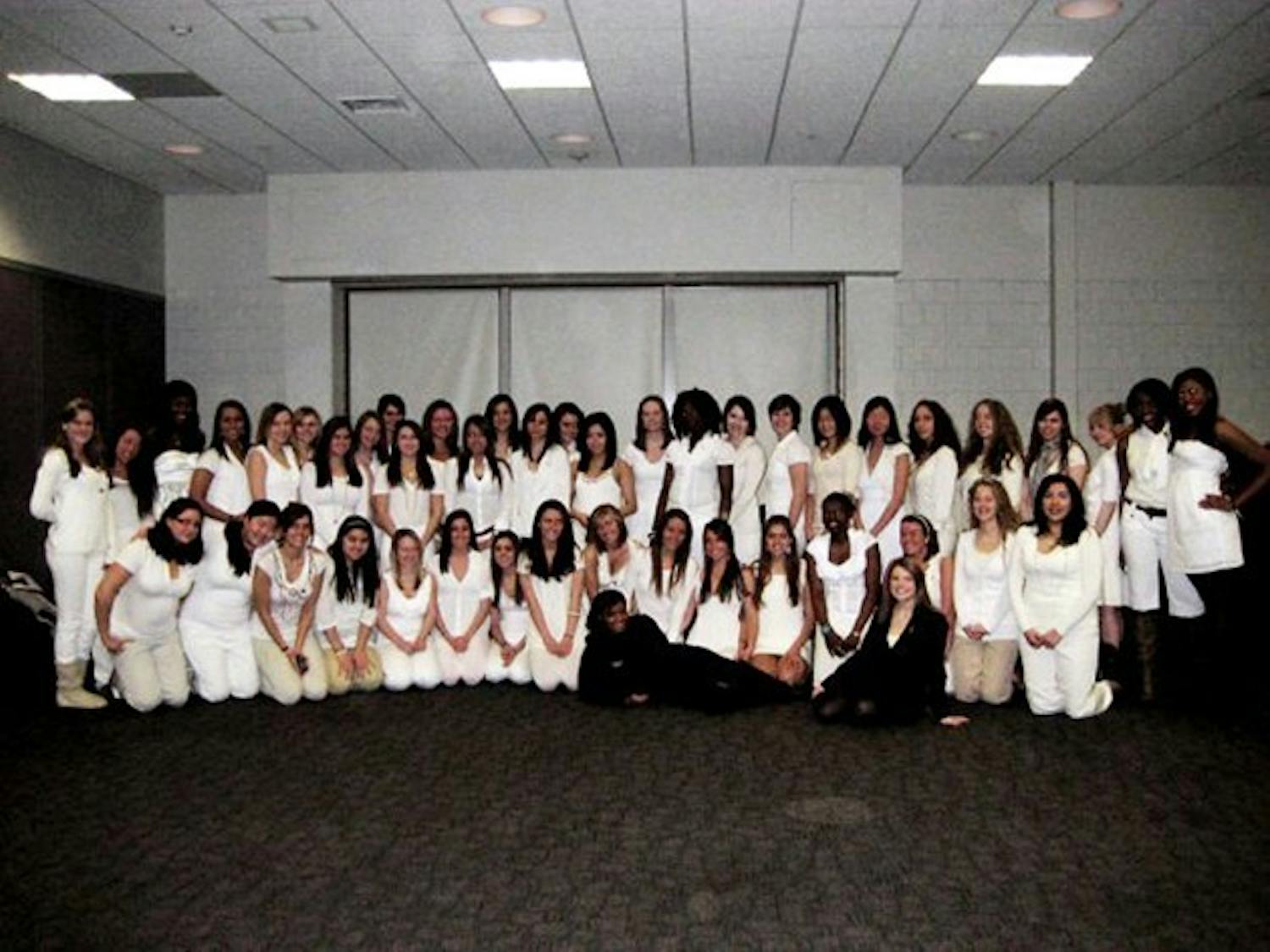
Within three weeks, the colony of Delta Phi Epsilon (DPhiE) at UB has already racked up enough girls to nearly double the average number of members in a sorority. They want the rest of UB to know that they are not your "average sorority." At 52 members, DPhiE is becoming known on campus for its diversity and academic prowess. Created in 1917 at New York University's Law School, DPhiE was the only sorority to be founded at a professional school. The founders were five Jewish women that were not allowed into existing sororities because of their religion. This sorority is not exclusive to just New York State; it has over 100 chapters throughout the Unites States and Canada. The colony "Sigma" at UB is DPhiE's 150th colony. Michelle Sears, a product merchandiser with Emedco and adviser to the new colony, said, "I've been a sister for almost 10 years, and I'm so thrilled to help this chapter get established at UB. Being a sister of DPhiE has been one of the best experiences of my life. I've made my best friends within the organization and have had so many opportunities that I would never have had without it." There are three philanthropies that the group supports: The Cystic Fibrosis Foundation, The National Association for Anorexia Nervosa and Associated Disorders, and the Delta Phi Epsilon Educational Foundation. In addition to being involved with these groups, the members of DPhiE can also be found doing community service together. "One of our sisters is going to put on a Haiti relief fashion show," said Hyelim Park, a junior nursing major and member at large. "We support individuals who decide to do great things like this. Even though we just started, we support each other. That's what a sorority is for." What makes DPhiE different from other sororities, however, is not that it helps others, but that it is a group of diverse and smart women. "We are a group of girls who are really up in our academics, but at the same time, we can balance that and have a good time with each other," Park said. Cara Nassar, president of the new group, said, "When I came to UB as a freshman, I was originally against Greek life … I later realized that there was more to Greek life than just partying." Although there are already many sororities on campus, DPhiE appears to attract a group of women that no others do. "I really wanted to start something new because I didn't feel that I fit into any of the groups that already existed on campus. I immediately stepped up when DPhiE came to campus, thinking it would be a great opportunity for girls that didn't feel like they fit into other groups like this," Nassar said. DPhiE has the Latin motto "Esse Quam Videri," which means, "To be rather than to seem." "We are founded on being unique and being yourself, and we really do try to put a focus on that. We are all very different people, but we can still come together and have a lot of fun," Nassar said. The enthusiasm that the girls in DPhiE have is well placed. They are surrounding themselves with independent and intelligent women, and they are proud to call themselves members. They do not even feel the need to always push for new members. "I don't feel the need to go out of the way to convince people to join our group … I want them to want to join because they feel like they fit in and have similar likes and dislikes," Nassar said. DPhiE is filling a space in Greek life because it accounts for students who have more difficult majors and need to put more time toward studying. DPhiE also glorifies the diversity that exists naturally in many communities. The members feel that this is something very fitting for a school like UB, where diversity abounds. "It would be great to be part of a sorority that also has diversity. There are a lot of girls in majors that require a lot of study time," Park said. "We value quality over quantity even though we are a big group. To have so many women that are right-headed, intelligent, and have character ... isn't that something you would just want to join?" E-mail: news@ubspectrum.com


NEWS

UB establishing environmental geosciences major

For students looking for the more environmental side of science, UB will be offering a new major in the fall.After student demand for a more scientific-driven environmental studies program, Dr. Mary Alice Coffroth, a professor of ecology in the Geology Department at UB, realized the need at UB for an Environmental Sciences major and answered the call."Several faculty decided that there was a need for environmental sciences rather than environmental studies at UB," Coffroth said.


NEWS

A different use for campus trash

Tom Ludtka's enthusiasm about UB's recycling program is well placed. As the Service Center Manager for UB's Campus Dining & Shops, Ludtka is expected to take care of all of the waste generated by all of the UB Campus Dining and Shop locations.


The Spectrum
NEWS

One step forward in cancer treatments

Dr. Stefan Roberts, a professor in the Department of Biology at UB, has played a part in possibly advancing cancer treatment. By linking an enzyme to the breakdown of a specific protein in cancerous cells, it may be possible to lower the necessary amount of chemotherapy needed to treat cancerous tumors. The protein known as WT1 is found in many cancerous tumors. WT1 stands for 'Wilms' Tumor 1,' which is a gene that codes for the protein critically involved in the normal development of the urogenital system. A childhood kidney cancer called 'Wilms' Tumor,' or nephroblastoma, is associated with a mutation in the genes for the WT1 protein, hence the name. In this cancer and also in childhood leukemia, the WT1 acts as a tumor suppressor. 'WT1 is kind of a bit of a Janus – it has two heads to it, one of them is not very nice, and one of them is nice. And it depends what tumor you're looking at,' Roberts said when referring to the fact that the WT1 protein can sometimes act as a tumor suppressor and at other times act as an oncogene, a gene that stimulates cancer proliferation. By using cultures of human cancer cell lines that express WT1, Roberts and his colleagues were able to discover what happens when cancer cells are treated with HtrA2, an enzyme that breaks down proteins. By linking WT1 with this enzyme, they have discovered that it has the capability of degrading WT1. In some cancers, WT1 needs to be degraded in order for cells to die on time, undergoing a process called apoptosis. It appears that in many adult cancers, WT1 helps the cancer continue to reproduce, but in some childhood cancers the WT1 acts as a tumor suppressor. Therefore, the elimination of WT1 in many adult tumors would slow the growth of the cancer. This means that the rate at which cancer cells die would increase because of the addition of HtrA2. This finding has implications for patients regarding chemotherapy. The cytotoxic drug administered during treatment 'damages DNA, inhibits cell division, and generally targets dividing cells,' according to Roberts. This includes cancerous cells, of course, but it also includes the digestive lining, hair cells and skin cells, which is why people undergoing chemotherapy often lose their hair and have skin and digestive system complications. 'If we eliminated the WT1 from the cells [of certain cancers], you need to take less drugs to kill them. So the idea … is that if you can target things that stack the odds towards the cell undergoing apoptosis, then that can only be a good thing,' Roberts said. This would reduce the amount of chemotherapy needed to treat an individual's cancer, meaning that there would be fewer side effects. Fewer side effects are imperative in childhood cancer because chemotherapy makes children so sick for such a long time. Being so ill often disturbs kids' progress in school, among other things. A problem with chemotherapy is that most times, it ends up causing DNA damage in healthy cells along the way, which can cause secondary cancers years later that result from the original treatment of chemotherapy. The less chemotherapy children undergo, the better chance they have at leading a longer, healthier and cancer-free life. 'This is not a cure for cancer by any means, but it is something you really want to go check out now because these agents are basically degrading a protein that in one cancer is a good thing, but in another tumor might not be a good thing and make the treatment less effective,' Roberts said. This gives hope to the eventual use of this enzyme on real patients in order to reduce the amount of chemotherapy for certain types of cancers. E-mail: news@ubspectrum.com


More articles »


Popular


View this profile on Instagram

The Spectrum (@ubspectrum) • Instagram photos and videos


Powered by SNworks Solutions by The State News
All Content © 2025 The Spectrum