
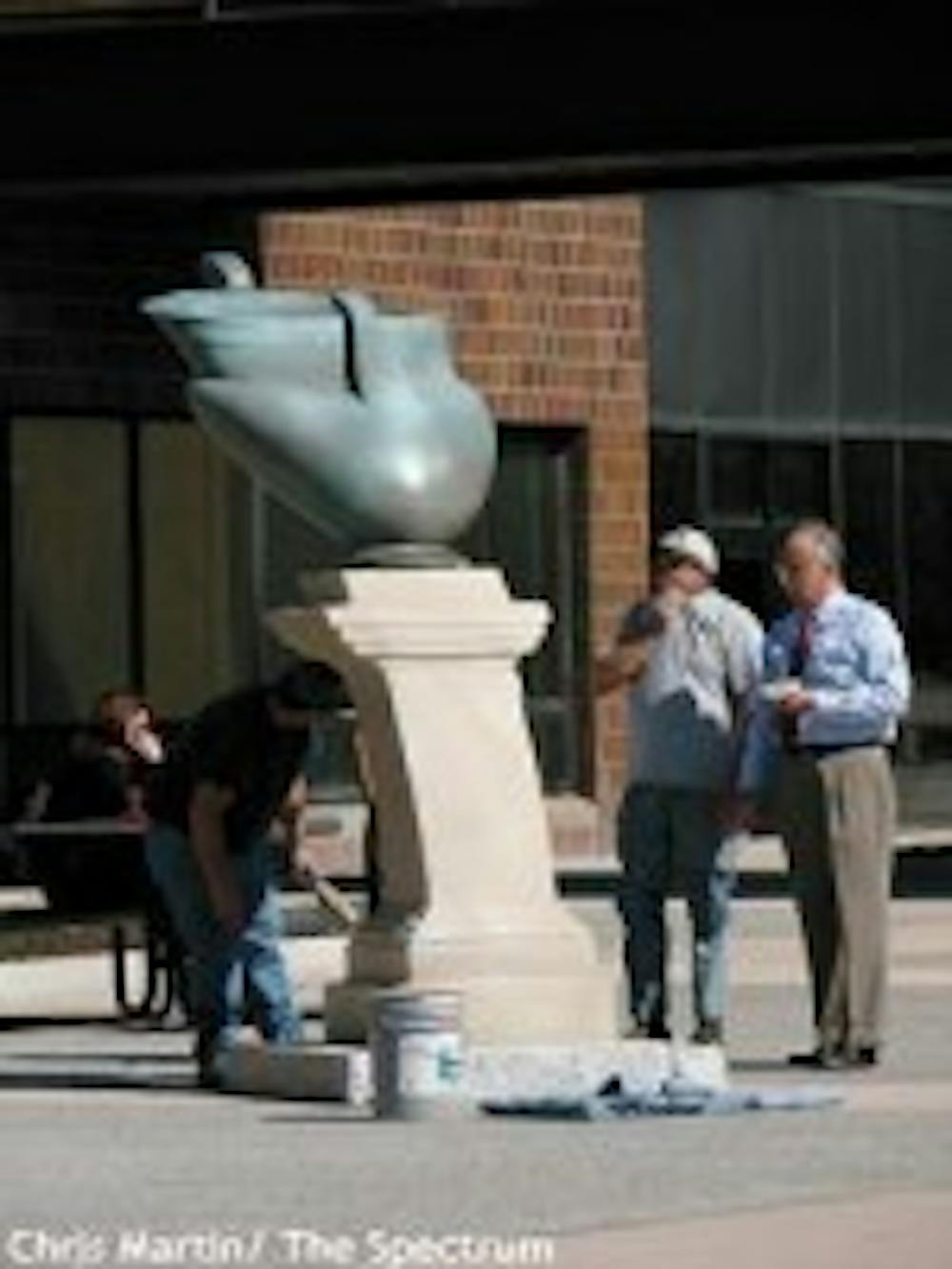
When the pedestals and urns created by internationally known artist Brian Tolle were installed in Founders Plaza this past October, it marked the beginning of an initiative to bring more public art to UB campuses.
The neo-classical planters are public artwork pieces titled "For the Gentle Wind Doth Move Silently, Invisibly" that were donated to the University and will be on loan for two years, according to a UB press release.
Tolle used a cutting-edge computer program, SOFTIMAGE, to bend the polyurethane-covered high-density Styrofoam to exact measurements of the wind blowing off Lake Erie, according to an Art and Business News article.
Originally, Cleveland Public Art (CPA) commissioned the artwork, and the piece was displayed at the Cleveland Mall in an effort to revitalize the downtown area, according to the CPA Web site.
The pieces will serve the same purpose at UB. The installation of the pedestals is the beginning of an initiative to improve UB's public spaces as part of the Building UB comprehensive plan that is connected to the UB 2020 plan, explained Robert Shibley, senior advisor to UB President John B. Simpson and one of the lead planners for UB 2020.
According to Shibley, a committee of faculty members has been formed to help bring more artwork to the University.
"We've assembled a committee representing a cross section on campus, to think more broadly about public art on campus," he said.
The committee will consider what Shibley referred to as artistic works by serious, well-respected artists, either as loans or to be purchased by UB. Student and faculty work is also a possibility, along with experimental art.
"If we are to remain consistent with our standing as a research institution, we should be boldly experimental with our use of public art," he said.
Since the addition of the first pieces of artwork in Founders Plaza, students have expressed mixed feelings about the artwork. While some feel that the art is out of place in the plaza, others think that the concept is good but the artwork should be chosen in better taste.
"It's a good idea, but they could get better looking art," said Christine Chonka, a freshman history major.
On the other hand, Peter Hanzly, a freshman history major, thinks the pedestals and urns are an improvement to the space.
"I like them. It adds a classy touch to the front of Capen," he said.
Chonka is also disappointed that a plaque explaining the significance and meaning of the pieces has not been installed in the plaza.
"If they put something up explaining it, that would be helpful," she said.
Shibley noted the possibility of having musicians or performance art around the three campuses, similar to art found in New York City subway stations.
"It could be everything from someone with a guitar and a chair, to small dances," he said. "These are all possible ways to enliven our public spaces."
However, students expressed the need for smaller scale changes to improve the University's atmosphere.
"I'd like to see more benches at bus stops," said Elizabeth Kwiatkowski, a graduate student in library sciences.
Hanzly would like to see more flowers around campus in the spring.
"Not necessarily big artwork, but little things to touch it up," he said.
The artwork was installed in the plaza after major renovations to the concrete and underlying pipe systems took place over the summer.
"We recognize it as a critical maintenance project," Shibley said. "The pipes (and) pumps underneath had been there for a long time. It was time to do major repairs."
According to Shibley, careful attention was paid to the color, texture and pattern selection of the concrete blocks that now line the plaza.
"We restored the landscape from its original plan," he said. "We added more seating than there had been in the past."
Still, students are concerned about the possibility of their tuition money being spent on unnecessary additions to the campus.
"It seems like a waste of money to bring art to the general areas," said Ryan Karcher, a freshman undecided major. "We have art galleries. Go there if you want to see art."
According to Brandon Potyrala, a senior English major, the lengths and costs to which a University will go to remain competitive are problematic.
"I find it troubling that education has been turned into a marketable product," Potyrala said.
Additional reporting by Kelly Warth, News Editor.



