
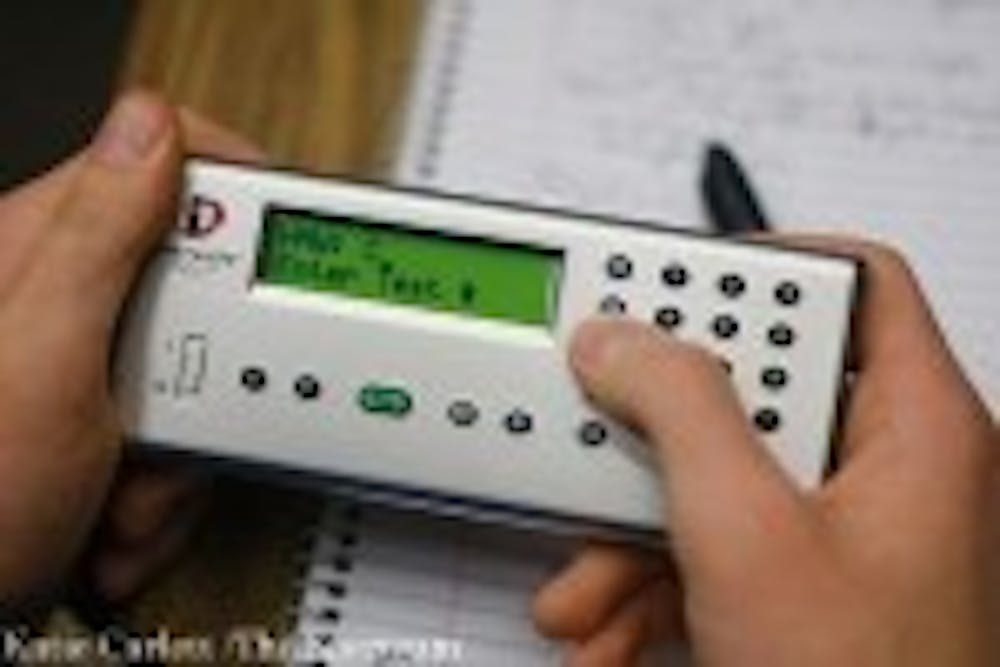
The National Science Foundation has provided UB with a $500,000 grant to study the use of personal response systems, or clickers, in large lecture classes. UB is one of 10 universities nationwide to be given this grant.
Clyde Herreid, a distinguished professor in the Department of Biological Sciences, will perform the study. Herreid is also a co-director of the National Center for Case Study Teaching in Science.
Herreid will be working with Dr. Paula Lemons of the University at Georgia, an assistant professor who is an expert in designing critical thinking questions. He will also be working with Dr. Dave Terry of Alfred University, an expert at the Watson-Glazer test, a national critical thinking test.
'[The] study and grant in general are done to find the best teaching methods anywhere in the world and for any discipline,' Herreid said.
For the first year of the study, the group will study the nature of the clicker to determine the answer to Herreid's hypothesis: 'Does emotional impact have any effect upon the learning of a certain material by a student?'
Herreid thinks clickers might create a sense of cohesiveness and belonging in a large classroom setting, allowing students to truly connect with what they're learning so they don't feel like just another face in the crowd. Herried hopes to find out the best possible way to teach and engage students in large lectures.
In his large lecture classes, Herreid uses the clickers to allow students to click in answers to discussion questions posed. Clickers present an opportunity to engage every student, Herreid said.
Ned Semoff, a freshman communication design major, agrees with Herreid on the helpfulness of clickers in the classroom.
'I think the advantages are the student voices can be heard through the results,' Semoff said. 'With the huge 101 classes, sometimes professors forget there are more people than just the front row.'
Semoff thinks that the clickers are useful for getting class opinions, although not so much for quizzes.
'I don't think [clickers] are that effective when used for in class quizzes since everyone can see what people are pressing, but when asking for opinions they are actually kind of useful since sometimes the professor is shocked to see how many people got the question wrong,' Semoff said.
However, Jackson Frenzel, a freshman business major, feels that clickers are distracting and unnecessary.
'I think that the increased dependency on new technologies can hinder academic achievement because of all of the time spent explaining, fixing and ‘improving' the clickers,' Frenzel said.
E-mail: news@ubspectrum.com



