
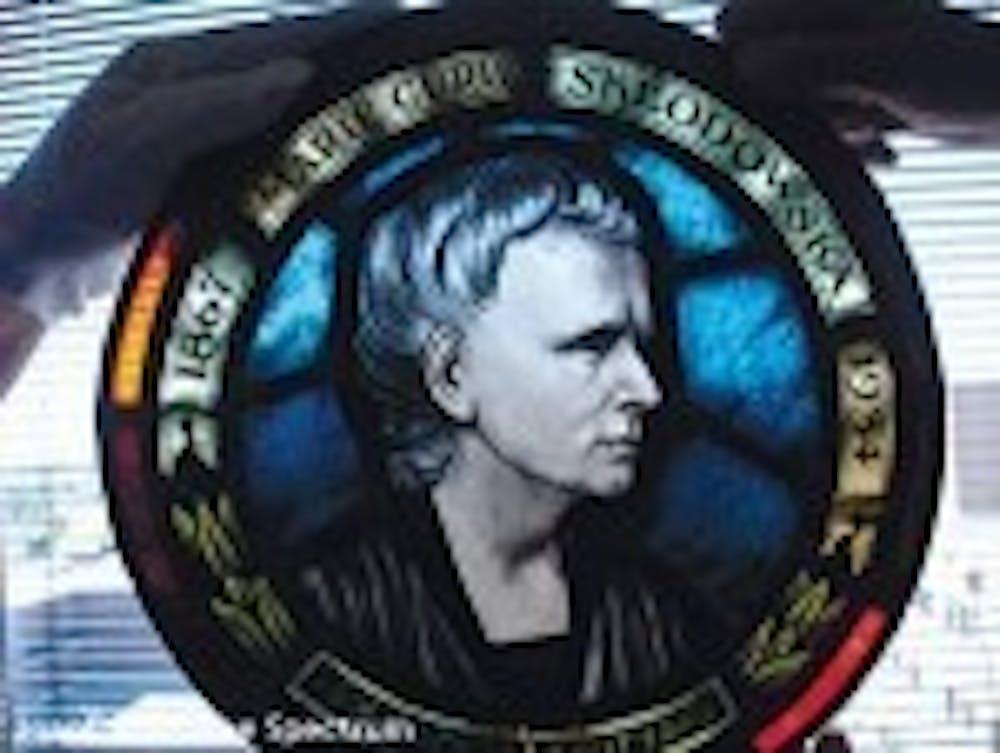
The Marie Curie medallion, missing from the University's Polish Collection since the 1970s, has recently been returned to UB.
The medallion is one of a set of four stained-glass pieces by Jozef Mazar, and was returned to the University nearly three weeks ago. A 2005 UB graduate, Gregory Witul, led the active search that resulted in the recovery of the medallion.
Greg Lontkowski, the latest owner of the medallion, put the piece on eBay without knowing the history or significance of it. According to Witul, Lontkowski received the medallion from a deceased family friend. He returned the medallion at no cost to the University after learning its history.
"He got it from a family friend who was not associated with the University or really into Polish culture," Witul said. "He could have picked it up from the Salvation Army for all we know."
According to Witul, he stumbled upon this mystery while working on a side project, cataloging Jozef Mazar's works of art. It was a picture of the Polish room where the medallions hung, in a book called Mickiewicz and the West, which clued him into their disappearance.
"I started a catalog of his work six to eight months ago, and through my research I knew he did work for UB," Witul said. "I only knew (UB) had the lamp until I found a picture of the four medallions in a book."
Witul partly blames archaic methods of documentation in the past for the loss of the four medallions. He said that the current administration did not know these works of Mazar were missing because there was no documentation of them ever existing.
There are no conclusive explanations as to how the medallions were lost.
"Going through the archives, some of them started showing up missing in the early '70s," Witul said. "By the time of the big move from the downtown campus to North Campus, they weren't in the inventory anymore."
Witul found the first medallion with help from the online auction Web site, ebay.com.
"I did the basic Google searches and had been checking eBay everyday since I started this project. I got a hit one day and as soon as it came up, I knew what I was staring at," Witul said.
The other three medallions remain missing. According to the curator of the Polish Collection, Jean Dickson, these medallions are priceless in historical value. Another missing medallion portrays Nicolaus Copernicus. The others are of two unidentified Polish figures.
According to Dickson, Jozef Mazar donated the medallions to the University in 1955 after the Polish Collection was founded. Along with Mazar, other local artists and people in the community donated artwork, furniture and rare books to the collection.
"In 1955, there was a big nationwide meeting of all the Polish cultural clubs in the United States, in Buffalo. Aleksander Janta, chair of the Polish Arts Club, organized this whole thing to get gifts for the collection," Dickson said.
The medallion, belonging to the Polish Collection, is currently being held in the Special Exhibits room on North Campus until it can be repaired and relocated to a safer location.
"It is a treasure of Polish-Americans in Buffalo. He was a Polish-American artist and very well known. It was created to memorialize a Polish woman scientist, Marie Curie," Dickson said.
Jozef Mazar donated a stained-glass lamp, along with the stained-glass medallions to commemorate the opening of the Polish Room. Witul hopes the television and media coverage of this discovery will also help locate the other three medallions that are still missing.



