
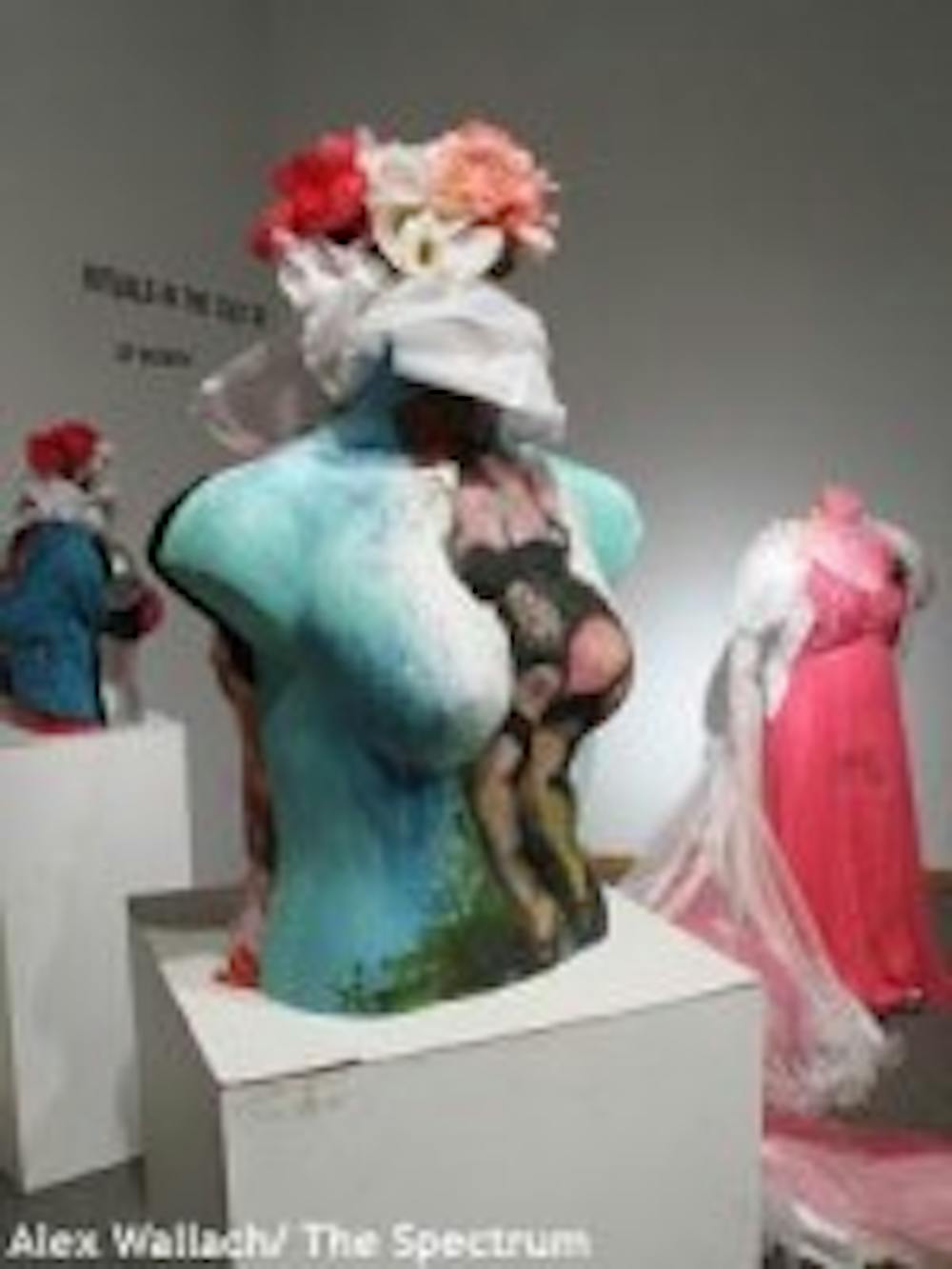
Many artists strive to capture originality in redundancy - taking a technique or idea that has been used and putting a contemporary and unique touch to it. The artists featured in the Rumsey Scholarship Exhibition excel in this category, not to mention several others.
Walking into the exhibit, anything from a group of clothed torsos to the oil on canvas paintings draw your eye. On the surface, each piece is aesthetically pleasing. After speaking with the graduate students involved, layers and depth are added to the pieces that an untrained eye might have missed.
The artists are competing for a scholarship, not to go to school but instead to go on a voyage into art and its history. Depending on the student in question, desired locations include Japan and parts of Ireland.
Attached near each work of art are short descriptions of the students' travel itinerary and an explanation of their piece. The students are pursuing the Rumsey Scholarship in an effort to learn about culture while improving their technique, in the country of its origin.
A particularly interesting piece is an offshoot of Michelangelo's The Creation of Man. The piece itself is surrounded by a frame with various kinds of telephone and other communication wires piercing the borders of the paper and fastening it in place.
The picture depicts a hand reaching over what seems to be a churning body of water. On the shore is a fence, keeping back heaps of technological waste and all forms of remote communication, such as cell phones and wires.
It is a stab at the deteriorating state of communication with the onset of technology, and a testament to how much is lost when there is a transition from face-to-face interaction to speaking through another medium.
The piece was created using a process called intaglio, where a plate of metal is etched and then covered in ink, and then a piece of paper is pressed against the etching, creating a picture. Ironically, though it was probably intended, this is the same process used to create money; the fuel that runs the technological advances, what the artist believes is the root of the problem.
Another part of the exhibit that was particularly clever was of Archana Jayakumar's oil on canvas painting. From a distance, it is a painting of three different people, each with interesting texture added to their features.
Upon closer inspection, the texture is composed of organic chemical formulas. One of them is a man smoking a cigarette, and the artist reveals that the formulas covering his face are that of the carcinogens released, coupled with the basic formulas of hair and skin proteins.
Jerry Mead, graduate student majoring in visual studies, believed that many of the artists exceeded in their challenge to "take something that is age-old and bring it up to modern times."
The exhibit draws away from relying strictly on two-dimensional mediums, however. Two of the artists employed fashion as one of their styles. Jackie Spicer's piece is a likely tribute to Queen, aptly named "I want to break free."
It consists of various articles of clothing, which traditionally are used to cover up the human body.
Seeking to counteract this, Spicer modified each piece to reveal the human beauty beneath. For instance, a blouse has a suggestion of breasts drawn onto it and a pair of pants rife with holes, revealing flesh colored fabric beneath.
Many of the pieces are suggestive and powerful. A particular strength is that the level of analysis is left to the audience. You can appreciate the work at face value or willingly delve into their mysteries and still not be disappointed.
It is definitely worth the trip to stop by and check out the Rumsey Scholarship Exhibition, located in the CFA. When artists compete, the audience is always rewarded.



