
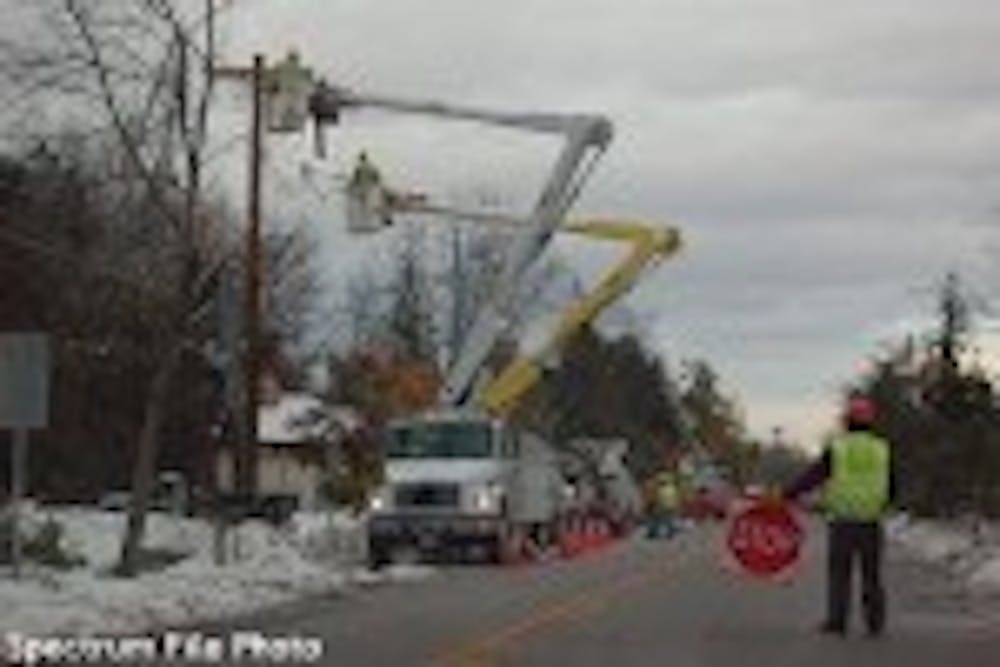
Students and professors of the UB School of Management have recently published the result of their research of methods of emergency response that were used during last year's October snowstorm.
The National Science Foundation is a government agency that donates money for engineering and science-related research provided the funds for the study, which aims to pinpoint the most effective methods of aiding people in emergency situations.
UB helped to fund the research as a part of the UB 2020 plan, focusing on preparing efficient disaster response systems.
According to Raj Sharman, a professor of management science and systems, much of the research data came from interviewing workers from the Emergency Operations Center, the first responders during the October storm.
"The Emergency Operations Center normally consists of high level people from different areas like public health, police, fire and so on, coordinating the response," Sharman said.
Sharman noted that the Emergency Operations Center quickly and efficiently got the first and second responders to the right places. Responders were in charge of keeping residents calm and ensuring that they followed the restrictions imposed during the storm.
"We thought that they were very knowledgeable and very proactive in terms of what they did," he said. "The citizens of the community were well served by the regulations that were imposed, especially the travel bans."
Sharman also thinks that their swift action aided the cleanup effort, allowing it to be competed as quickly as possible.
"Because the roads were less crowded the rescue workers, for example, the tree cutters and the electricians could get to the locations a little bit easier and that was very good," he said.
While the Emergency Operations Center was a great help during the storm, other methods of emergency response left residents confused. According to Sharman, there were several discrepancies between the emergency response efforts and the information given to the public.
"When the radio broadcasts were saying 'come to the shelters if you have a problem,' there was also a communication that was being made over all the public media that there were traveling bans," he said. "One is left wondering, should I go? Am I going to get a ticket?"
Another issue tackled during the storm was the implementation of a software program called DisasterLAN, to aid the emergency response efforts.
According to Sharman, DisasterLAN, a program developed by Buffalo-based company Buffalo Graphics, was designed to help manage the Emergency Response Center, which is where all the disaster-time decisions take place.
Sharman explained that the problem faced by those responding to the October storm was the lack of emergency response workers who were fully trained to use DisasterLAN.
"Not all of them were familiar with all of the (software's features), even though Erie County offers free training," he said.
Shaman feels that all members of the Emergency Response Center should know how to use DisasterLAN.
"We don't send people from the different services for that training and that's something that perhaps we will modify. Next time around we should be better prepared," he said.
According to Riya Farias, a graduate student at the UB School of Management, who also participated in the study, the Red Cross did not meet expectations in terms of obtaining the necessary supplies and tools to help.
"They expected a little more from the Red Cross that they did not get," she said.
According to Sharman, the research group that carried out this study participated in two other studies relating to last year's October storm. Students were involved in all three studies.
Other professors involved in the study include: Hejamadi Rao, professor of management science and systems, Shambhu Upadhyaya, professor of computer science and engineering and Catherine Cook-Cottone, professor of counseling, school and education psychology.



