
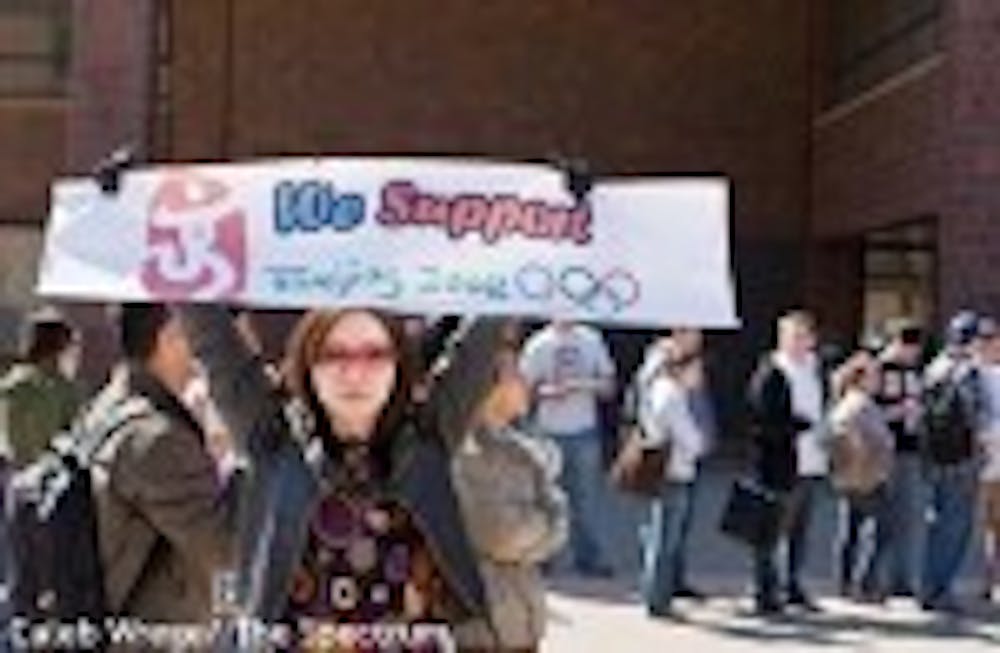
A cultural battle currently raging halfway across the world erupted onto the UB campus when pro-Chinese and pro-Tibetan protestors met Wednesday in Founders Plaza.
The demonstration began as a rally to support Chinese unity and the 2008 Olympic Games in Beijing, China.
At several points during the day, the students supporting two separate sides of the issue clashed in yelling matches and shoving.
The unrest began when a group of pro-Tibetan protesters arrived on the scene of the protest with a Tibetan flag several hours after the start of the demonstration, chanting "free Tibet."
The Chinese students outnumbering the pro-Tibetans by at least a hundred, answered with cries of "one China, peaceful Olympics." The protest continued for several hours.
The commotion was large enough to draw the attention of the University Police and members of the Buffalo Police Department who showed up later in the day.
"We just want to make sure that it's peaceful," said Assistant Chief of Police John Woods.
The political aggression in China began last month when a peaceful demonstration for regional autonomy in the Tibetan capital of Lhasa turned bloody.
Protestors in Tibet burned cars and threw rocks at police, according to Qianlan Cheng, a freshman in the School of Management who was pro-Chinese at the protest. She displayed several photos at the rally of Tibetans wielding machetes and burning Chinese shops.
Several of the pro-Tibetan students in attendance disagreed with the handouts and speeches of the Chinese students at the rally. Supporters of Tibet argued that Tibetans are peaceful and non-violent.
"This is just a group of concerned students who have gathered here today. This is not against China. This is about human rights and doing what's right for the world," said Molly Rubin, a senior Asian Studies major.
Chinese students maintained that most Tibetan protests were hostile.
"They are not peaceful protests - maybe at the beginning, but they turned to violence," Cheng said.
The Tibetans have accused the Chinese government of brutality and human rights violations.
"The Chinese government has admitted to shooting and killing people in Tibet," Rubin said. "I think we can all agree that it is absolutely inexcusable for the Chinese government to kill innocent civilians."
Over 140 demonstrators in Tibet have been shot and are confirmed dead with eyewitnesses reporting many more since the beginning of the political rioting, according to Rubin. People are currently being kidnapped from their homes and taken to unknown locations.
According to several Chinese students at the rally, the strong government crackdown on protestors should be considered a justified action.
"I don't know whether they crushed down or not but the government needs to take action when it gets violent," Cheng said.
Propaganda from both sides makes it almost impossible to know the truth about what is going on in Tibet. The communist Chinese government has banned all foreign journalists in the region and only allows the state-run media to have access to the events unfolding there.
Pro-Chinese students at the protest spoke out against western news media, which they believe to be biased against China. For instance, China has provided Tibetans with a powerful economy, easier admittance into Chinese universities and more modern schools. According to Mangran Hao, an industrial engineering student, the Western media does not report these things.
"The information you get from CNN, BBC-they don't talk about this. There is a bias," Hao said.
Many believe that none of these events would have happened if the Olympics were not in Beijing this year.
The protests are largely viewed as an attempt to draw worldwide criticism towards China on the eve of its showcase of power. With close to six months until the games begin, the British Prime Minister Gordon Brown and the German Chancellor Angela Merkel have decided to boycott the opening ceremonies, according to the Associated Press.
Some feel this is a poor decision. Cheng explained that if world leaders feel Tibet is an important issue they should not boycott the Olympics because they lose their chance for dialogue.
Many Chinese students feel that the Olympics are no place for politics at all.
"We don't want to involve politics in the Olympic games," said Chinese Students and Scholars Association (CSSA) President Ying Zhang. "It's just a sporting event."
Others were horrified by the response to the international Olympic torch relay, which has been heavily protested in several countries, including the United States.
Torch carriers have been met by large groups of protestors attempting to stop the flame from completing its journey around the world. Several photos from the French portion of the relay show a young torch-carrier in a wheelchair being attacked by protesters.
"You shouldn't target the torch," Cheng said. "You shouldn't attack innocent people to prove your point."
Several bystanders disagreed, noting that the Olympics may be the opportunity Tibet needs to gain global attention.
"I feel that the Olympics are a great event for the Tibetans because they allow them to be brought onto the world forums," said Christopher May, a junior electrical engineering major.
Regardless of whether countries boycott the Olympics or not, China will be the same nation following the same path, according to Ren Zhu, a junior business major.
"Protesting the Olympics - it's not going to help," said Zhu. "Countries will have to deal with China no matter what."
Some students were impressed by the expressive demonstrations of both groups.
"I think it's a powerful thing that students are actually coming out for a cause," said Brad Loliger, a junior psychology major.
Other students did not see a point in staging the protests.
"These sorts of protests are a ridiculous waste of time and a display of absurd nationalism," said Max Tresmond, a junior political science major.
Dennis Black, vice president of Student Affairs, felt that the protests on campus highlighted one of the main benefits of life in the United States, the right to free speech.
"Isn't it great that students in this country, regardless of where they are, can stand up and express their beliefs openly and strongly?," Black said.



