
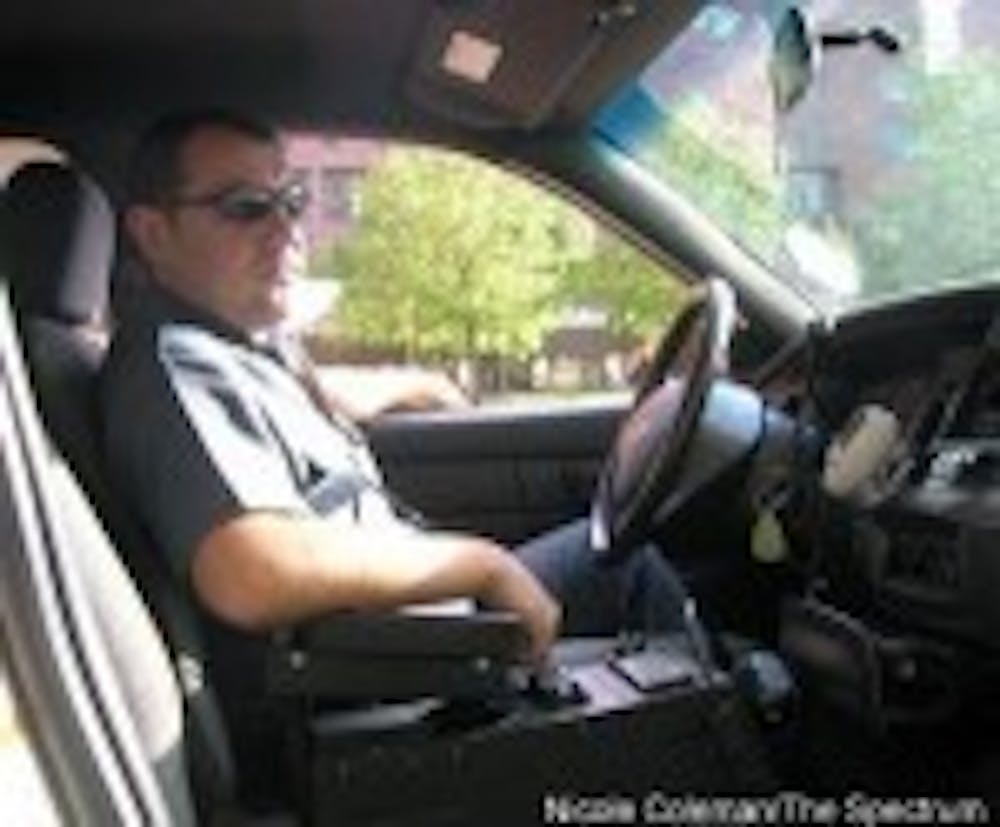
Lieutenant David Urbanek's shift is nearing its end when he spots a group of students gathered on a corner near Ellicott laughing and goofing around, various beer bottles in tow. It is nearing 11 p.m., and he pulls over to check things out.
This is the usual scene Urbanek comes across on his weekend rounds, and what follows is routine for him and anything but for the busted students.
The students are rounded up and a backup car is called in through the dispatch office. Each student is handcuffed, their arms behind their backs, and put into the backseat. There is so little room, their legs are jammed against black leather and bent up towards their chests, their backs arched from the handcuffs.
It will not be a fun ride the short distance to Bissell Hall, where their blood alcohol content will be tested.
"What you see now is a heavy underage drinking issue, and it has led to a lot of negative issues," said Urbanek, an afternoon supervisor for University Police who has been with UB since 1987. "Rational decision-making definitely goes out the window."
Next, the students will face the Student-wide Judiciary, an on campus substitute for town court, a convenience not offered on all college campuses. For Urbanek, it means more paperwork and another SWJ appearance to tell a well-worn story of drunken student hijinks.
But University Police responds to more than partied-out underclassmen. On a Tuesday ride-along, Urbanek responded to calls ranging from arranging ambulance calls to assisting a girl suffering from electrical shock at Alumni Arena.
Urbanek received the call and, being a former EMT, was qualified to respond to the situation. The girl had been shocked trying to turn off a fan when her arm hit exposed wires. Though she was not seriously injured, Urbanek's first-responder training allowed him to evaluate the girl.
"See, it's not all chasing the students around," he joked, pulling on a pair of rubber gloves before taking the student's pulse, before the arrival of an ambulance.
For campus police officers, their days are not unlike traditional police for a small city. Every day brings new experiences, whether it's larceny charges, underage drinking, breaking and entering calls or an injured student. At the beginning of each shift, the officers are debriefed on events going on around campus that may create potentially threatening situations.
Inconspicuous Bissell Hall, near Alumni Arena, serves as headquarters and dispatch office. Along with offices and a conference room, Bissell Hall also contains an alarm system connected to all campus property and computers monitoring occurrences such as terrorist warnings. They also have a small armory and data and forensics facilities.
Campus police patrols campus property 24 hours a day by car, bike and foot, covering the North and South Campuses, the bike path, President Simpson's mansion, the Anderson Art Gallery on Englewood and a recently sold building located on Main Street.
"At any time of day, anything could happen," Urbanek said. "The big thing is knowing what is going on for when things come up."
Each police officer is assigned a designated area for a period of one year, so that they can become experts on the buildings and the comings and goings of the students and faculty.
Officers are required to have a minimum two-year degree as well as completion of a six-month police academy, along with any other additional certification training. Some, like Urbanek, have additional training from previous experience.
According to Urbanek, common calls involve petty theft and first aids as a result of drinking, and the percentage of people falling victim to a crime on campus is less than in the rest of Amherst
"Some of them are pretty stupid, but when they call you have to show up," said Scott Marciszewski, a University Police officer since 1997, referring to the incidents that make up the weekly safety report.
"There's so many wacky things here, it's hard to keep track," he continued. "Some days you just deal with some bizarre people."
Marciszewski said there are a handful of regulars on their list, such as a man who is frequently arrested for lewd behavior on South Campus.
"For some reason he likes the Health Science Library," he said.
He also said students who hand University Police fake ID's are both stupid and common.
"I find that pretty funny, that they don't think we're going to find out what their real identity is," Marcizewski said.
The shifts are not without danger. In 1994, Urbanek was sitting in an unmarked car in plain clothing when a stolen Jeep came flying through a parking lot. When Urbanek emerged from his car, the driver of the other vehicle slammed Urbanek's car in reverse, attempting to pin him against it.
According to Marciszewski, the recent addition of the blue light phones has helped keep such incidents at bay, when students report suspicious persons they do not recognize, or RA's report large dorm parties.
"We have most calls most police do, but we don't have the frequency," he said. "We're trained to handle anything the municipal police would handle."
There is also the rare occasion University Police will be requested for backup by the Buffalo Police Department, Marciszewski said.
Many of the University Police also have other duties. Officer Brieanna Hahn teaches an anti-rape defense course for students, and Urbanek is an EMS instructor for fellow police officers.
The busiest shifts are on the weekends when students are out and about, and there is an increased risk of crime from the neighborhood filtering onto South Campus property, Marciszewski said.
On such nights, he occasionally needs to subdue criminals, but for the most part students are cooperative, Marciszewski said.
For Marciszewski, his favorite part of the job is catching criminals, especially in DWI arrests and robbery.
"Those are always good arrests to make, and we're always glad to make those," he said. "We really like catching thieves in the dorms."
Marciszewski said in doing his job, he hopes to dispel any confusion surrounding a University Police officer's duties.
"Sometimes people think we're a band of thugs," he said. "Some students just think we drive around and make parking tickets."
As for the old police officer and donut jokes, Marciszewski takes them in stride.
"I think it's funny," he said. "I don't know anybody who doesn't like a donut."



