
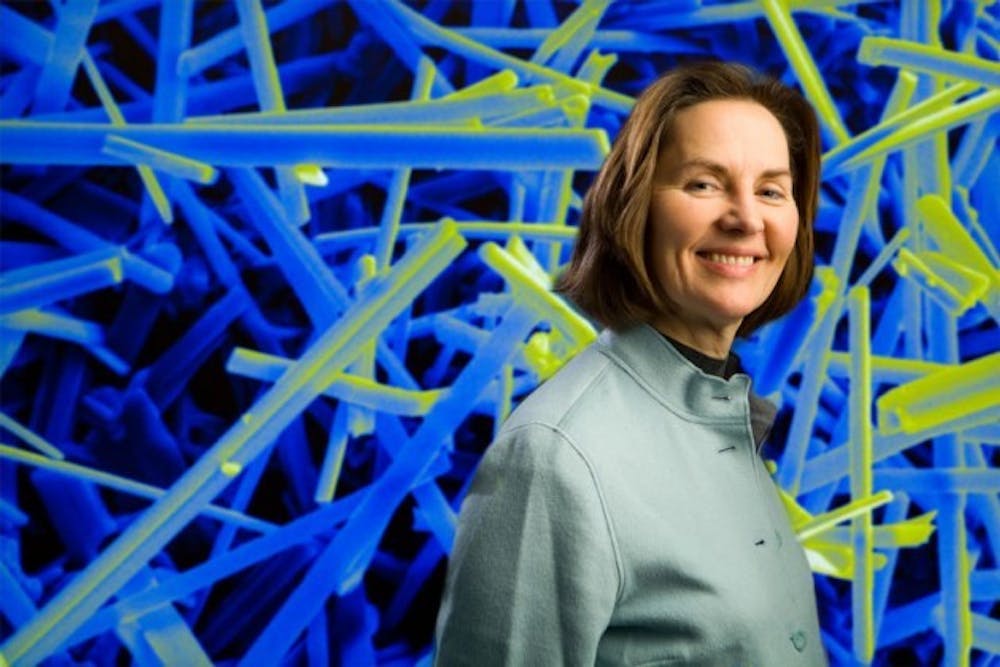
Women in scientific academia are severely outnumbered compared to their male counterparts. Last Tuesday, UB Undergraduate Academies hosted two guest speakers to discuss this trend.
Wendy M. Williams of Cornell University and SUNY Distinguished Professor Esther S. Takeuchi of UB spoke to a crowd of 140 students and faculty in the Student Union Theater, aiming to answer the question, "Why Aren't More Women In Science?" The focus of the lecture was to create a better understanding of the underrepresentation of females in science-based careers and addressing its causes.
Williams, a professor in the Department of Human Development and the founder and director of the Cornell Institute for Women in Science, served as the keynote speaker for the event. She offered a few factors to explain the lack of females in scientific academia.
Women's preference and choice of a career was one of the theories for the unbalanced gender roles in scientific academia that Williams most supported. She suggested that some of the preferences are tied to a chemical hormone level in amniotic fluid during fetus development. Women with higher levels of testosterone, regardless of the gender of the child, were more likely to produce children who had a greater interest in "hands-on" experiences and learning how things work. This drives them more toward careers in "hands-on" science, such as engineering and physics.
Meanwhile, women with lower levels of testosterone were more likely to be interested in helping others and, if interested in science, pursued careers in the health sciences and veterinary medicine.
Williams also presented the fact that women's standardized testing scores across the board leave them with more possibilities.
"People who get high scores in both aspects of standardized testing in verbal and math, are far more likely to be women than men," Williams said. "Because women's tendencies push them more in that direction [of non-math intensive fields] and their scores are [high in both aspects], the girls have more options."
Williams also suggested that there is a difference in math ability between genders. This often suggested factor was one that Williams quickly disregarded as being true in its entirety, but explained it was not totally false.
"We do know that girls and boys have the same average scores in mathematics [on the SAT and GRE]," Williams said. "[But] boys have a much broader, flatter distribution, meaning that there are many more boys and men at the extremely high level of ability…and many more boys at the low level."
This fact shows that, compared to men, more women tend to score around the average than at either end of the percentage distribution. Therefore, for universities that base admission on a certain percentile ranking level, the number of men in that group is more likely to be higher than the number of women.
Williams, however, stated that women are certainly gaining ground. Over the past 22 years, the percentage of women making up the top 1 percent of scores has risen from 8 percent to 25 percent. She also cited a 2005 study that stated that girls, when they are taking the same mathematics class, typically outscore their male counterparts.
The issue of sex discrimination preventing women from getting jobs in the scientific fields was also addressed at the lecture. Williams argued both sides of this factor by citing several studies.
"Swedish researches that looked at 114 post-doctoral funding applicants and saw that their analysis of data that women had to be three times as productive as men to get funded," Williams said.
Williams presented a study conducted by the National Academy of Science that concluded that, after reviewing 2,680 academic grant applications, found no gender-related bias in which papers were accepted. A similar study had 989 academics peer-review the exact same paper submitted under a male name, a female name, and a non-gender name and found that there was no preference toward a particular gender.
Women looking to pursue academic careers and achieve tenure often run into the conundrum that Williams jokingly referred to as the "Temporal Incompatibility of Academic Tenure Clock and Biological Clock." This incompatibility exists between the age at which a woman might receive tenure in a position and its inverse relationship with fertility.
While Williams' messages was somewhat challenged by some members of the faculty, her message of postponing child rearing until after tenure is achieved was not happily accepted by some of those in attendance.
"Everything that [Williams] said made sense, but it's discouraging to hear that her only advice for women considering parenthood and a life of academia is delay because her assumptions are based on [women] getting a position in your late 20s or early 30s," said Dawn Ruth, a graduate student in her early 30s pursuing her Ph.D. in geology. "[Her message] was representative of a very specific assumption of women starting their academic career at 29…I didn't get what I wanted out of it."
Williams' message was contrasted and curbed by Takeuchi's post-lecture comments. Takeuchi is a SUNY Distinguished Professor at UB in the engineering and chemistry departments and serves as co-director of the New York State Office of Science, Technology and Academic Research (NYSTAR).
Takeuchi's message focused on participation and encouraging people to step outside of realm of what is expected. As a recipient of over 140 patents and a recipient of the National Medal of Technology and Innovation, Takeuchi's call for participation was well-accepted.
Takeuchi shared quotes from famous philosophers and academics and summed up her message by telling the audience that there are still plenty of advances to be made and that everyone has a contribution to make.
"If you think you are too small to make a difference, try sleeping in a closed room with one mosquito," Takeuchi said.
Email: news@ubspectrum.com



