
With incidents like 9/11, the Virginia Tech shootings, Hurricane Katrina and the October Surprise storm influencing UB's Critical Incident Management plan, the possibilities for emergency preparation are endless, according to Beau Willis, executive vice president for University Support Services.
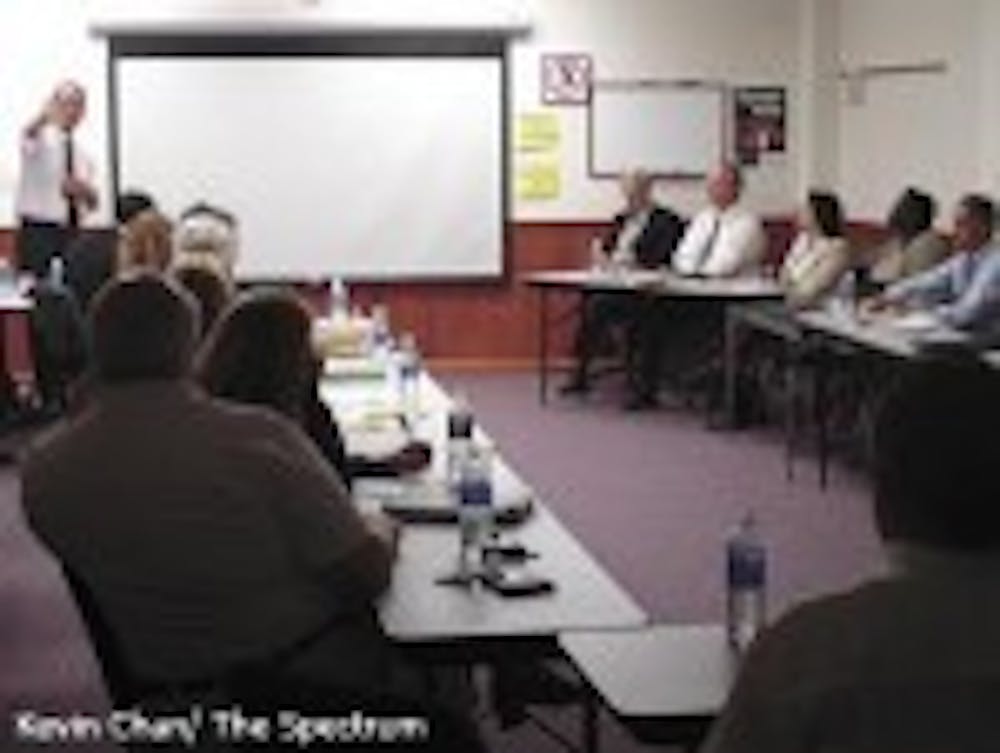
Improvements in UB's emergency preparedness plan that occurred over the summer as well as future concerns for the University were addressed in a panel discussion held at the Faculty Senate Executive Committee (FSEC) meeting this past Wednesday.
"We're trying to promote the notion of UBSafe," Willis said. "In thinking about the responsibility of the University to me, at the core, is making sure we have a place where students, faculty and staff can live, learn and work."
In the presentation, Willis listed several on-campus resources for emergency planning, including the University Police, University Facilities and Counseling Services. However, the student government did not make it onto this list.
"We can use student government...as a resource," said Peter Grollitsch, SA president. "The more informed we can be...the more information we can relate to students. Every little bit counts."
Since the VA Tech incident, several upgrades have been made to UBSafe. According to Willis, an All-Hazard emergency plan was created, along with an Extended Operations Group. The group consists of 30 to 40 people who will be called upon in the event of an incident that requires their area of expertise. Upgrades have also been made to the communication infrastructure on campuses with the addition of the text message alert system, he said.
"This summer we spent a lot of time making sure we have the right policies and procedures in place," Willis said.
According to Dennis Black, vice president for Student Affairs, two main issues that came from the Virginia Tech incident that the panel is focusing on this year are getting the word out in an emergency situation and watching for warning signs.
UB Police Chief Gerald Schoenle thinks that communication is a main problem in dealing with disasters in the country, and UB is not an exception to this.
Willis believes communication was a weakness of the University's response to the October Surprise blizzard last year.
"I think we handled it quite well in most regards," he said. "Where we fell down is in our communications."
Moreover, Virginia Tech brought attention to the need for communication in all college communities, Willis said.
"Just like 9/11 changed the world, VA Tech changed our world," said Scott Nostaja, interim vice president for Human Resources.
For this reason, emergency "blue light" stations on South Campus will be replaced with high-tech systems that have a camera with a closed-circuit TV on them so that UP can see the person at the light, Schoenle said. Speakers are also built in for public address and communication.
The panel is also looking to implement a closed-circuit television system that will better connect the intercampus communications over the next year, Willis said.
"The solutions we're putting in place today really have to do with technology," he added.
The FSEC also addressed the logistics of watching for "risk behaviors" in students.
"One thing that came out of VA Tech is that probably most universities in the nation aren't prepared to deal with mental health situations," Nostaja said.
According to Dean of Students Barbara Ricotta, faculty can confidentially report a student who is exhibiting one or more of these "risk behaviors," such as talking about suicide or homicide often. A committee called "Students of Concern" addresses the state of these students. Each week, this committee meets and talks about students who have shown troubled behavior and makes sure there is a counselor following up with the student, she said.
Willis thinks the University is set up for success in this area, but there are still gaps that need to be filled.
"Within the Student Affairs division, we have a very professional staff that addresses student health and counseling," he said. "We're in the process of putting together a formal training program for faculty...for safety in the classroom."
According to Willis, information about how to deal with emergency situations and dealing with students of concern may have been available previously, but wasn't as accessible as it will be in the future.
"It hits home to everybody that we all have the responsibility to know what to do in an emergency situation," he said.



