
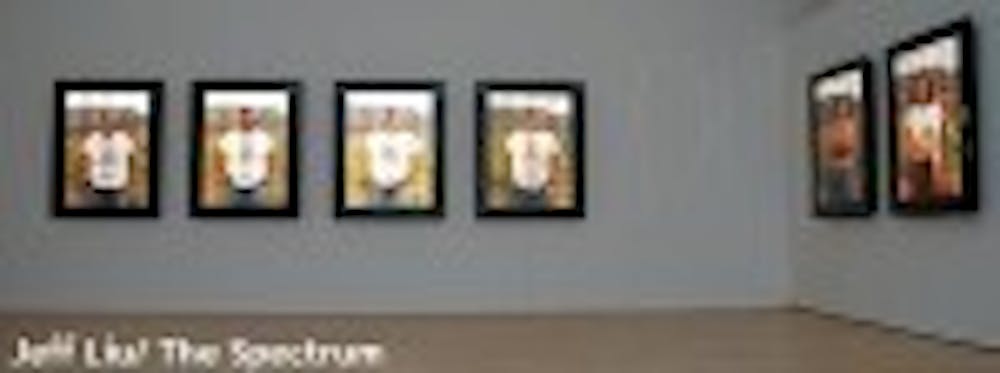
Anyone whose seen the columns on Baird Point might want to view the work of internationally recognized artist Shelley Niro in the Shelley Niro: Outside the Columns exhibition at the CFA art gallery.
This exhibition is part of an ongoing project of the UB Art Galleries and graduate student of fine arts Sherry Corcoran, and is taking place from Nov. 29 until Jan. 27.
"Shelley's work is unique and important for UB students because UB commissioned a film from a top artist, and it's highlighting the campus," Corcoran said. She is the curator for the event.
Indeed, it is a very unique experience for the UB community. It is not often that an internationally recognized artist is commissioned for work that focuses on the campus, and it brings Niro's message close to home.
The gallery, along with much of Niro's other works, focuses primarily on the state of Mohawk and other Native American people's, and their condition and adaptation to a world that is at first glance not conducive to their heritage.
This gallery offers viewers a unique experience because the focal piece in the exhibition, a short film titled Hunger, was shot and created by Niro on the UB campus and was the focus of Corcoran's thesis.
"This was my master's thesis project," Corcoran explained, "This (gallery) was the first thesis of this type. Typically, they're written. I wanted an artist to use the column image and to redefine its meaning."
The film itself included a good deal of juxtaposition between natural images like a great white pine on top of structured images, such as a white column.
While at first glance, the gallery may seem to be condemning our modern world, that assumption is simply not the case.
"Niro is lining up two different perceptions of reality," Corcoran said. "The Mohawk have the symbol of the great white pine, which represents universal shelter. On the other hand, we have the column, which is a symbol of Greco European culture. (Niro) is subverting the Native American symbol on to more modern symbols."
While Niro's own particular background, growing up as a member of the six nations, lends itself to the exploration of Native American culture, Niro's work is not meant for Native Americans alone.
"As the curator," Corcoran said, "I would say Niro's message is primarily for people to step outside of their cultural borders."
Today, Niro's message seems to be more applicable than ever. All around the world exists cultural conflicts stemming from single-mindedness and an unwillingness to compromise these differences.
Niro's message of cultural acceptance and integration are important steps toward a more peaceful existence, and her medium of art and the moving image are accessible to all people.
"The answer to a lot of modern day problems perhaps exists in the natural law," explained. "The philosophical standpoint of the white pine, for example, holds the answer to many of the problems in today's society."
While this message is important for many people, it is even more important when put in open dialogue at a university as large as UB. Students are the future, and campuses are the breeding ground for social change.



