
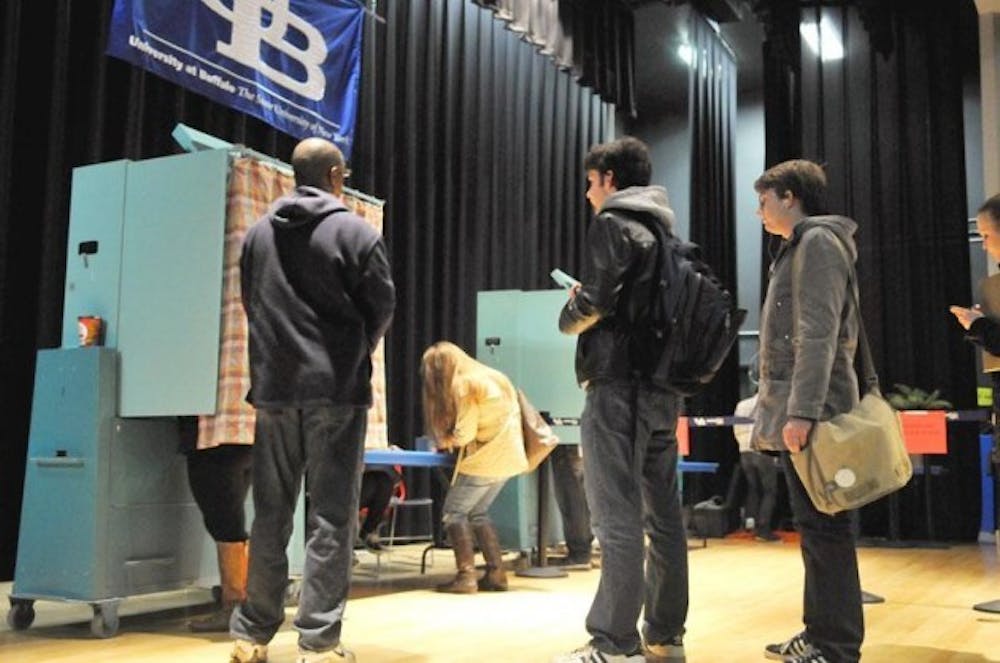
Editor's note: This story was held after the SA elections because of The Spectrum's ongoing investigation into SA Treasurer Sikander Khan's and Vice President Meghan McMonagle's signing of a questionable $300,000 contract for a mobile application. All quotes and information attributed to McMonagle was obtained before Thursday, when the SA released its investigation into the contract.
The recent SA elections were marred by harsh accusations, violations of SA protocol, and failure to follow New York State Election Law.
It all started when SA President JoAnna Datz had to find a replacement for Elections and Credentials Committee Chair Travis Nemmer, who was responsible for maintaining fair and impartial elections. Nemmer had to step down because he was running for president in the election, which he eventually won.
It was a problem that SA officials had never dealt with - Nemmer decided to run after the election had technically "started" because petitions to become a candidate had already gone out. By SA law, an election cannot continue without an E&C chair in place.
When Datz appointed her friend Gretchen Garcia to replace Nemmer, instead of Nemmer's assistant Raphew Fahm, SA officials began accusing each other of misconduct.
Another person who was considered to replace Nemmer (and wishes to remain anonymous) has accused Datz and On-Campus Senator Dan Ovadia, who ran against each other for SA president last year, of trying to swing the election to benefit Judy Mai and Darwinson Valdez, who unsuccessfully ran as a presidential pairing. Both Datz and Ovadia have strongly denied the claims.
SA Vice President Meghan McMonagle accused Datz of mishandling the entire process and costing the SA substantial legal fees because lawyer Joshua Korman had to be consulted numerous times.
Assembly Rejects Garcia
After Nemmer resigned, Datz appointed Garcia on Feb. 26. Datz has the sole discretion to fill vacant staff positions, and the SA Assembly then has the power to approve or deny her appointments. On March 7, the Assembly rejected Garcia in a 6-10-5 vote, leaving the E&C chair unconstitutionally vacant as the election continued.
"Although the election timeline was indeed thrown off, it was not due to any attempt by myself but rather the resignation of former Election and Credentials Chairman Travis Nemmer who declared his candidacy for president after the election had already begun," Datz said in an email on Tuesday.
Because time was running out and the difficulty of calling Assembly meetings, the decision fell to the Emergency Powers Council (EPC), a body that has the ability to act in place of the Assembly or Senate. It consists of Datz, McMonagle, SA Treasurer Sikander Khan, Senate Chair Darwinson Valdez, and Assembly Speaker Steven Jackson.
Datz needed to appoint another E&C chair by March 8 (the Thursday before spring break) in order for the "mandatory candidates meeting" to happen and for the election to continue on schedule, according to McMonagle. She didn't.
Tensions within the EPC
"After Gretchen wasn't approved, JoAnna had until the last Friday before break to appoint a new E&C chair," McMonagle said. "The EPC email had to be sent [by JoAnna] by Thursday at 4:50 p.m., but JoAnna didn't do that, which made it unconstitutional."
Ovadia recommended Dan Kozlowski as a choice for the next E&C chair; Datz said she considered his recommendation because of Ovadia's "unquestionable loyalty and commitment to the best interest of SA." She - along with Engineering Coordinator Dan Pastuf, Administrative Director Mark Sorel, and Associate Administrative Director Amanda Johnson - met with Kozlowski the afternoon of March 9 (right before break) to discuss the opportunity and gauge his interest in the position.
Khan came into the meeting with Kozlowski and immediately began making accusations about Kozlowski, according to Datz.
"I believe Sikander did not even give Kozlowski the opportunity to succeed in his mind, but rather was wrapped up in politics of accusing me of wrongdoing," Datz said in an email on Tuesday.
Datz admitted she did not appoint an E&C chair by the time of the mandatory meeting that was originally set for March 9 at 5 p.m. She said she postponed the meeting until further notice, as she had just met with Kozlowski that same day.
The next day, Khan sent an email to Datz asking her to call the EPC meeting, and he also agreed to approve Datz's appointment of Kozlowski, but with reservations. He worried about Kozlowski's lack of experience and added that he wasn't writing to repair his relationship with Datz.
Khan's email noted that Kozlowski had no prior experience running elections at any level. Khan also said that it seemed highly probable that Kozlowski may "end up making mistakes that will nullify the elections."
"A Rushed Decision"
On March 19 - the first Monday after spring break - Datz sent out an email calling for an EPC meeting. Datz did not provide any information on the qualifications of the new candidate or give any contact information to the EPC, according to McMonagle.
Datz was also required by SA rules to provide an alternate for E&C chair, should the EPC not approve of her choice, according to McMonagle. She didn't.
The EPC finally met to vote on the appointment of Kozlowski on March 21. Datz said she hadn't chosen an alternate because Kozlowski was Datz's sole and best option for the position, as other potential candidates were unwilling, unavailable, or potentially biased.
If Datz's new appointment hadn't been approved at that meeting, the election would not have been able to take place.
Jackson voted "yes, with reservations," according to the EPC meeting minutes. Jackson said that his issue wasn't with Kozlowski, but with the committee as a whole.
"I regret voting yes to begin with," Jackson said on March 29. "The way the EPC has been handling their decisions from my understanding, I'm not proud of. I think the committee has been biased, and it's unfortunate. I expected them to have a little more...moderate attitude, and they haven't demonstrated that."
Jackson scheduled an April 5 interview with The Spectrum, but then declined the interview. He sent a statement via email.
"The E&C Chair issue was certainly a rushed decision that we as the Emergency Powers Council needed to make to maintain the timeliness of the Student Association in the long run," Jackson wrote. "If we had more time, I would have been much happier about the result."
Jackson wasn't the only EPC member that voiced concerns during the meeting. McMonagle voted "yes with concerns," and Khan voted "yes with extreme reservations," according to the March 21 EPC minutes.
"Individuals have accused me of being biased in my appointment of Dan Kozlowski," Datz said in a Tuesday email. "I would also like to point out that our student government, like the U.S. government, is set up to have a system of checks and balances. Regarding Meghan and Sikander's accusations that my appointment of Dan Kozlowski was biased, they had the opportunity to vote against the approval of his appointment."
Because Valdez was running in the election - a conflict of interest - he sent Ovadia to the meeting as his proxy. Ovadia voted "yes" during the meeting - according to the minutes - and criticized the lack of communication within SA.
"I've sat in the room with [the e-board] numerous times, and I think a lot of the time they argue about last year, or old stuff," Ovadia said. "I think they dwell on the past too much."
He added that Khan argued in the EPC meeting that things were handled differently last year and in past elections, instead of focusing on the task at hand: appointing an E&C chair for this year's election.
McMonagle thought Kozlowski was a poor candidate for the position as E&C chair because he lacked the skills and experience necessary of running a good election.
"During the meeting, when Kozlowski was asked questions, he turned to Ovadia and JoAnna before he answered," McMonagle said.
McMonagle said Kozlowski had no idea that the E&C chair was involved in club elections, and he had zero experience with the e-board. Kozlowski, though, argues that he has experience to qualify him as E&C chair.
"I don't think that it's true [that I was unknowledgeable]," Kozlowski said. "I've been a member of the Assembly since my freshman year [Kozlowski is a junior now]. I've been a frequent proxy at Senate meetings. I know the workings of SA, and I've read the constitution. I read up on all of this stuff before my appointment."
Differing Opinions About the Election Itself
Kozlowski was happy with the way the elections turned out this year, and he believes that, given the circumstances, the entire process ran smoothly without any serious problems.
"I think [the elections] went well, given the timeline we had," Kozlowski said. "I think if you talked to most of the candidates, they would feel that we were fair - that we acted on all of the complaints promptly. I don't think we were too aggressive or too lenient on anything."
But The Spectrum obtained an email sent to Kozlowski that outlined a flaw within SA's Elections Rules and Regulations.
Part of the SA Elections Rules and Regulations states that during elections, SA "intends to comply with applicable federal, state and local laws." In short, SA wants to legitimize its elections by abiding by New York State Election laws.
Those state laws were just updated this year. The law states - under Section 17, subsection 130, clause 4 - that a person cannot "electioneer on election day or on days of registration within 100 feet, as defined herein, from a polling place...For the purposes of this section, the 100 feet distance shall be deemed to include a 100 foot radial measured from the entrances...to a building where the election or registration is being held."
The SA rules (last updated during Summer 2010) state:
"The Polling Area is the area extending 50 feet in all directions around the voting machines, unless otherwise determined by the Elections and Credentials Committee. This area shall be clearly marked by tape on the floor or other means. No campaigning shall take place within the Polling Area."
Quite simply, SA allows students to campaign within the Student Union, but the New York State law deems that practice illegal.
David Noll, a junior economics and political science major who ran for SUNY delegate with the Blue Party in last year's election, brought both clauses and the clear disconnect to Kozlowski's attention on March 26, just before the elections began.
Kozlowski, along with his committee, reviewed the law and deemed the elections still legal despite the contradictions.
The election can still be contested and reviewed at any time, according to Kozlowski. If it were to be contested and thrown out, a new election could not occur until September or October of this year because an election cannot take place during finals time, according to SA's lawyer. During the summer, the club council chair with the most credits would serve as president, according to SA's constitution. An election has never been thrown out in the history of SA, according to Kozlowski.
But Kozlowski remains hopeful for future elections and plans to learn from this experience to help him run the committee going forward.
"The only changes we're making are based off the issue with the chair stepping down after the petitions were already out," Kozlowski said. "We're hoping to change the constitution to make that not possible, that he would have to step down before the petitions were available. Other than disclosing out some of those loopholes from this year, I think everything will be the same."
Additional reporting by News Editor Rebecca Bratek.
Email: news@ubspectrum.com



