
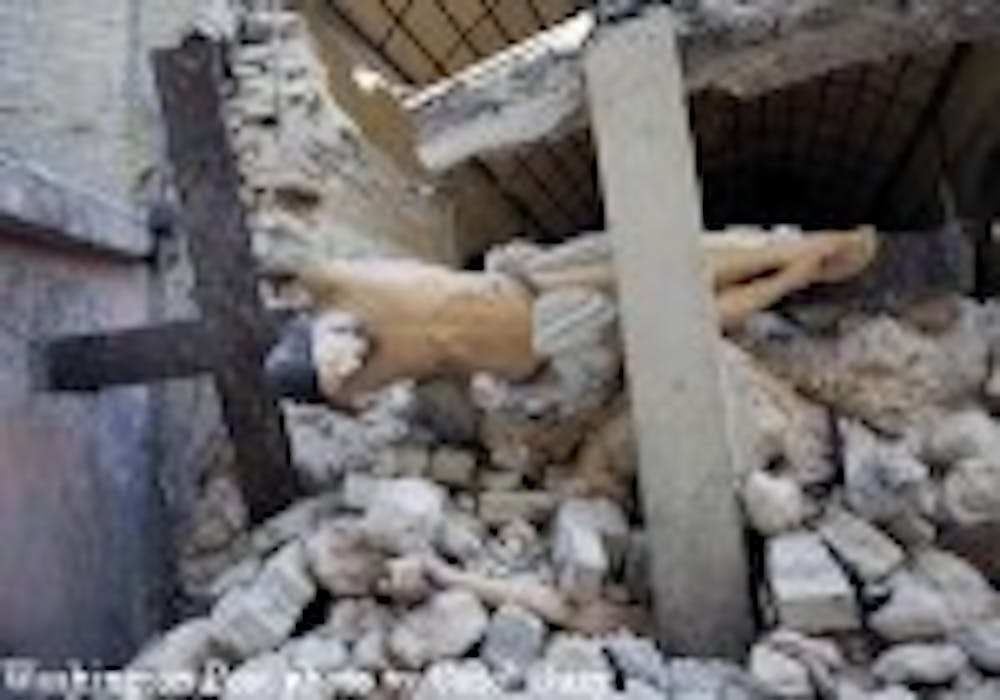
When a disaster like the earthquake in Haiti hits, there is no perfect situation.
'Every emergency is a bad situation to start with,' said Ernest Sternberg, UB Associate Professor of Urban and Regional Planning. 'A well resourced country like America would be well-organized, but a country like Haiti doesn't have those resources.'
With a gross domestic product of only $7.018 billion in 2009, Haiti is the poorest country in the Western hemisphere. Haiti's economic growth has always been disturbingly low, and even turned negative earlier this decade. Nearly 40 percent of Haiti's national budget is made up of foreign aid, the majority of which is provided by the U.S.
Due in part to a long history of corruption in government, Haiti has had a sizeable external debt for almost the entirety of its existence. When this debt peaked at $1.4 billion in 2009, Haiti was added to the international highly indebted poor country initiative (HIPC) and qualified to have its external debt canceled.
Nearly 70 percent of all Haitians depend on agriculture for their survival, many of whom are subsistence farmers. Such a lifestyle provides them with little to no protection from the frequent natural disasters, like the one experienced on Tuesday.
Sternberg feels that the Haitian government isn't doing what is necessary to assist those affected by the earthquake, largely because of the problems within the government and the country's lack of domestic wealth.
'One of the most tragic parts of the situation is that the Haitian government isn't coordinating [with the countries who have already arrived to assist],' Sternberg said.
China, the U.S. and Brazil have already arrived by ship and by plane, either into Haiti or into the neighboring Dominican Republic to assist in relief efforts.
'What needs to be done is that someone needs to take charge and decide who is going to oversee the relief in which area,' Sternberg said. 'It needs to be broken down into manageable sections and I don't think any of that is happening.'
Sternberg also notes that while immediate relief efforts in sending money, food and supplies are necessary. He also urges students and the general public to look at the bigger picture.
'In order to truly help Haiti recover, we need to look in the long run,' Sternberg said. 'Students should learn the Haitian language and the culture in order to better assist Haiti in rebuilding.'
Sternberg also notes that a good way to help Haitians recover from the disaster would be to hire them to work the relief effort because, after all, Haitians know their country better than anyone else.
'There's no lack of supplies or money for the relief effort, but there is a lack of understanding, which is an important tool in helping to overcome any disaster in a foreign country,' Sternberg said.
E-mail: news@ubspectrum.com



