
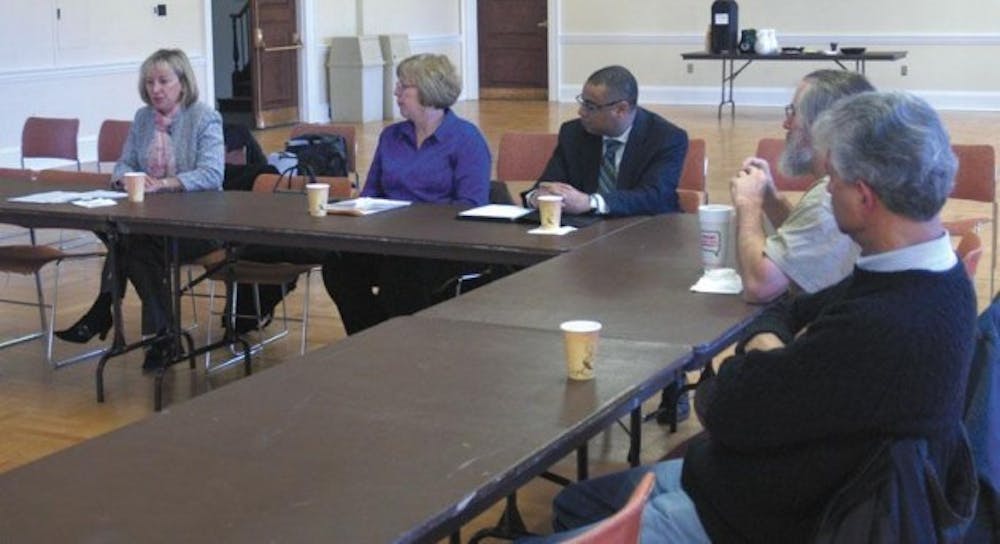
This week, the search committee for UB's next provost held public listening sessions in the Student Union and in Harriman Hall on South Campus.
On Wednesday evening, there was a student listening session held in the Student Union.
And on Thursday morning, Committee Co-Chairs Anne B. Curtis and David Felder hosted the Harriman Hall session. Students and members of the UB community were presented with an overview of the search and selection process followed by a question-and-answer session with committee officials.
The public listening sessions on Wednesday and Thursday provided the UB community with updates on the search process and outlined the large issues facing the committee.
Curtis began both sessions by explaining the search process and allowing for committee members to introduce themselves. Committee members in attendance at Thursday morning's session included Senior Associate Dean of Student and Academic Affairs David Milling and Director of Public Services and Arts and Sciences Libraries Margaret Wells.
Curtis started by describing the role of consultant Ilene Nagel, the head of the higher education practice for Russell Reynolds Associates, a private firm assisting the committee in the search process.
In the fall, Nagel and her team made a list of 350 potential applicants for the provost position. Nagel has now provided approximately 55 names for the search committee to review.
The committee is now in the process of bringing the number of candidates down to 16. The final 16 will also sit down with President Satish K. Tripathi for half-hour interviews.
Before that, each candidate will undergo an hour-long interview; they will be given three questions in advance. Members of the committee – including its two student representatives, Student Association President JoAnna Datz and UB Council Student Representative Mia Jorgenson – will have an opportunity to ask questions.
"Something that we discussed with the search committee on behalf of the students is that we wanted to formulate, for the interview process, a question that is specifically student-oriented," Datz said during the student listening session.
Datz expressed that she wanted to use the student session as a springboard to understand what students care about, so the question can be appropriately crafted.
The committee announced at Wednesday night's session that they established an email account, provostsearch@buffalo.edu.
The 16 candidates will then be narrowed down to between three and five. Each finalist will make an on-campus visit to UB, meeting senior leadership and faculty representatives and attending a public forum to take questions from the UB community.
Barbara Ricotta, associate vice president for student affairs, said at Wednesday's session that the provost should be someone who can work in a large, diverse institution and still prioritize the humanities and arts as equal to the medical school.
"It is our responsibility to go out there and find that person…The search firm has gone out there and very actively looked for folks in the humanities and arts and sciences to apply for the position; I can't sit here and guarantee that the successful candidate is going to be from that area," Ricotta said.
Curtis, though, acknowledged that many candidates come from the biological sciences.
"Frankly, it's turning out that a lot of strong candidates have medical backgrounds, which is an interesting trend in higher education," Curtis said. "They have to convince everybody that they are ready and able to deal with all the schools in the university. We're going to be looking for that."
Ricotta also pointed out that the provost search is more of an internal process compared to the presidential search, which was a SUNY process.
Curtis stressed the sensitivity involved in contacting and interviewing potential candidates, explaining that great consideration must be given to each applicant's current job status.
"The importance of keeping that initial review confidential is that 10 or more people don't get to that next step." Curtis said at the Harriman Hall session. "There's no reason that any word should get back to where they work…It can be damaging to them and their current careers."
In attendance at Thursday's Harriman Hall session was Robert Burkard, chair of the department of rehabilitation science, who raised the issues of the school's budget and maintaining fiscal conservancy.
"I think we need somebody that comes from a public university," Burkard said in the session, stressing the importance of a provost who will understand UB's budget and the type of debt a school like UB is accumulating. "We have to figure out a way to run this dinosaur with less space and less resources."
Additional reporting by Asst. News Editor Sara DiNatale.
Email: news@ubspectrum.com



