
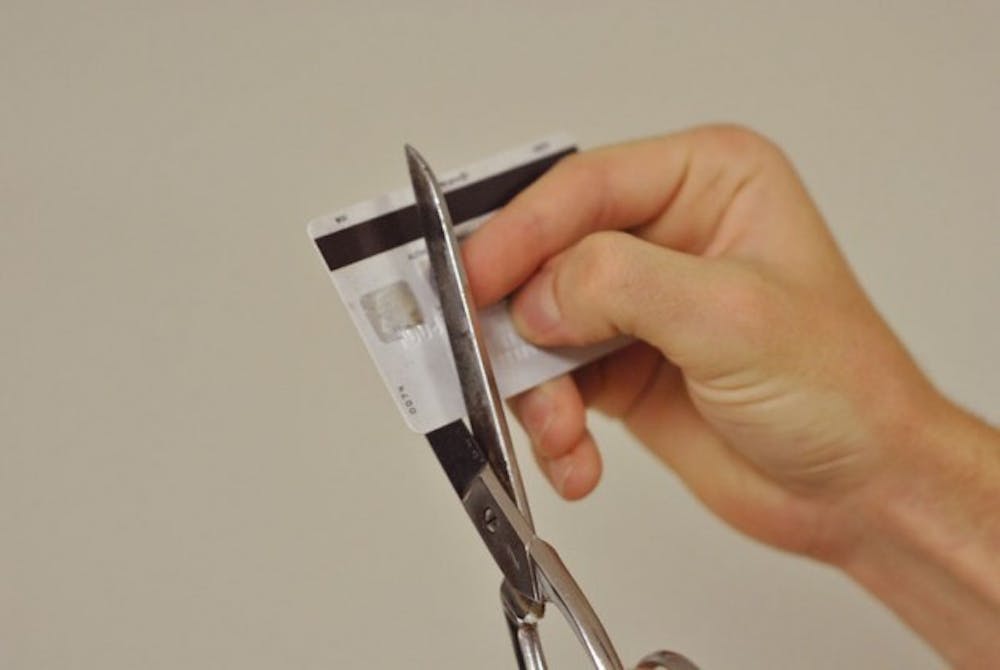
For many students, lessons on credit card debt are learned the hard way. Usually, tens of thousands of dollars are owed after four years of racking up expenses after each every swipe of a student's plastic card.
Students are often not aware or educated about the responsibility and dangers that come with owning their own credit card. Many times, students and their families see credit as an available and sensible option to entirely finance college education and expenses.
At UB, students are able to find many types of support and services to gain financial advice. Kellie Kostek, UB's financial literacy program coordinator, is prepared to teach as many students as possible how to prevent credit card debt.
"The majority of students have not had any formal education on credit," Kostek said. "Some debt cannot be avoided and is a good investment, [like] paying for a college education, but the amount of debt is the important piece here."
According to a Nellie Mae student loan survey, 84 percent of undergraduates end up owning at least one credit card by the time of graduation. One-fifth of graduating seniors will have accumulated more than $7,000 in debt specifically linked to credit cards.
The convenience of having a credit card is perfectly suited for the life of a college student. This convenience is often abused, and students are left unaware of the expenses they've piled up. However, when credit cards are used as a complement to another payment system, they can make handling finances much easier.
"Take out Federal Stafford loans to cover your necessary costs: tuition, fees, meals and housing," Kostek said. "Cut your costs wherever and whenever you can. Do not take out the max loans and use your refund to cover a daily coffee habit at Tim Horton's or Starbucks."
Part of the reason for credit card misusage is the fact that the user doesn't see the money being deducted. Swiping a plastic card requires much less thought and consideration than actually giving a cashier two $20 bills.
"Handing over a card and then [having] it given back to you is a much different feeling than having to give up actual physical money," said Justin Levinson, a junior undecided major. "Paying with a credit card mistakenly makes it feel like you haven't really had to give anything to get something in return."
There are many ways to avoid using credit altogether or to minimize an already existent debt load. Making a budget is the simplest and most effective way to keep expenses in check. From there, students can determine the best method for repaying any debt.
"I'm on a fixed budget of $100 [put onto a debit card] per week, so I need to limit my expenses to the most important things," said Bradley S. Corgan, a senior business major. "A good incentive for me is that if I overspend throughout the week, I can't do what I like to do on the weekends."
Kostek warns students that while debit cards are used without actually having to borrow money from a company or bank, they have their own risks involved.
"Although using debit is much better than using credit, you still have to look out for fees," Kostek said. "The new Credit CARD Act has tried to address some issues with banks' fees but due to the loss in revenue, banks are coming up with new ways to fee to their customers."
The Credit CARD (Credit Card Accountability, Responsibility and Disclosure) Act of 2009 was passed as an effort to help young adults protect themselves and their credit against surprise interest-rate hikes, over-limit fees and easy credit.
Maintaining a respectable credit history and credit score is becoming more and more important for students. Credit scores are often as looked into as criminal background checks on certain job applications.
"Credit scores are used in determining the amount you'll pay for car insurance and renters or homeowners insurance," Kostek said.
Financial advice and contact information for UB's financial literacy program can be found at www.cashcourse.org/buffalo and at the program's Facebook page.



