
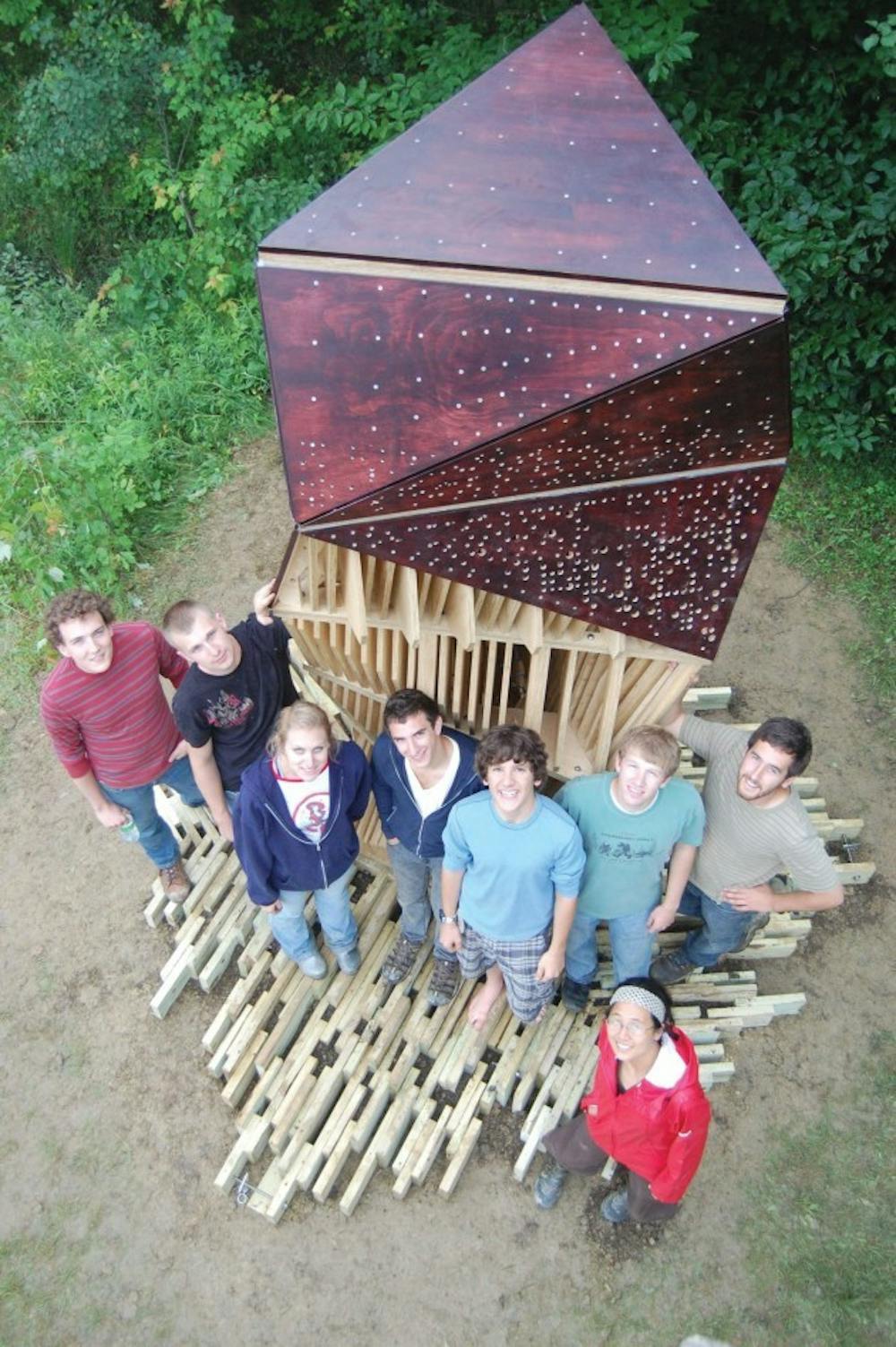
While most people recognize bats as nothing more than cave dwelling mammals that fly around at night, a professor in the UB architecture department sees them as endangered animals important to the ecosystem.
Joyce Hwang's latest project, "Bat Tower," is a twisted, soaring structure constructed from plywood and steel, assembled in a jagged, yet flowing triangular pattern that extends 12 feet into the sky. The structure, located alongside a pond at Griffis Sculpture Park, is expected to become a new haven for local bats seeking refuge from white-nose syndrome, a growing disease that has threatened the animals' existence.
White-nose syndrome, which was discovered in 2006, is a life-threatening white fungal growth located on the wings and muzzles of infected bats. The problem has spread from the Northeast and outbreaks have been identified as far west as Oklahoma.
According to Alan Hicks, a bat expert with the New York Department of Environmental Conservation, the fatal illness claims the lives of 90 percent of all bats infected.
"If we assume only 50 percent decline at the new sites, we are talking hundreds of thousands of bats that could die," Hicks said in an interview with The Boston Globe.
While the exact cause of the disease is still unidentified, researchers speculate that excessive use of pesticides either causes the disease itself or, more importantly, reduces the insect population, a chief source of a bat's nutrition.
Ironically, in order to counteract a rise in the insect population, farmers would have to use more insecticides. This could potentially aggravate the problem even more, and with the added costs of chemical insecticides, consumer prices for farmers' goods could increase.
The increase in insecticides would also result in harmful environmental consequences due to the toxins found in a majority of insect-killing sprays.
Gary Root, a sophomore accounting major, feels that the danger to the bat population is an issue that needs to be dealt with.
"[The problem is] interesting and important," Root said. "It's sad that human beings are encroaching on another part of wildlife."
Hwang received grant money from the New York State Council for the Arts (NYSCA) and the Van Alen Institute, an independent nonprofit architectural organization, to help fund the project. Hwang used the help of many students and faculty members to install and construct the artificial bat habitat.
Sergio Lopez-Pineiro, an assistant professor of architecture, helped with the construction of the habitat.
"We helped arrange different models and helped construct the structure itself," Pineiro said. "Yet, I think it's important to emphasize that it was entirely Joyce's vision and authorship behind the project."
"Bat Tower" will become a permanent installation at the Griffis Sculpture Park in East Otto, N.Y. In addition, there will be an official reception and opening hike in the park on Oct. 2 from 5 p.m. until sunset.



