
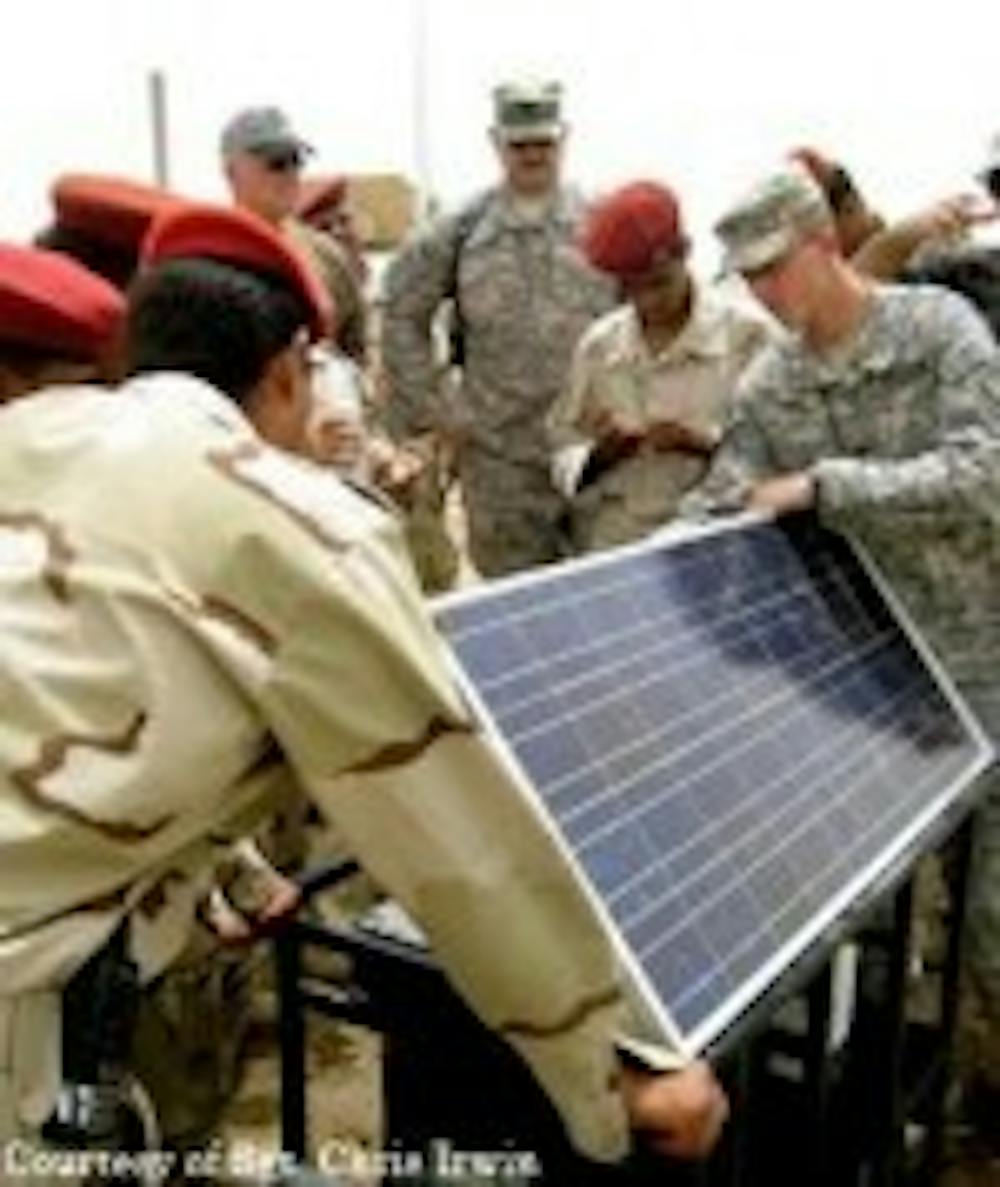
When Sgt. Chris Irwin joined the 403rd Civil Affairs Battalion out of Mattydale, N.Y., he didn't know what he would be getting into. After a year of school at Tompkins Cortland Community College, he decided he needed more adventure and something more challenging – something he figured the U.S. Army Reserve would deliver.
For many young Americans, the decision to join the military isn't always the first choice. With the U.S. involved in two wars and daily suicide and roadside bombings around the world, the potential for harm is as high as ever.
But within a war-torn country lies a much more peaceful mission, one void of terrorist hunts, destruction and violence. This mission involves spending billions of U.S. dollars on rebuilding villages, supplying them with basic needs and providing a helping hand to the Iraqi people.
Sgt. Irwin has spent the past 10 months deployed in Iraq, providing water purification systems to villages, rebuilding schools and giving the Iraqi people a chance to turn their lives around.
'[Iraq is] very poor,' said Irwin, a chemical operations specialist in the USAR who served as a non-commissioned officer in Iraq. 'It's also very dirty. Outside the bases there was trash everywhere and oil on the side of the road; [even] the roads are horrible.'
Irwin, 21, originally from Elmira, N.Y., has been stateside since Aug. 29 and recalls the time he spent in the southern provinces of Iraq very clearly. Since his return, Irwin spent a short two days with friends and family before moving to Buffalo for his first semester at UB.
'This place is huge, I'm amazed by this college,' Irwin said, talking about his first impressions of UB.
Irwin entered the university with an associate's degree and is studying mechanical engineering.
Life in Iraq
Though his transition from the front lines to the classroom occurred in a matter of days, he says the adjustment has been comfortable.
'There are a lot of things that are very different,' Irwin said. 'It's like a job when you're over [in Iraq] – you wake up, go to work, then go to sleep, it's all the same. Then you get back over here and you're free to do whatever you want. I can eat wherever I want and go to sleep when I want to.'
Irwin said that the biggest adjustment is getting used to regular kids. In Iraq, many of the children are from extremely impoverished areas and constantly ask the soldiers for anything of value.
'When we go out on missions we are known for giving stuff away,' Irwin said. 'Over there it is ridiculously poor, so people would ask us for water, candy, whatever they could get – they would take the shirt off your back.'
Irwin worked with several departments to help the Iraqi people, including the Department of State and the U.S. Army Corps of Engineers, where he worked on a variety of projects – including the supply of water, electricity, sewage and new schools. Requests for these projects come from the Iraqi people, municipal governments and officials.
For the duration of his tour Irwin said he provided assistance to – and spent most of his time in – one of Iraq's poorest provinces, Muthanna.
The price of rebuilding
Within the poorest province of Iraq lies an effort to get the country into a self-sufficient, clean and safe way of day-to-day life. According to a document from the Army COE's Iraq Reconstruction Management System Database, the Army has spent $8.93 billion on over 5,250 projects and reconstruction efforts in Iraq as of Sept. 1.
An additional $1.95 billion has been set aside for 360 ongoing projects, according to the Army COE. Another 168 projects have been planned with an estimated $460 million price tag.
Soldiers like Irwin and other civil affairs battalions use these funds to provide water purification systems, electric generators and to construct and improve buildings – including over 1,100 schools.
'We were giving kids a place to learn,' Irwin said. 'The schools over there were made out of mud, they were small little shanties where 25 or more students would be packed and classes would be held when it was over 120 degrees out.'
In addition, the Army COE has helped construct 133 healthcare centers, 46 hospitals, 95 fire stations and 62 courthouses and correctional facilities throughout Iraq.
Irwin said that he mostly worked with the water purification systems. Each unit costs between $20,000 and $35,000 and can produce up to 1,000 gallons of clean, drinkable water per day.
'The [systems] are completely sufficient by themselves,' Irwin said. 'We would take them out to a village with no electricity, no nothing. They did have a water source, but they couldn't drink it because it's dirty and contaminated, so we would bring [the machine] to them, we would set it up and teach them how to work it, how to maintain it. Then we flip the switch and they would have clean water.'
The American-made water purification systems run on solar power and have an internal battery, according to Irwin. Each unit comes with enough filters to last between two and three years.
The Army COE also constructed over 695 water treatment plants and irrigation projects, including over 180 wastewater treatment, sewage collection and solid waste projects.
Iraq's rise to self-sufficiency
Along with receiving much needed aid, the Iraqi people have been eager to help with the work, according to Wayne Marcus, a water and agricultural advisor for the Department of State. Marcus has been working in the Muthanna province since March of 2005 as part of the provisional reconstruction team.
'The province is a relatively peaceful province so we could go out and do quite a bit of interacting with the directors of municipal utilities and departments to try to get projects to make their lives better,' Marcus said.
The Iraqi Army works well with the U.S. Army, which provides training and funding to the Iraqi forces in an effort to make them more independent, according to Marcus.
The projects employ an average of 8,900 Iraqi people. Materials for the projects are often purchased and produced through local companies, helping to create economic growth, according to the Army COE.
To further stimulate the local economy, Iraqi contractors bid on many of the projects, meaning most of the labor is completed by Iraqi workers, according to Irwin. To ensure that a project is worthwhile, the DOS must approve the funding and the provisional reconstruction team has to decide if it would provide enough benefits before work is started.
'The economy over there is awful and the people are looking for work,' Irwin said.
Marcus provided oversight for many of the schools being built in the province. However, as more U.S. funded projects reach completion and the Iraqi economy and government begin to expand, the country has begun to support its own projects, according to the Army COE.
A patriot returning home
Though Irwin's mission in Iraq was peaceful, the echoes of war sometimes hit close to home, he said. Mortar and rocket fire was occasionally directed towards his base, but Irwin was never directly involved in combat. He also says his experience in Iraq has changed him forever, crafting him into a more mature and responsible person – all of which spawned from his initial sense of adventure.
'It's a totally different sense,' Irwin said. '[I] fought for my country, my life was on the line for 12 months and anything could have happened to me where I could have died for my country. So you come back a little more patriotic, you feel like you've done something big –something that will follow you for the rest of your life. [This is] something nothing else in the world will you do for you.'
E-mail: spectrum-features@buffalo.edu



