
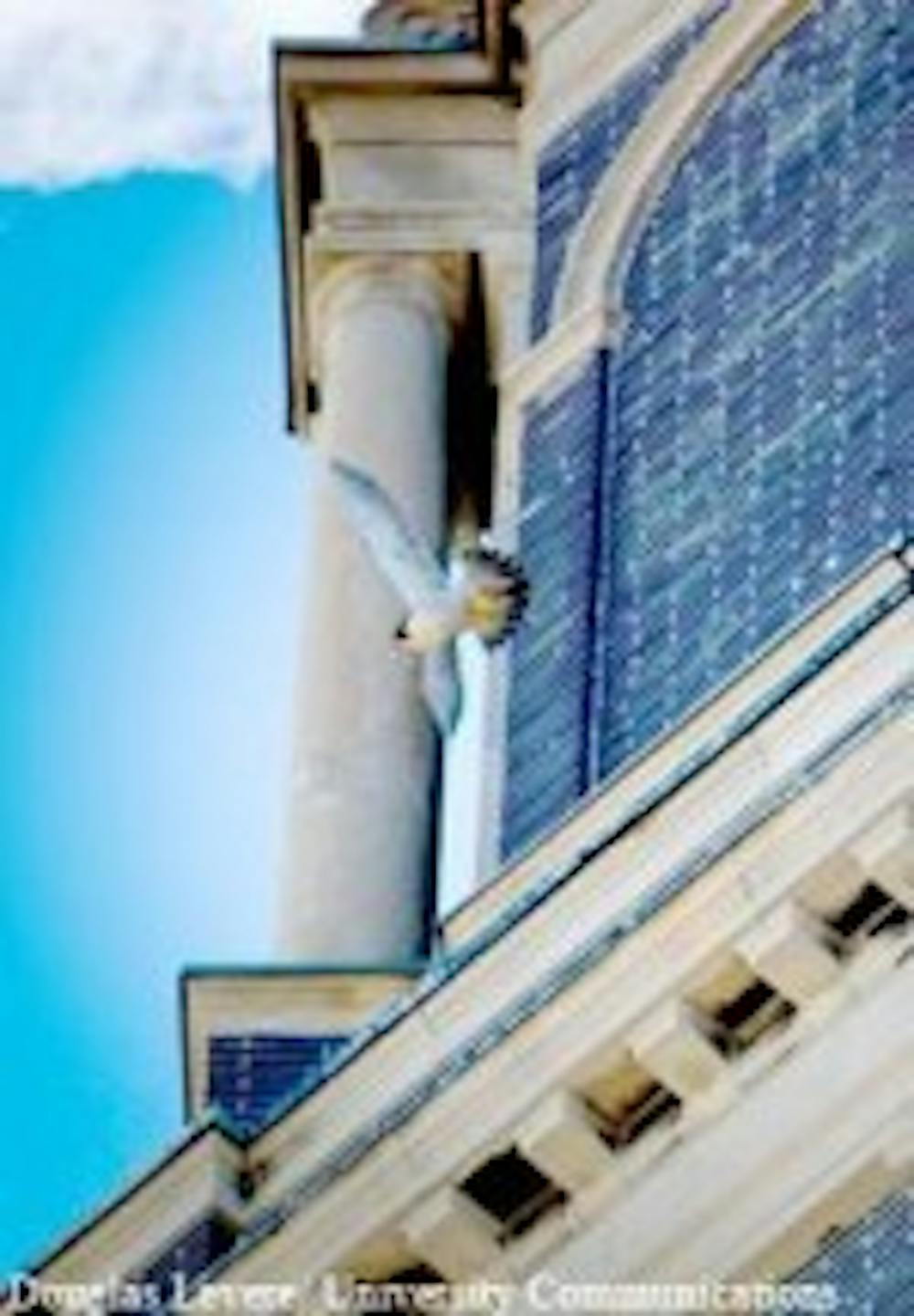
Though UB is generally known for having a diverse student body, two new members are very different from the rest.
A couple of endangered peregrine falcons have found a welcoming home for themselves in the newly built nesting box on top of the South Campus' MacKay Heating Plant, due to the collaborative work of UB, New York State Department of Environmental Conservation and New York State Historic Preservation Office (SHPO).
Local birdwatchers Vicki Kadow and Roger Johnson contacted the DEC after spotting the pair of falcons frequenting the South Campus area late last spring.
After confirming the sighting, the DEC approached UB asking to host housing for the falcons. UB needed to obtain special permission from SHPO because the MacKay Heating Plant is a historic building.
With authorization, building of the nesting box began in February when the birds were south for the winter.
The box was built under the instructions of Ronald Van Splunder, manager of architectural support for UB facilities planning and design.
"Placing the nesting box on top of MacKay Heating Plant, where the birds had been habituating prior, created an increase in nesting safety, with its gravel floors preventing any eggs from rolling away and becoming damaged, as well as from threatening weather conditions," said Van Splunder.
The pair of Peregrine Falcons, which Kadow and Johnson named Smokey and Misty, discovered their new home as early as March 24. Observations from birdwatchers and footage from the observation camera installed in the nesting box showed that the falcons seem to be habituating well in their man-made housing.
There are also speculations that the birds have already laid eggs, as the female has reportedly been in the box more than usual. However, the assumption that she is caring for her unborn chicks cannot yet be confirmed due to the observation camera being out of order and unfixed out of fear of disturbing the nest, which would cause the mother to neglect her eggs, according to Van Splunder.
"The whole project is a great collaboration between UB, the DEC and the New York State historic preservation," said Van Splunder
Peregrine falcons were almost entirely eliminated from the Eastern United States in the 1960s because their prey of choice was tainted by certain pesticides, according to the DEC. Since then, reintroduction efforts across the East Coast have created a steady rebirth of the species.
The DEC recently noted that New York State now holds the largest population of peregrine falcons in the eastern United States.
The DEC also reported that Western New York has greatly contributed to the peregrine falcon population increase, providing homes for several peregrine families. An estimated 60 peregrine falcons now live in all of New York, with four recently reported in the area.
The other local falcons live in a box on the Slater building in downtown Buffalo, the ledge of an old power plant on the Canadian side of the Niagara Gorge and a box on the south Grand Island Bridge.


