
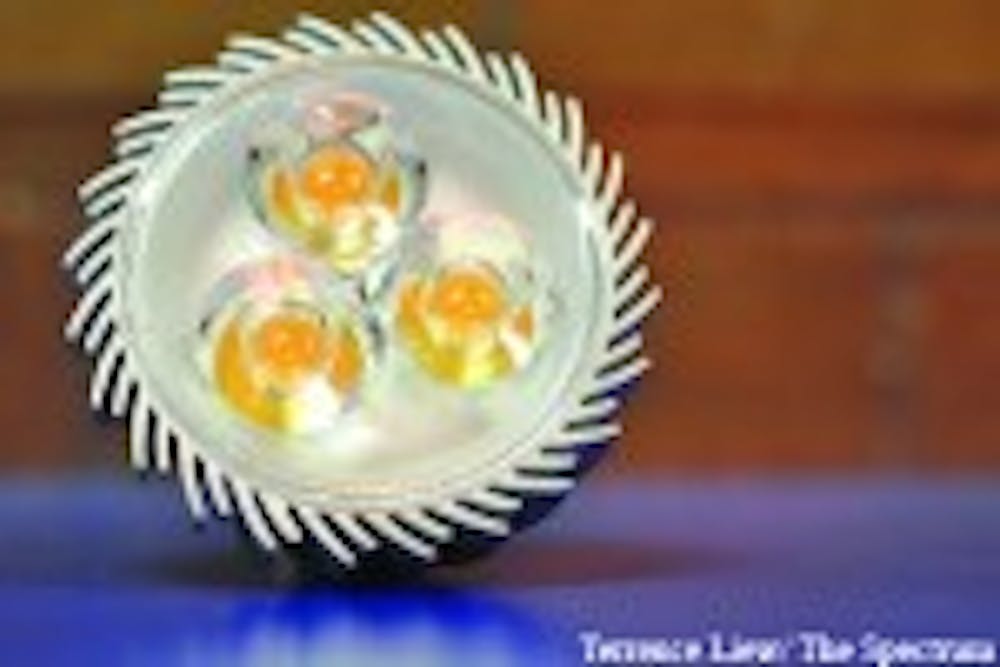
???In addition to becoming a greener university, one new upgrade will also make UB a brighter university.
???Several campus locales have begun to make the transition from traditional bulbs to light emitting diodes (LEDs), including Alumni Arena, the Center for the Arts and some street lights on North Campus.
???A typical incandescent floodlight uses 75 watts of electricity, significantly more than a compact florescent, which uses 23 watts. However, an LED light of similar brightness uses 11 watts, which can amount to large energy savings.
???President John B. Simpson signed the Presidents Climate Neutrality letter over a year ago. The initiative requires UB to develop a plan to reduce carbon emissions, which contribute to global warming. UB's goal is to have a carbon neutral campus.
???UB has been working with Solid State Lighting Industries and discussing the potential of LEDs for the past two years, but had not implemented them until recently.
???Albert J. Gilewicz, assistant director of utility operations, had a major role in the switch.
???The objective of the proposal is to save the university money and energy, as well as reduce greenhouse gas emissions.
???"The university has replaced about 20 lights in Alumni Arena," Gilewicz said. "By replacing these lights, UB will save over 10,000 kilowatt-hours a year of electricity. The average American house uses around 8,500 kilowatts per year. The university will benefit by saving $1,100 off the utility bill. This will reduce carbon emissions by almost 4 tons."
???Although the lights will save UB money in the long run, the price of the bulbs keep the university from switching to LEDs on a larger scale.
???"LEDs are more expensive than other lights, but over a long period of time, they're less expensive and the investment will be made back," Gilewicz said. "The payback at UB is less than two years. It's hard to find a negative."
???However, speaking with over 30 years experience in the field of energy engineering, Gilewicz believes that LEDs will take some time to become a mainstream product.
???"From the standpoint of cost and benefit, people will eventually switch to LEDs when the price comes down in the years to come," Gilewicz said. "I feel it is a little early to start putting them in houses, but given the fact that there is a lot of savings to be had, LEDs will become a household product."
???Gilewicz believes that, in time, LEDs will play a larger role at UB.
???"We should move at a pace where we don't negatively affect the university. We need to be methodical in our approach to make sure that what we do is in the best interest of the university," said Gilewicz. "This is the future of UB and within the next five years there will be a lot more LED lighting from building to building."



