
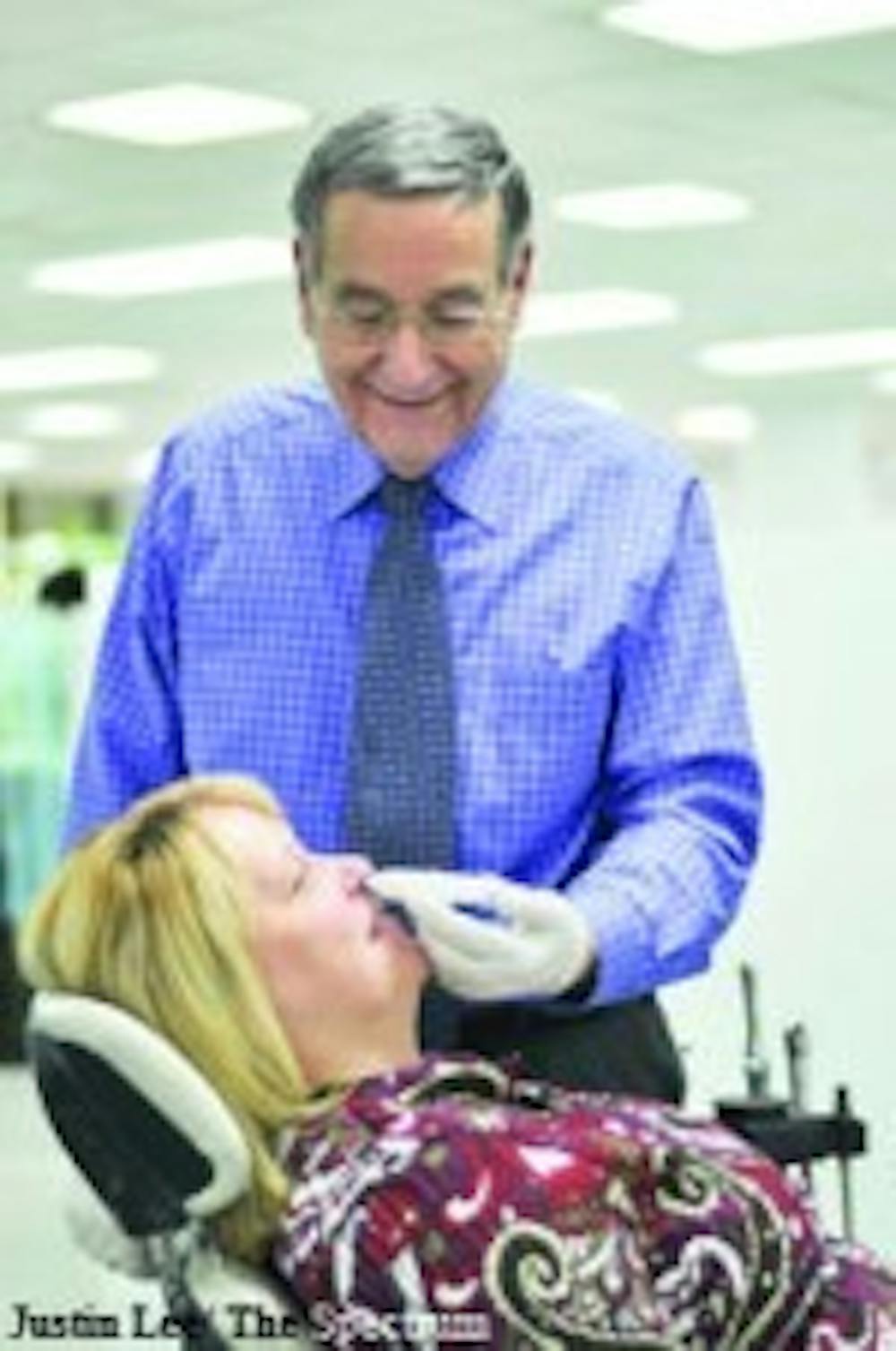
???Perhaps one of the most frightening experiences in life is watching a dentist bring a 3-inch needle up to your mouth, slowly sinking it into your gums while injecting several cubic centimeters of Novocain into the soft tissue below your teeth.
???Researchers at the University at Buffalo School of Dental Medicine hope to eliminate this potentially traumatizing experience by replacing the oral needle with a nasal spray, which is currently in a 2009 Food and Drug Administration (FDA) Phase 3 trial.
???This nasal spray has demonstrated the ability to numb the upper jaw without the use of a dental injection.
??? The dental school will be the first to test the nasal spray in a "real life" dental situation in the Phase 3 trial, in which the patients will actually have their teeth filled, according to Sebastian Ciancio, a distinguished service professor and clinical professor of the Department of Periodontics and Endodontics.
??? "The product was first tested at the UB dental school for safety in 80 patients," Ciancio said.
???A dentist and an ear, nose and throat (ENT) doctor in Colorado developed the nasal spray. Both doctors came up with the idea when the dentist had surgery on his nose, and noted that his upper teeth were numb after the ENT doctor used a nasal anesthetic, Ciancio said.
???Only the upper jaw can be numbed by the nasal spray. The only reported side effect is some stuffiness of the nose, which lasts about an hour after the procedure.
???"What this means for the patient is that for painful injections in the [upper] jaw, including the palate... can be avoided when treating the majority of teeth in that jaw or doing surgery on the gums," Ciancio said. "For the doctors it means a more pleasant relationship with their patients and less chance of needle stick errors for the dentist and his staff since no needles are involved."
???Phanith Leang Lim, a UB dental school alumnus, agrees that the nasal spray would be beneficial to both the patient and the dentist.
???"I believe in theory if there was a nasal spray that could successfully anesthetize the mouth it would be revolutionary to dentistry because the fear of needles is a major impediment towards receiving dental treatment; more so than money, noise or the actual procedure-it's the fear of needles," Lim said.
???Many people including Tara Polla, a freshman biomedical sciences major, expect the availability of the nasal spray to be welcomed by the public.
???"The anxiety and stress of having a dental injection would decrease because of the nasal spray, putting patients at ease," Polla said.
???The nasal spray is expected to be on the market in about one year, and will come at additional cost of $15 to $20 more the dental injection, Ciancio explained.
???"Having a successful nasal spray would be profound because it eliminates one more psychological barrier; dentistry is 70 percent treating and catering to the patients mental health/dental fears and 30 percent actual dental procedure," Lim said. "If the anesthesia was delivered pain-free and made the entire dental procedure pain-free, then patients would be more inclined to keeping up with their oral health."



