
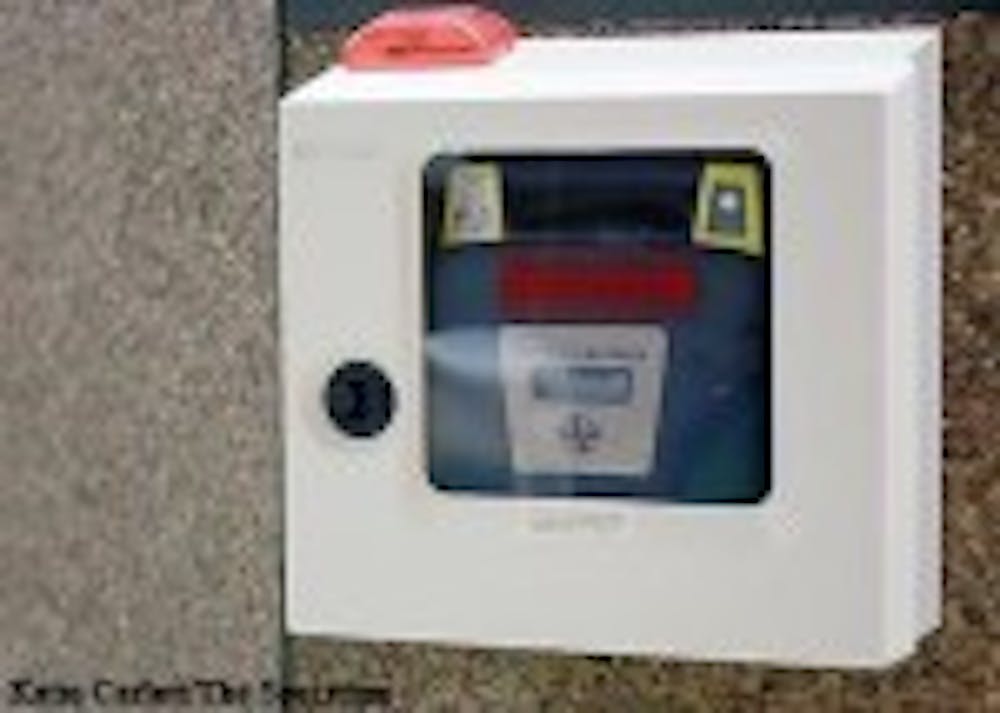
Approximately 450 automated external defibrillators (AEDs) have been installed on campus due to a new regulation that requires all public buildings in New York State to have on-site cardiac AEDs.
???According to the Director for the Department of Environment, Health & Safety Services Joseph T. Raab, the AEDs are an "easy to use" device to be used on victims suffering from sudden cardiac arrest. The AED administers an electrical shock to restore a normal rhythm to the heart.
???"If defibrillation is applied within five to seven minutes of a cardiac arrest, statistics indicate that there is a 49 percent chance that a victim will survive the event," Raab said.
???The use of an AED is one of the steps to "the 3 Cs" (check, call, and care) of responding to a potential cardiac emergency event, Raab explained.
???For the first step, the individual providing care should check the victim for responsiveness. The individual should then call the University Police Department or any other local police department, depending on the victim's location. The last step is to care for the victim.
???Individuals who are not trained operators of an AED should send someone to retrieve an individual who is, and begin cardio pulmonary resuscitation (CPR), according to Raab.
???UPD Lieutenant David P. Urbanek has used "the 3 Cs" in the past and is pleased with the new devices.
???"With SUNY's commitment to CPR and AED training and placement, it's a great step in helping people, pure and simple," Urbanek said.
???Urbanek responded to a report of a male that fell off his bike on the Amherst Bike Path at St. Rita's in 2006. With the use of an AED, Urbanek administered one shock to the man, and began CPR with Officer Anthony Vinci. While awaiting the ambulance the patient regained a pulse and minimal breathing.
???Only individuals who are properly trained are allowed to use the AEDs, explained Raab.
???"I can't stress enough for people to get trained, a medical emergency can happen anywhere and at any time," Urbanek said.
???Several UB students have shown an interest in obtaining training. Corey Neal, a junior computer science and engineering major, is one of those students.
???"Training should be offered to students and faculty in case of a medical emergency when no medical professionals are present," Neal said.
???UB has trained over 1,000 people including students on an annual basis in AED operation, Raab stated.
???There are two different training methods, awareness training and operator training, according to Raab.
???Awareness training is aimed at all UB students, faculty, staff and visitors, Raab explained. This training explains how the AED works, describes warning signs of an individual experiencing cardiac arrest, and informs the trainee on how to seek help for the cardiac arrest patient.
???"The operator training is live instruction on the administration of CPR and use of the AED device," Raab said. "The operator training qualifies the attendee for CPR/AED rescue, and is valid for two years."
???At a minimum, UB will have two trained operators for each AED on campus, and an operator will be able to respond to a cardiac arrest within three minutes, according to Raab.
???"Like in fire drills where you can locate the nearest exit, individuals should be notified where the AEDs on campus are located," Neal said.
???Raab hopes members of the UB community will take the time to familiarize themselves with the locations of AEDs and to take the initiative to get operator training.
???"Now is a great time for everyone to learn more about them [AEDs]," Raab said.
???Individuals interested in receiving training can contact UB CPR/AED Program Training Center at 829-2935 or visit their Web site at www.ubathletics.buffalo.edu.



