
The free penis and breast-shaped cookies may have lured students to the third annual Sexual Health Fair in the Student Union on Thursday, but once inside an array of information ensured they would leave with more than just a pocket full of free condoms.
The fair, organized by Sub Board Inc. (SBI) Health Education, featured facts on sexually transmitted infections (STI) and how to avoid them, and activities that tested students' knowledge of their own sexual health.
"I felt sick after seeing all the STIs you could get," said Katherine Ruiz-Meneses, a junior nursing major. "You know there's a lot but you really don't know there's that many."
Students were consistently drawn to one table in the back corner of the room displaying an assortment of sex toys laid out like a handyman's set of tools. Anal beads, vibrators and a royal blue butt plug were among the playthings presented for the inquisitive mind while Liz Lyon, a sex education intern at SBI, used a dildo to demonstrate the proper way to put on a condom.
"This shows [students] that they can still have fun with their partner and be safe," Lyon said of the presentation, which also holds workshops at campus residence halls. "We're not here to judge what you do."
One of Lyon's activities was to have students blow up a condom and rub an oil-based lubricant like baby oil on it. Not more than a few seconds into the procedure, the condom would pop and Lyon would explain that only water-based lube should be used with condoms.
"This gives you a chance to see firsthand that the oil-based lube will break down the latex and cause the condom to break," she said.
There were also plenty of facts about human papillomavirus (HPV), the most common STI. The presentation at the event convinced Mariah Spence, a freshman occupational therapy major, to get the HPV vaccine that prevents four strains of the virus. By age 50, at least 80 percent of women will have acquired the infection.
The virus, which is spread by skin contact, shows no symptoms and is considered benign in most cases. Some infections, however, can develop into genital warts or cervical cancer.
Although the election is over, politics was not left out of the fair's attractions. A table from Planned Parenthood gave out petitions asking legislators to reject a plan to cut state budget funding for family planning services.
The petition states that nationally, every dollar spent on family planning services saves four dollars of Medicaid service funds.
"Health policy and legislation is very politicized, and we wanted to shed light on that," said Jane Fischer, director of SBI Health Education. "It's more than just Roe v. Wade, there are a lot of state concerns."
A nearby table highlighted a subject that might hit close to home for many students-mixing beer and sex. Students were quizzed on their knowledge of how nutrition plays a role in sexual health.
Dark chocolate, as many correctly guessed, is an aphrodisiac. Alcohol's role depends on how one looks at it, according to Safiyya Hunter, education coordinator for the Anti-Rape Task Force.
"Beer might get you into the bed, but once they're there the majority of people can't get it up," she said.
Herpes was inevitably a hot topic at the fair. Statistics state that one in four women and one in five men have the virus, according to Emily Briglia, a supervising counselor at SBI Health Education.
"It's a scary thing. A lot of people are infected, and most don't know they have it," she said, citing figures as high as 90 percent of people unaware that they could be infecting others.
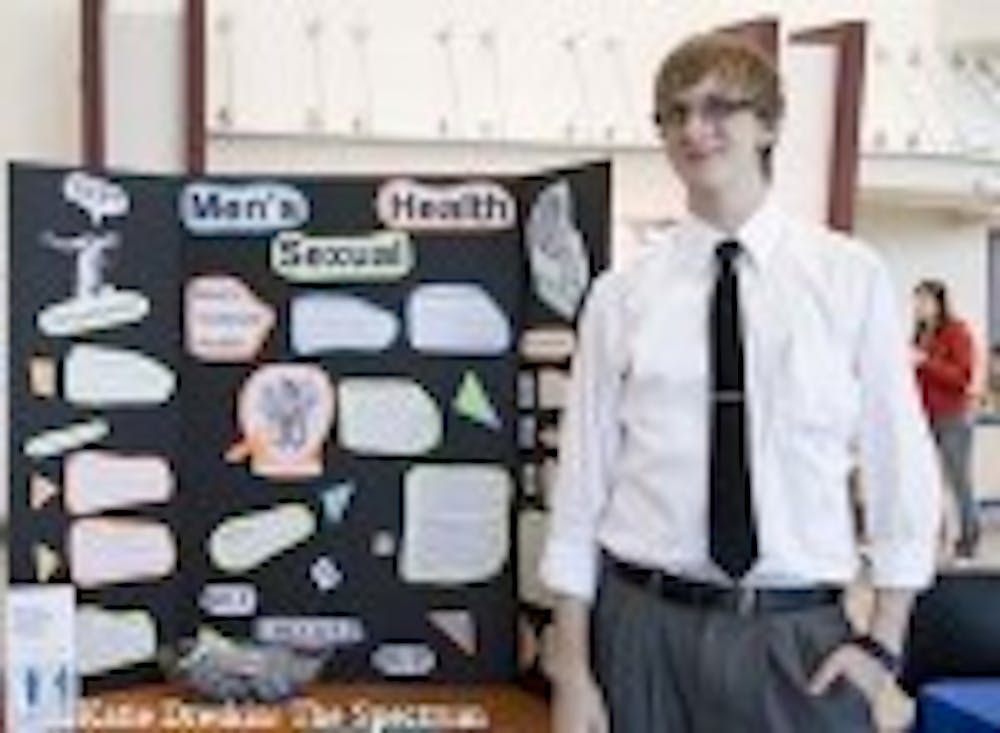
A men's sexual health table also presented some surprising facts to male students, where Jake White, an SBI intern, said he received several questions about testicular cancer.
"It's not a cancer that shows up often in older men. It more often affects guys ages 15 to 35," White said, stressing the importance of testicular self-exams.
White also reported an Australian study that found that men who ejaculate more frequently have a lower risk of developing prostate cancer.
For $10, any student can get tested for STI infections such as Hepatitis A, B and C, Syphilis, HIV, Gonorrhea and Chlamydia, with results in two to three weeks. An HIV rapid test with results in 20 minutes is also available, as well as Plan B emergency contraception and free pregnancy tests. These services are offered at the Student Health Center in Michael Hall. See www.healtheducation.buffalo.edu for details.



