
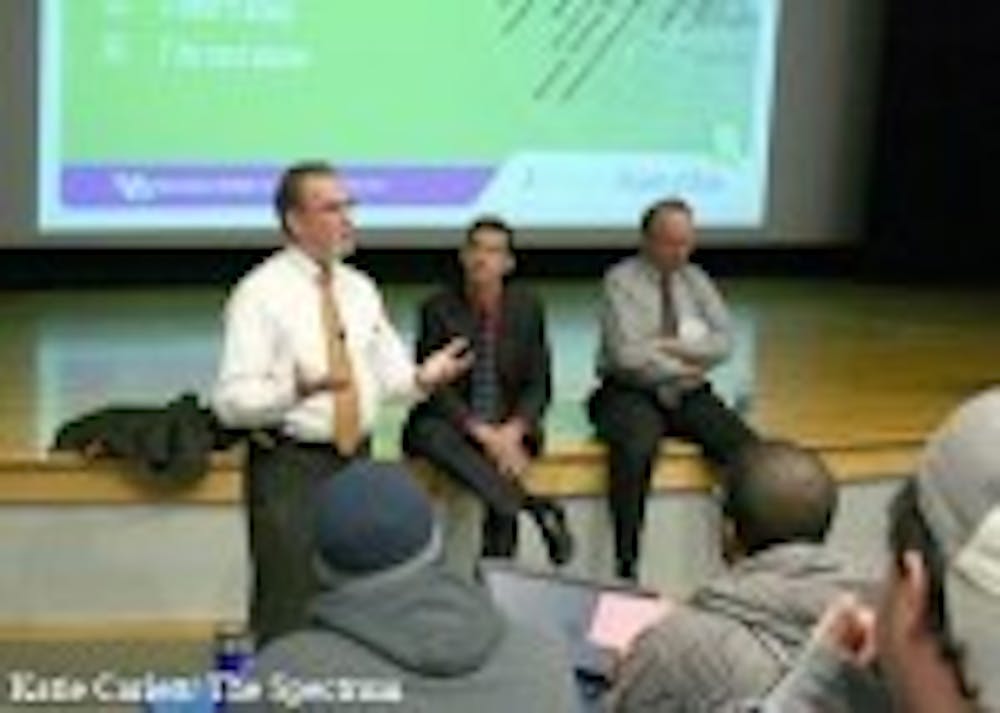
The University at Buffalo threw its first major punch in the fight against climate change on Tuesday as the Environmental Stewardship Committee (ESC) met with students, faculty, staff and community members for the first of three public forums.
The Fall Sustainability Forum served as a brainstorming session to help the ESC plan for a climate neutral campus. President John B. Simpson formally acknowledged the matter when he signed the American College & University Presidents Climate Commitment (ACUPCC) in the spring of 2007, leading to the creation of the ESC later that year.
"UB is already a sustainability leader," said Robert Shibley, ESC chairman and senior adviser to the president for Campus Planning and Design. "What's left to do is going to be harder. We need your help to shape and frame the priorities related to that."
According to the ACUPCC Web site, college campuses need to proactively take action due to the "unprecedented scale and speed of global warming and its potential for large-scale, adverse health, social, economic and ecological effects."
Over 560 higher education institutions in the U.S. have signed up to reduce emissions, according to the ACUPCC Web site.
"We believe that higher education should lead," Shibley said.
The audience of the forum, comprised of over 170 people, broke into groups based on the six sub-committees of the ESC to generate ideas on how to transform UB into a climate neutral campus.
The groups discussed topics such as energy, transportation, information technology, materials, communication and public service. They later reconvened to compile a summary of the sub-committees' research and priorities.
"It's key to this whole thing to elevate the discussion; get it so that it's grassroots-fed," Shibley said.
Participants in the forum produced a variety of ideas, ranging from nuclear power to expanding NFTA Metro routes to banning freshmen parking on campus.
Some of the more popular ideas included expanding the use of alternative energy sources, linking with established Western New York transportation infrastructure, using the entire campus for energy research and simple education campaigns to remind students to turn off appliances.
The ESC hopes to use the commentary from the forum to develop a basic framework and build an action plan by September.
"I think, in the assumption of President John Simpson...it makes academic sense to do this plan, it makes economic sense to do this plan, and it makes ethical sense to do this plan," Shibley said.
According to Shibley, the campus has continued to grow but carbon emissions have remained the same. The ESC hopes to diminish carbon emissions as UB expands under UB 2020.
"Given that we plan to grow significantly, we can still hold emissions and in fact, get to zero," Shibley said.
The campus could cut carbon emissions by 50 percent by switching to renewable energy, according to Michael Dupre, assistant vice president for University Facilities. The long-term cost savings of the switch would provide the university with additional funds in the future.
Even though the campus is making institutional changes to help facilitate reduced carbon emissions, changes in student behavior are also important to the cause, according to Dupre. By turning off lights when leaving rooms and shutting down computers when not in use, students, faculty and staff can decrease campus costs by an estimated $2 million.
"No one person is going to get this done," Shibley said. "The [ESC] is embedding sustainability everywhere in UB. Sustainability is everybody's mission; it's their personal choice."



