
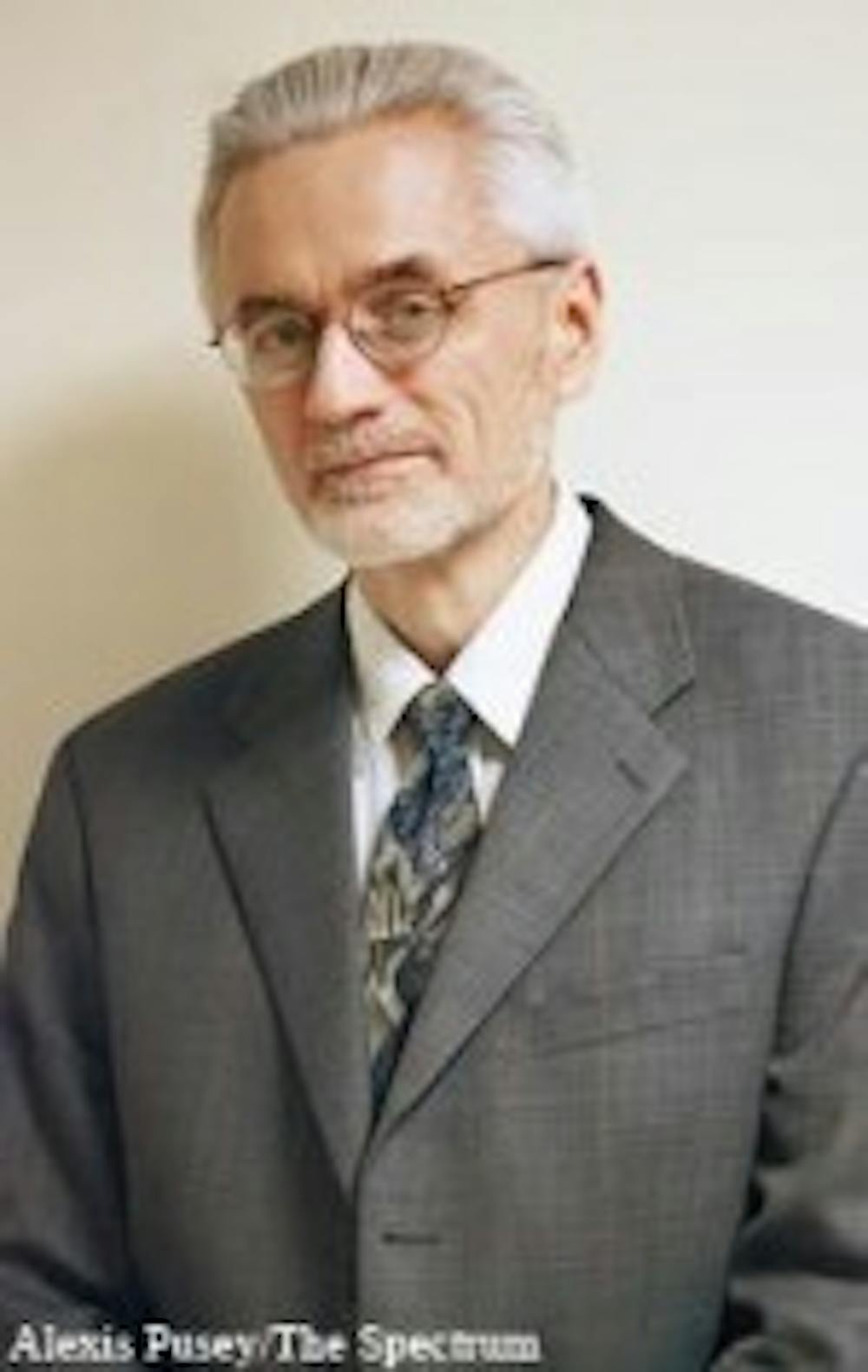
Even though millions died due to forced starvation and collectivization, for many the Ukrainian Famine Genocide isn't a very well-known subject, according to Dr. Alexander J. Motyl, a political science professor at Rutgers University.
Motyl attempted to enlighten UB students with a two-hour lecture and discussion in 280 Park Hall Friday afternoon.
Beginning in 1932, a manufactured two-year famine struck the heavily agricultural Soviet region of Ukraine. Motyl believes that 4 to 7 million Ukrainians perished during the famine, though he has heard of estimates ranging from 2 to 13 million.
"We don't know more because Soviet statistics aren't very good," Motyl said.
Soviet dictator Joseph Stalin sometimes had his census-takers shot because he did not like the data that was produced, according to Motyl.
An authority on Eastern European politics, Motyl spoke at UB to commemorate the 75th anniversary of the Ukrainian Famine Genocide, an event that some Western governments and institutions have only recently declared a criminal act.
Motyl recalled that the first time he gave the lecture, in 1982, many in the academic community were skeptical of an actual intent to starve millions of people. They cited the Soviet policy of collectivization, taking individual land and grouping it together for the state, as the primary cause of the famine.
However, Motyl believes scholars mistakenly look at the famine as an isolated example of agricultural mismanagement rather than placing the event in the context of the overarching goals of Stalin. According to Motyl, the famine was orchestrated as part of a much larger plan of consolidating power in the Soviet empire.
"Ukraine was a major obstacle to this plan...it was a political obstacle and a cultural obstacle," Motyl said.
The Soviet plan, according to Motyl, was a multi-tiered attempt to cripple Ukraine. First, the Soviets planned to remove the intellectual and political elite, then moving onto members of the church and finally crushing the peasantry.
Motyl stressed that Ukraine was too important to the Soviets to let slip away because, besides being the most populous non-Russian state, Ukraine was rich in mineral resources and showed potential to secede.
"What you have in the case of Ukraine is something in the nature of a perfect storm," Motyl said. "The peasantry, and the intelligentsia, and the size of the country, and its economic importance, and its strategic location all matter in ways that few other regions mattered to the same degree."
Motyl also asserts that the actions of Russian officials and Russian military personnel were clear indicators of genocide. According to Motyl, roadblocks were created to keep peasants from traveling and foodstuffs from entering the villages. In addition, soldiers and members of the Soviet secret police would remove food produced in village farms, resulting in a widespread famine.
"They would send in battalions of party activists and simply take all the grain," Motyl said. "They would also search for it...and if you were found hiding the grain you would be shot."
Many critics of this explanation doubt such brutality but Motyl believes that historical context supports the existence of genocide.
"Lenin, Trotsky, Stalin and many of the other Bolshevik leaders, were always, from the very beginning, fully committed to massive destruction of the population," Motyl said. "You got in the way, you were destroyed."
Although it hit its peak in 1933, the truth about the famine only became widely accepted after the collapse of the Soviet Union in the early 1990s when Soviet documents were finally declassified.
Motyl explained that in America, those who witnessed the famine were regarded as bumbling, disgruntled immigrants and the scholars who claimed genocide were dismissed as crazy McCarthians with an anti-Communist agenda.
The lecture served as an eye-opening experience for some students.
"I think it's really a very overlooked part of history when discussing the Soviet Union," said Jordan Gerow, a senior economics and English major.
Alyssa Puhacz, a freshmen business major and member of the Ukrainian SA said that most of her friends have never heard of the Ukrainian Famine Genocide.
"It was very informative and I think it's unfortunate a lot of students don't know about the genocide considering how many people died," said Puhacz.
Motyl believes it is important that he continue to lecture and shed light on the Ukrainian Famine Genocide.
"It's a question of understanding what the crimes of the 20th century were, and if we understand them in their entirety, then perhaps we can prevent them." Motyl said.



