
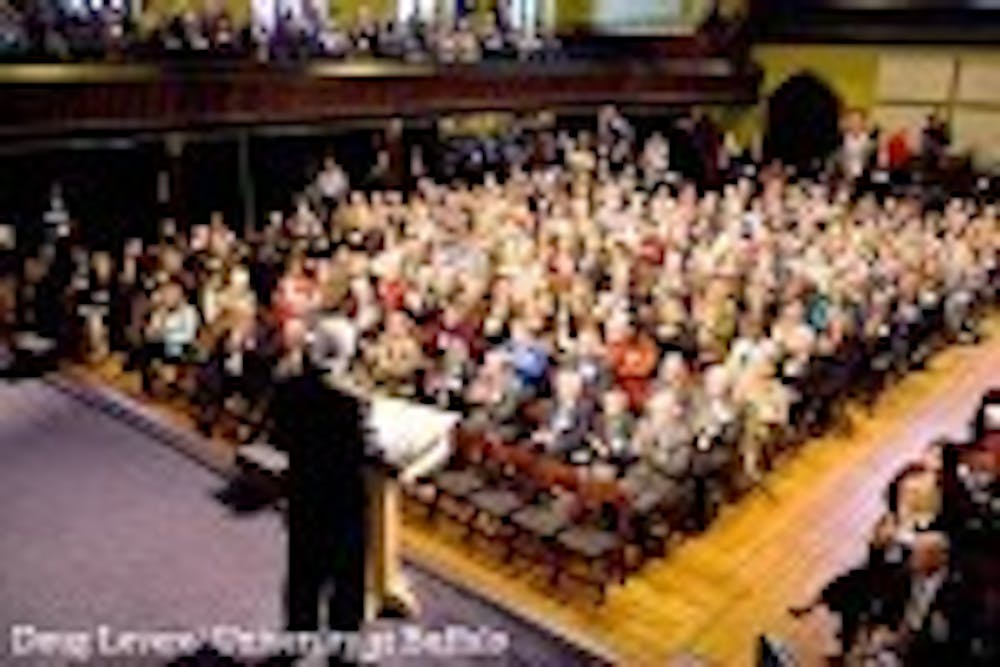
The setup for President John B. Simpson's Third Annual Address to the Community on Wednesday morning was a metaphor waiting to happen.
Held in Asbury Hall, an old refurbished church in downtown Buffalo, Simpson stood at the podium like a preacher on Sunday morning and delivered his speech to a crowd of UB Believers, renewing their faith in UB 2020 despite impeding state budget cuts.
Simpson started the address by outlining the expected cuts to UB's share of state revenue, estimating that $20 million would be withheld from the university's budget, which is 10 percent of what it receives from Albany.
"These cuts are real, and they're as painful as they are myopic," Simpson said. "And I am very angry about them."
Simpson's tone grew inspirational, almost revolutionary, as he described the potential UB 2020 has to transform Buffalo's economy and chided Albany for a lack of steady support for UB's initiatives.
"We must unite our voices and tell Albany what we need for our region," Simpson said, going on to recite two similar "we must" proposals that elicited applause from the crowd.
Simpson mentioned cities like Pittsburgh, which, like Buffalo, once thrived thanks to the steel industry, and are now supported by its research universities. He brought up a promise the state made to UB in the 1960s - that the school would become a "Berkeley of the East," which he said has yet to be realized.
"We need to tell Albany that the time has come to make good on that promise," Simpson said. "And if they are not going to do it, they need to get out of our way and let us do it ourselves."
In the question-and-answer portion of the program, one attendee asked what exactly he meant by that statement. His response centered on the university's clear goals to positively impact Western New York, and ended with a more modest call to action.
"...I think we have to think about some kind of way to redefine in a primary way our relationship with SUNY and with the state of New York," Simpson said.
There are several matters that warrant a response from Albany, according to Simpson. New York State's Commission on Higher Education, of which Simpson was a member, investigated ways to improve the state's universities and published its findings in 2007.
"SUNY suffers from 'too little revenue, too little investment, and too much regulation,' " Simpson cited.
By deregulating the spending and contracting laws for land and equipment, Simpson argued that UB 2020 projects like turning the M. Wile Building into a major part of the Downtown Campus would speed up construction time and save taxpayers millions of dollars.
"We need deregulation and relief from a battery of outdated and inefficient laws," Simpson said. "...It would cost the state literally nothing to change these rules."
A logical tuition policy is also needed, Simpson said. Instead of tuition increases every time the school's budget is cut short by a state deficit, "a policy of small, regular, and predictable increases" would keep the university financially stable and avoid surprise tuition hikes for students.
To substantiate this point, Simpson used UB's Law School as an example where gradual tuition raises have provided the necessary funds for programs while keeping tuition "one of the lowest among our peers."
Simpson called on the attendees to provoke Albany to support these changes and UB 2020, which could increase the university's economic return to the state from $1.5 billion to $2.6 billion if it is achieved.
While few students attended the event, those who did were satisfied with Simpson's arguments but wanted to see more attention paid to student's needs on campus. Alexander Karas, a senior mechanical engineering major, thought the talk focused too much on the new Downtown Campus.
"The other two campuses sort of seemed like the elephant in the room that he didn't want to mention too much," Karas said.
In the end, Simpson's address seemed to have a rousing effect and drew a standing ovation from the assembly that gathered.
"Despite these tough budget times," he said, "we must not retreat, and we must not retrench. We must invest now in our future."



