
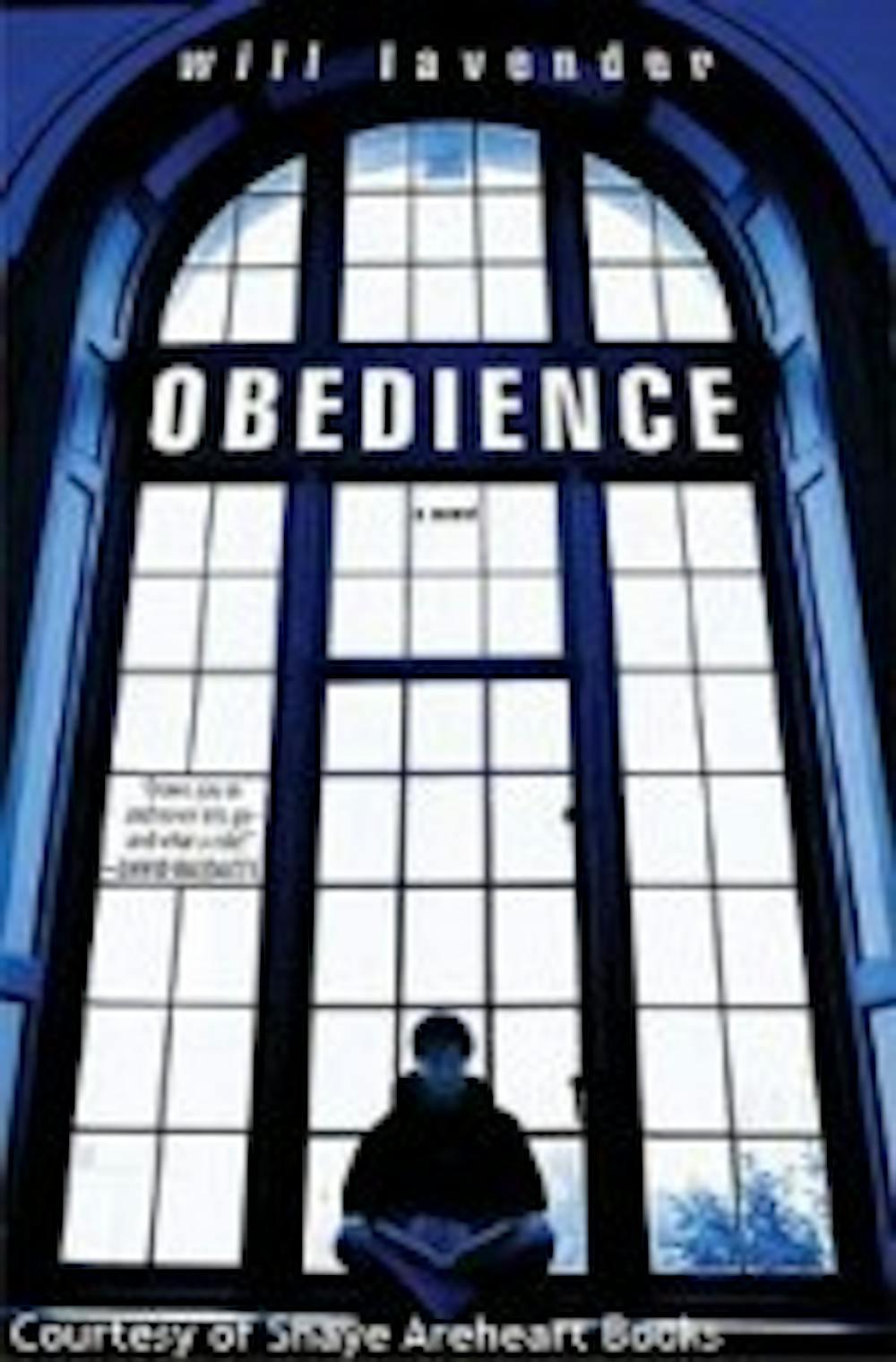
When our professors tell us to jump, we ask, "how high?" This dramatic and, for the most part, unchallenged power structure is the subject of Obedience, the debut novel from Will Lavender, literature professor extraordinaire.
Obedience takes place at the fictional Winchester University and begins with a group of students in a logic and reasoning class, being told by their professor that their term project will be to find a fabricated missing girl, using provided clues and their wits. As the story progresses, the students begin to suspect the missing girl may in fact be real, and seeds of doubt are planted regarding their professor's sanity.
"The way I came up with this novel is that I was noticing anything I would tell my students, they would believe," Lavender said. "And sometimes I would go home and I would check my facts and they would be wrong, and that was really interesting. I can give them basically anything and they would just nod and write it in their notes."
What occurred to Lavender was the potential that this unquestioned authority had for abuse. Obedience is his effort to distill this potential into a fine liquor of literary terror and paranoia.
"What I was trying to sort of get to, is this sort of Kafka-esque notion that it's kind of academia gone haywire. People essentially betraying their authority, [and] kind of seeing themselves as much more powerful than they really are. It creates a situation of chaos," Lavender continued.
The writer/professor is an avid suspense fan, attempting to bring his experience with the traditional forms of suspense to the table when he began Obedience.
"I wanted to put those suspense tropes in, like the missing girl, there's a missing girl all OVER suspense," Lavender said, "But I remember thinking, 'how can I write a missing girl story and just turn it on its head?'"
Part of Lavender's plan to turn suspense on its head involved a constancy of confusion in the reader. This meant toeing a tight line between the sort of believable craziness that a reader feels the need to get to the bottom of, and the kind of over-arching confusion that makes a reader throw down a novel in disgust.
"I set out to essentially make it so that the reader is never clear of what exactly is real and what is going on, and to offer the reader a suggestion of reality and then pull it away," Lavender said.
It's safe to say without revealing anything, that the end of Obedience is unexpected. Whatever people theorize, they are wrong, unless they're the kind of paranoid that destines them for a lonely life. Lavender has run into some trouble with his ending, though, mostly because for some it is simply too unbelievable, even for suspense.
Still, Lavender says "that believability aspect was never mentioned once in the auction of the book, never mentioned in any of the early reviews, never mentioned by any of the editors, never mentioned by anyone in Hollywood, never mentioned anywhere until the average reader got a hold of it. That's a really interesting thing to me. I think if you've got a scenario that is a trapdoor, then a reader that's actually paid 24 bucks may see that as a kind of kick in the teeth."
The thing is, Lavender never set out to write a book that would be totally believable. He refers to Obedience as "mad prop" and pays homage in the interview to the experimentalist, dada-esque writers he emulated as an undergrad.
"I like that trickster mentality of the language poets and the experimentalists," Lavender said. "I still like that idea of tinkering with the readers' notions of what reality is."
Instead of creating an absolutely believable chain of events that explains everything away neatly and is promptly forgotten, Obedience reads like an unbelievable chain of events that create a very real slew of sensations, ranging from paranoia to anger to horror. The book is fueled by emotion, not narrative storytelling.
Still, Lavender was never planning on changing the literary world or creating the next Great American Novel with Obedience.
"I don't know if the book holds a lesson so much as it's just a page-turner. I think if I was going to make any moral statement, [it is that] authority can be wrong, and distrust when your instincts tell you to distrust." Heed his words.



