
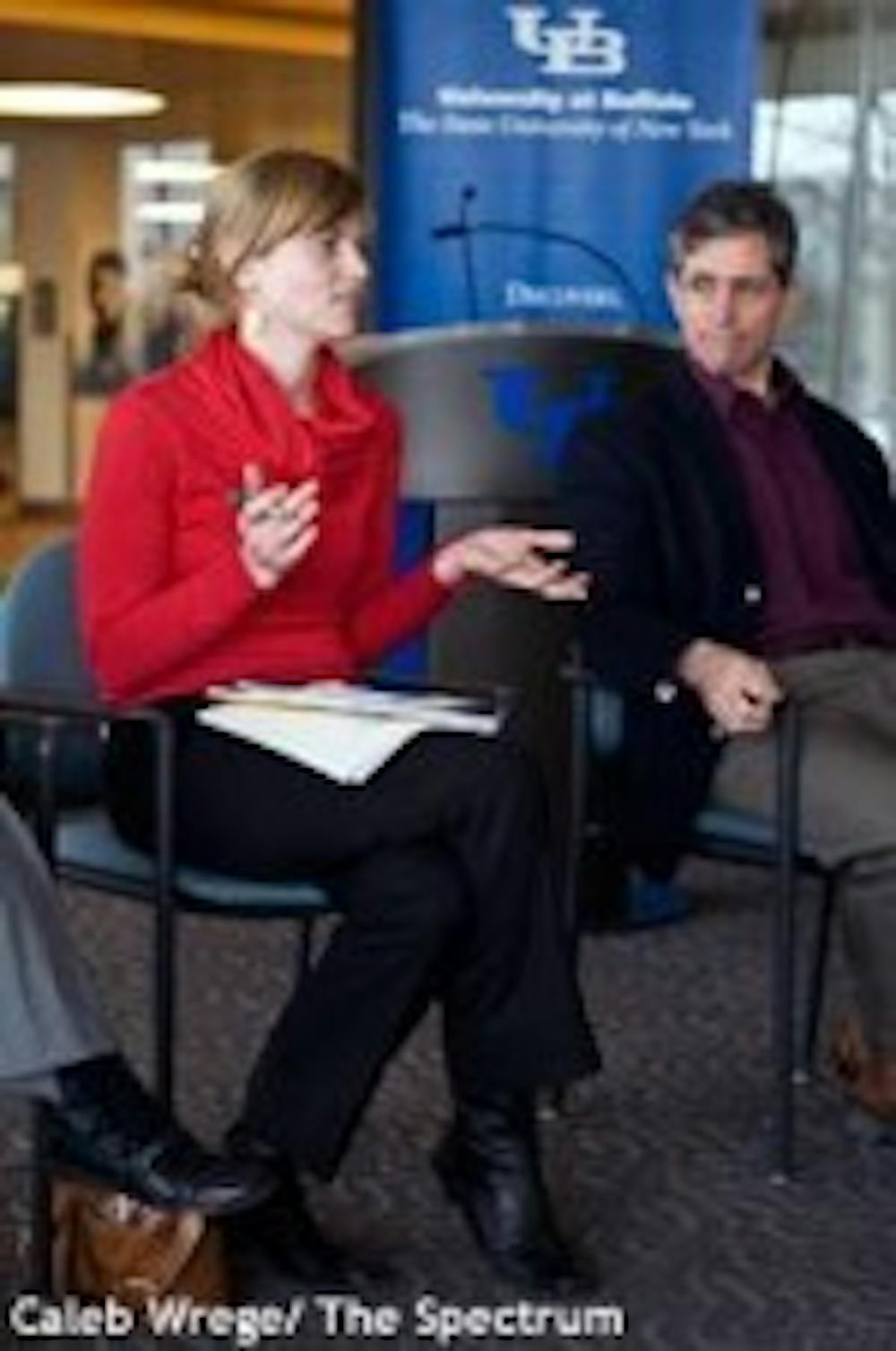
The Returned Volunteer Panel from the Peace Corps was honored Tuesday as part of Peace Corps Week at UB. Five panelists met in the Capen Undergraduate Library and discussed their individual experiences during their service.
The Peace Corps was established in 1961 by Pres. John F. Kennedy to promote world peace and friendship, according to Peacecorps.gov. The mission of the organization is to have trained people help those in need, promote a better understanding of Americans and better understand other peoples internationally.
Tim Hartigan of UB's Center on Rehabilitation Synergy went to Thailand for his service in the Peace Corps during the time when George H.W. Bush was President. Hartigan was a high school teacher when he went to Thailand to teach English.
Diane Hardy, a UB International Student Adviser, had a different experience traveling to Romania during her time in the Peace Corps. Hardy worked in the environmental studies field collaborating on projects in middle schools dealing with environmental issues.
The director of international student and scholar services at UB Ellen Dussourd taught English to the French-speaking people of Cameroon in the Sahel in Africa. Dussourd said that the country is very different from the US because of the number of cattle and the lack of electricity.
"I did not find my town for the first six weeks," Dussourd said.
Michael Marrone, UB's associate vice president for development, served in the Peace Corps in Liberia as a rural water technician. His daily challenge was to find a way to make the drinking water safe by building wells and spring boxes with limited resources and no electricity. He formed a crew of people possessing different skills and educated the people of the town about safe drinking water and health.
"It took me about six months or so to realize you're not going to change the world here," Marone said.
Everyone on the panel not only had to adjust to some very different countries, but also had deal with language barriers.
"I didn't know a word of Romanian going to Romania, but you learn it pretty quick because you're forced to," Hardy said.
Dussourd said that Cameroon and Canada are the only two countries that are bilingual in English and French.
For Marrone, living in Liberia under military dictatorship was not a typical experience. He contracted malaria twice and had to talk his way out of going to jail with some soldiers when on assignment in Liberia.
"There were days my truck would break down in the middle of nowhere," Marrone said.
The panelists unanimously said the challenges are endless during service in the Peace Corps.
Small and Dussourd rode bicycles for transportation around the town. Dussourd said she did not feel safe riding at night because there were packs of stray dogs wandering around town.
Small said that race was a big challenge to overcome in her town because she was the only white person present.
Despite the hardships, many panelists said that their experience enhanced their lives and careers. Hardy said that after serving in the Peace Corps she knew she wanted to go into education and is now working toward her Ph.D. at UB.
"It's been a fantastic experience working with international students coming here (to UB)," she said.
Small also believes her experience in the Peace Corps has broadened her views of the world. She enjoyed learning through her students and her host family.
"I joined the Peace Corps because I always knew I wanted to, I loved learning about new cultures and traveling," Small said. "I've realized how complicated some issues are that I didn't realize before like HIV and AIDS."
Diana Cummings, a junior humanitarian major, has already has studied abroad and is getting more involved with the Peace Corps.
"It's something I want to do and I'm hoping it will cover my loans, I'm up for anything," Cummings said.
The Peace Corps entails an approximate two-year service with a living stipend, varying in dollar amount depending on the country in which you serve. Shannon Small, the area Peace Corps recruiter suggests that students apply to the Peace Corps a year before graduating because of the eight to nine month application process.



