
Walter Simpson, university energy officer and UB Green's director, teaches about living a green lifestyle at UB every day. The day doesn't end when he packs up his briefcase at 5 p.m. though. For Simpson, teaching others to make environmentally friendly choices is all about living by example.
Simpson's home is proof that one person and one family can make a difference when it comes to reducing global footprints.
Simpson's home is a state-of-the-art eco-friendly household, with solar panels on the roof, super-insulated walls and high-tech windows that let sunlight in and little heat out. By having a large window wall facing the sun, Simpson and his family rely very little on their furnace, even during the coldest months of the year.
"Most of the windows are facing south. On a sunny day, the house is filled with sunlight," Simpson said. "It's a system called 'passive solar.' The windows are large and facing the right direction. We're running on sunlight."
Simpson's backyard has a clear view of the sun during the day, with only minor obstructions. Additionally, his windows are super-high performance and designed to keep heat in.
"The windows have three layers of glass and two extremely thin, invisible coatings of metal on them that reflect heat back into the house," Simpson said. "Yet the layers of glass are still transparent, allowing the sun's energy to enter the house. The house requires very little heat - the sunlight is enough to heat it, even on a very cold day."
Insulation is key to utilizing sunlight to heat a home, Simpson said.
"The reason why the sunlight works so well is because the house is so well insulated and requires very little heat in the first place," Simpson said. "When we moved in, we literally tore the house apart to insulate it."
According to Simpson, thick walls and high-tech windows give his home two to three times more isolation than the typical home.
"The higher the R-value, the more effective insulation is," Simpson said. "As a result, we only use the furnace a little at night - not a lot though."
The R-values of the attic, walls, and windows in the Simpson household are 50, 30, and 7, respectively, compared to 20, 11 and 2 in a typical house.
Similar green homes may use this high insulation model, called a super-insulated retrofit. With thick walls and super windows, Simpson is able to avoid the cold drafts that typically run through most homes, causing constant heat loss and discomfort.
"Big windows bring in energy instead of letting it out. The house is bathed with sunlight during the daylight hours; so much so that there's no reason to turn on a light."
Above the large south-facing windows are overhangs and an awning, which also allows the home to be reasonably comfortable during the summer without air conditioning. The overhangs allow sunlight in when the sun is lower in the sky (during the winter) and limit it when the sun is higher (during the summer months).
"We don't use air conditioning, we use fans in the summer. Air conditioning is a huge source of energy consumption," Simpson said. "If you don't mind a few warm days, it works just fine."
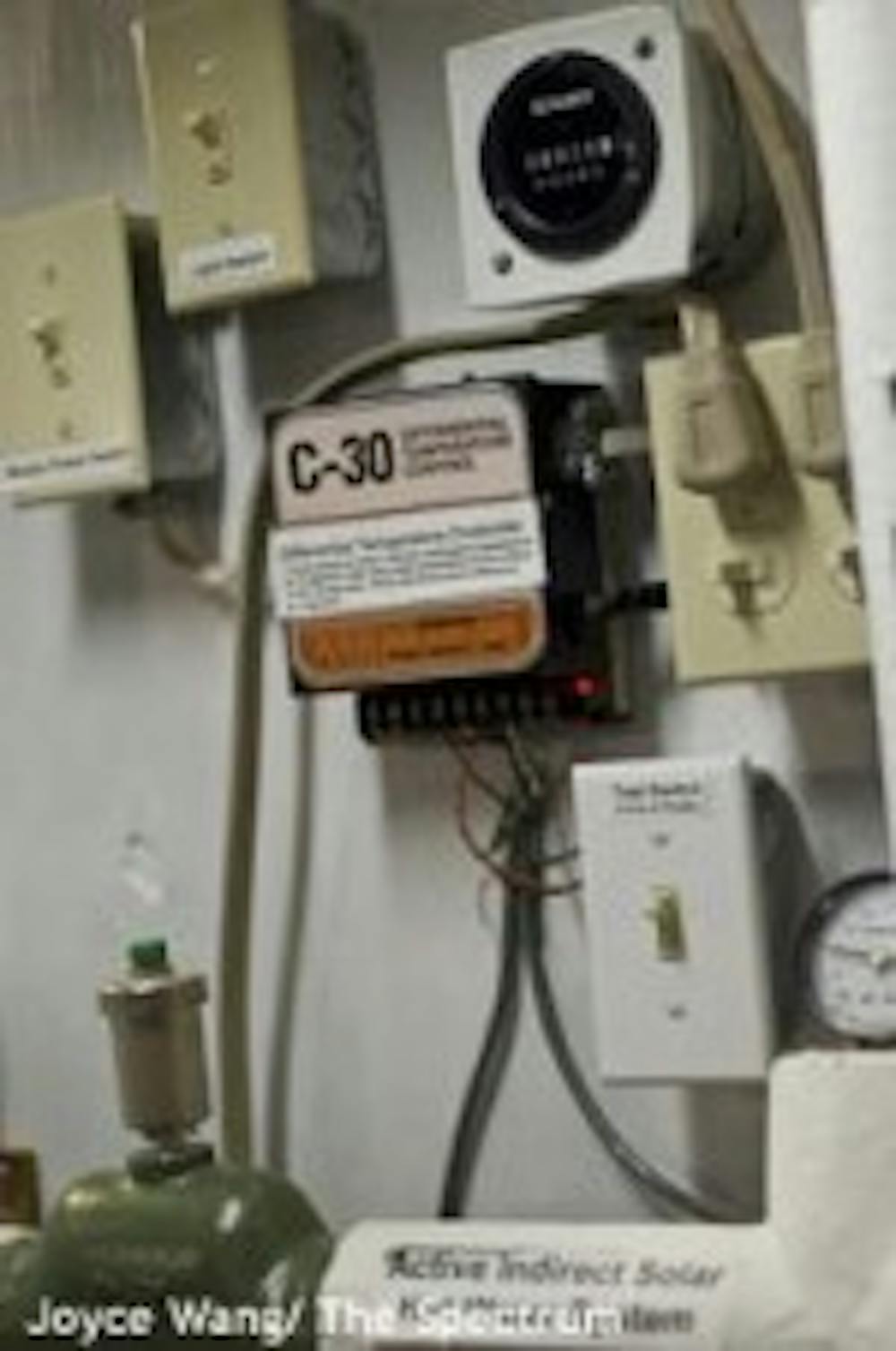
Simpson's home relies on sunlight in other ways such as solar panels on the roof that provide electricity for the whole house (called solar electric photovoltaic panels). Another type of solar panel on the Simpson house produces hot water from solar energy.
"The roof is not steeply pitched so the panels are optimized for spring, summer and fall when the sun is highest in the sky," Simpson said.
Solar panels work year round, despite being frozen in the cold months of winter. Energy production will improve as soon as the panels shed snow, according to Simpson. During the summer months there is an excess of energy production, with the solar panels providing more than his family of four could possibly use. During those periods, his electric meter spins backward and National Grid buys his excess electricity and puts it to work serving his neighbors' homes.
Simpson's investments have resulted in substantial savings for him and his family. For all 12 months of the year, Simpson said his family's electric and natural gas bill is less than half of the bill of an average household.
The features of his home, though costly, have a payback value in savings. The insulation project, which cost approximately $20,000, already paid for itself, he said. Other projects, such as the triple glazed windows, which cost $10,000, solar hot water, which cost $6,000, and the photovoltaic solar electric system, which cost $19,000, have varying paybacks while producing substantial energy savings. The cost of some of these energy features was discounted because of state incentives and tax benefits.
"The net cost of the solar electric system was only $5,000 because of state incentives and tax credits," Simpson said. "We get 75 percent of our electricity from it, and we're hoping for 100 percent after we take additional conservation steps to use less electricity. Even on the coldest month of the year, we only have a $100 heating bill. It's all led to substantial savings."
Simpson and his family also made simple changes to their lifestyle, which have benefited their health, home and budget. He, his wife and children are all vegetarians, which reduces their footprints on the environment. According to Simpson, cutting back on meat consumption reduces the amount of grains used to feed animals, which will later be eaten. This in turn saves water and energy and reduces carbon emissions into the atmosphere.
Additionally, the family monitors their energy usage daily through the use of a meter in their kitchen.
"The Energy Detective, which is a meter in our kitchen, tells us at any given time how much electricity we're using," Simpson said. "It encourages us to conserve and turn things off. You can think about what's on and what's off in the house and make changes immediately. Otherwise, you have to wait until the end of the month when you get your bill, when it's too late to fix anything."
Simpson recommends all families invest in a similar meter to monitor their own energy consumption. The first step to make changes and conserving is to know how much energy you're actually using. Being an environmentally friendly and a carbon-neutral household doesn't mean that lifestyle need be drastically altered to make positive changes.
In his home, he uses fluorescent light bulbs, which are four times more efficient, an Energy Star refrigerator, which is two times more energy efficient, and a horizontal axis clothes washer, which uses less than half as much water as a conventional washer. "A lot of what we have in our house is conventional. It's the way we operate which is different from the average family," Simpson said. "We keep things off when we're not using them. We've discovered it's possible to lead a normal life and still use significantly less than half of what the average family uses."
Simpson also drives a Toyota Echo, which drives at about 40 miles per gallon. His home is located between the two campuses, cutting down on travel time and mileage.
"We live between the two campuses, which was no accident. We were very deliberate about where we wanted to live," Simpson said. "Some people commute 200 miles plus per week, whereas I could walk, bicycle or drive two miles to work. Where you live and where you have to drive makes a huge difference on your environmental impact."
According to Simpson, students can make changes that will benefit the environment too, even if they live on-campus or in an apartment. He encourages students to get politically involved in the fight for a greener campus and to reduce carbon emissions in the US.
"There is a very important election coming up, and students should find out who stands for what and get involved. Getting involved politically is the most important thing students can do," Simpson said. "A person shouldn't even be running for office if they don't have a plan for the environment, and students should keep that in mind."
The thing that could lead to major changes on campus is student activism and involvement, Simpson said. UB is one of 500 colleges to sign a pledge committing to achieve carbon neutrality at the quickest possible date - a very important step in making UB a more environmentally friendly campus, he said. "Climate change is the most important issue we face and students can make a difference on and off campus."
Simpson is currently putting the final touches on his book, The Green Campus: Meeting the Challenge of Environmental Sustainability, an extensive anthology for which he served as editor. It contains a number of his own articles plus the writings of other national leaders in the green campus field. The topics covered include climate change, campus energy conservation, renewable energy, green purchasing, green building design, recycling, and sustainable grounds and transportation issues.
"UB has had an excellent green campus program as a result of decades of hard work by many people," Simpson said. "I am, however, concerned that in the last few years we have not kept pace and have slipped behind many other colleges and universities whose leadership has strongly backed expanding green campus programs."
Other schools are investing in green. Simpson points out that Harvard University, for example, has 19 staff members in its green campus office compared to UB Green's three.
While he is glad that UB President John Simpson signed the campus climate pledge, Simpson believes that there are other energy and environmental areas where top-level support has been and continues to be needed. He feels that his green teams have been unable to get the attention of the administration.
The environmentalist encourages students to demand a greener campus, through new programs and policies, including a policy (like at Princeton University) that requires all offices and departments to use 100 percent post consumer waste content recycled paper.
"For five years (going back to Bill Greiner's UB presidency) our campus environmental task force (which Walter Simpson chairs) has been asking the administration to support this policy," Simpson said. "Students should start to demand these things and shouldn't be satisfied. They need to organize themselves and demand a greener campus."



