
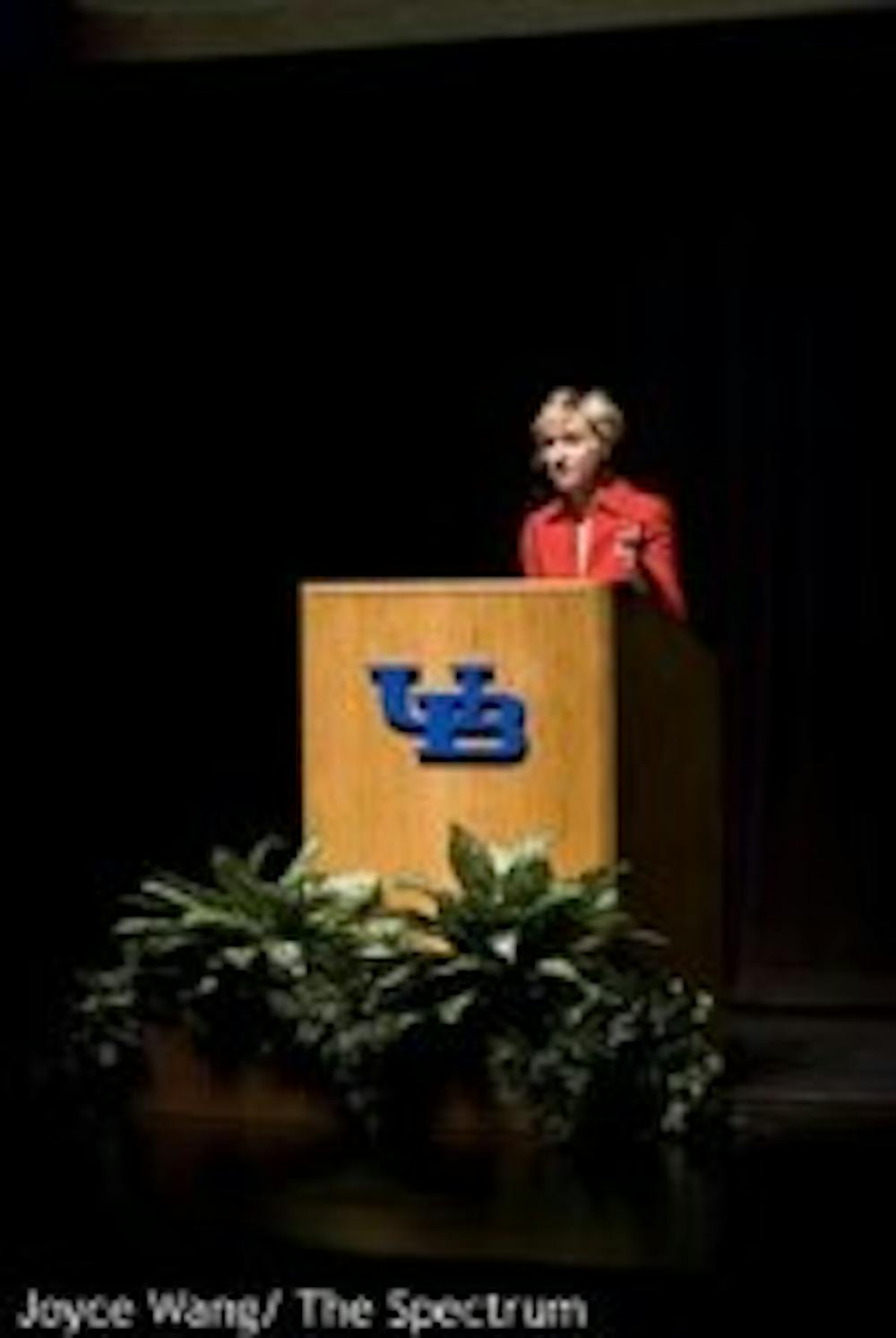
As a writer, Tina Brown has told the juicy details of the lives of the rich and famous, and as the fifth speaker in UB's Distinguished Speakers Series, the former editor and bestselling author did the same.
Focusing her talk solely on the subject of her New York Times bestselling book, The Diana Chronicles, Brown wove the story of Princess Diana's life beginning with her childhood and ending with her untimely death.
"There is nothing new that can be emerged out of the death of Diana," Brown admitted. Brown went on to give the audience a glimpse into the life of a woman she knew personally - a life that was entangled with the celebrity-hungry media that Brown herself was a part of.
Brown's own biography is the stuff of journalists' dreams. Beginning her career in the media business before her graduation from Oxford in 1974, she was the editor of Tatler, a British society magazine, at age 25. She went on to take charge of Vanity Fair in the 1980s and then The New Yorker less than a decade later, becoming their first female editor in chief.
Brown's quick wit and unforgiving opinions of celebrity culture brought laughs from the crowd, made up mostly of UB faculty and community members, when she drew comparisons between Princess Diana and the "Pop-tarts in rehab" that clutter the magazines of newsstands today.
"Diana was the first great glamour icon to live and die in the age of round-the-clock media," she said. An aspect of her life, Brown noted, that the princess mastered as if it were an art form.
Nowadays with reality shows that serve as breeding ground for instant star status and magazines competing for the dirtiest gossip, it seems the hunger for celebrity news has only become more ravenous.
"Everybody's famous and nobody's interesting," Brown said. "It's just too much media. There aren't enough celebrities to go around."
She went on to comment in response to an audience member who asked whether or not the future of magazine success lies in the ability to dish out the latest celebrity gossip.
"There's always a great quest to learn about lifestyle and private life, but very little interest in what people actually do," Brown said. "It's almost as if the process of work is no longer of interest and I don't think that's right."
In the 1980s, Brown was at the helm of the celebrity news phenomena, which was just beginning to blossom. She worked her way up to editor in chief of Vanity Fair and revamped the magazine, increasing circulation to more than a million people with her addition of movie star interviews and cultural critiques.
"I think what I did was to show that you can mix the world of celebrities and glamour with that of serious journalism and reporting - a magazine can do both," Brown said.
When she accepted a position at The New Yorker several years later, Brown was happy to join a publication that wasn't interested in putting Madonna on the cover. She assumed the tide of interest in celebrity life would soon recede.
"I thought, 'the world is going to get more serious and thank goodness for that,'" Brown said. "But I was totally wrong about that...it seems there is an endless and inexhaustible appetite."
Though she left behind a legacy of celebrity coverage like the famous photo of the naked Demi Moore exposing her pregnant belly on the cover of Vanity Fair in 1991, Brown took with her to The New Yorker her knack for revitalization.
"That was all about trying to revive a literary giant that needed to be modernized," she said.
Brown fired a slew of writers and hired new ones she thought more suitable, causing one disgruntled ex-employee to refer to her as "Stalin in heels," a title she doesn't deny.
Perhaps her fearless ambition in the face of criticism - an attribute that led her to increase the popularity of The New Yorker as well as Vanity Fair - comes from a rebellious adolescence, which included getting expelled from three "starchy English boarding schools," as she put it.
"I've always questioned authority," Brown said. "That's a good definition of a journalist - someone who's always questioning authority, refusing to toe the party line."
Much of her career was spent as the authority figure, though, with Brown being editor in chief of another magazine, Talk, which she created after leaving The New Yorker in 1998. Brown sees women leaders as an important counterpart to men's leadership styles.
"Women are better than men, I think, at persuading people to cooperate," Brown said. "I think women are better at not being so hierarchical in the way they lead."
In her second book that she is currently working on, The Clinton Chronicles, Brown examines the life of female powerhouse Hillary Clinton, whom she has spent time with on the campaign trail, gathering information and interviews.
"Hillary, like Diana, is a transitional woman between the era of being a woman who was dependent on her husband and a woman who was very independent," Brown said. "They are both blondes who bring a lot of turbulence in their wake."
As for similarities between Clinton and herself, Brown cites "maybe only the hair cut."
Her modest comparison neglects to acknowledge her own enterprising career, and her love for a good debate. Currently a columnist for The London Times, Brown said, "Unless somebody is annoyed, it's not a good column."
Brown closed the question-and-answer session of the night with advice to aspiring journalists, but the wisdom she accumulated from years as a media-industry leader can be appreciated by anyone driven to make their mark on the world.
"You've got to be able to see an opportunity," she said. "You've really got to see not what something is, but what it might become."



