
Common household objects, necessary for a comfortable lifestyle, are generally dismissed as insignificant and go unappreciated. Everyday Splendor, now on display at The Carnegie Art Center in North Tonawanda, presents such overlooked aspects of everyday life in a new light through the works of five internationally recognized artists.
Presented in diverse media ranging from domestic tools to eclectic video and audio clips, and such diverse subjects as psychoanalytical engagement to the ever-present conflict of man vs. nature, Splendor appeals both to the senses and the imagination.
"Initially I didn't really understand it all," said Stephen Millette, a sophomore photography major at Niagara County Community College, referring to the variety of media. "It was a weird mix, but I actually really enjoyed it."
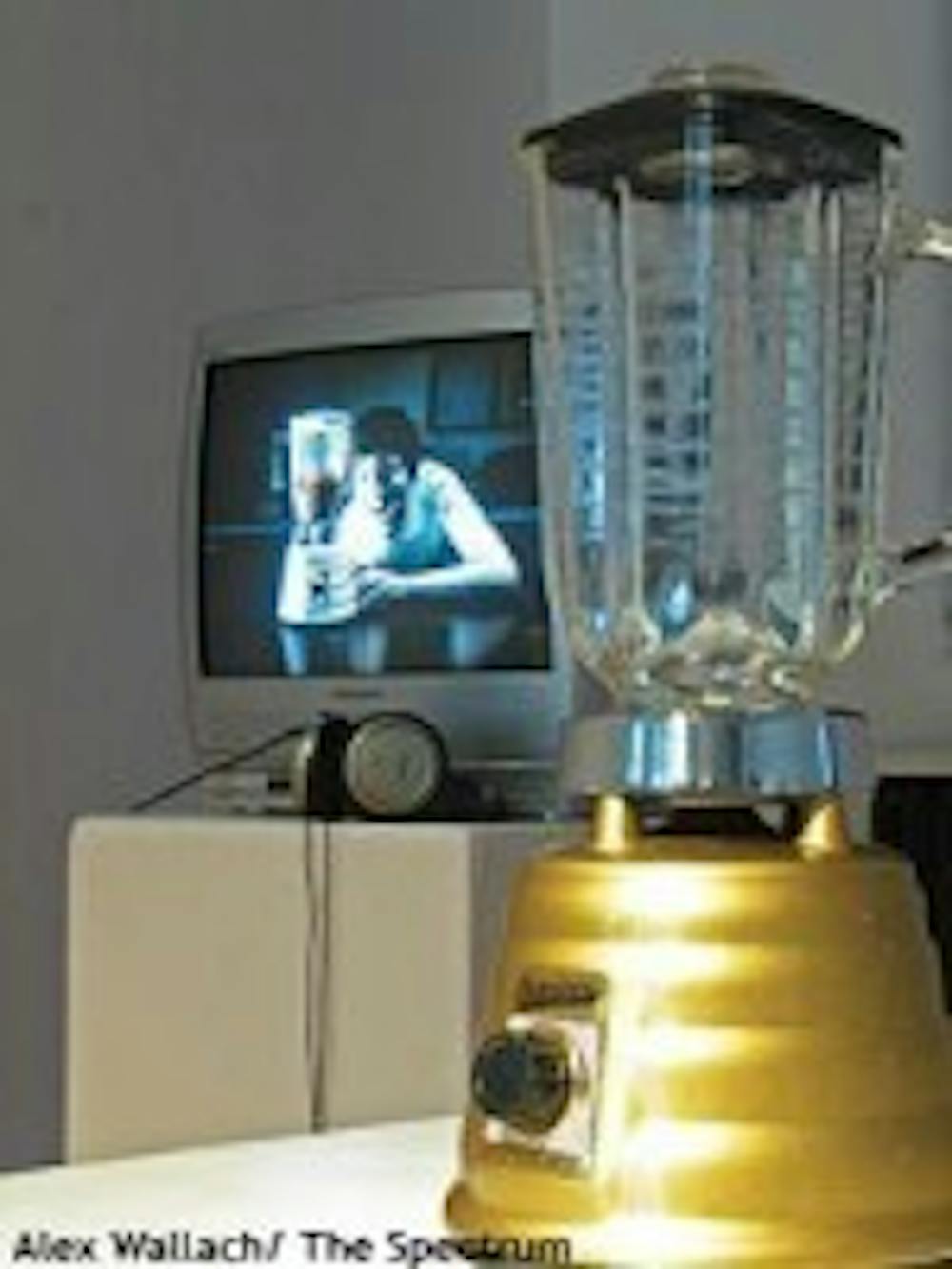
Perhaps one of the most intriguing and bizarre pieces, "Blendie," by MIT graduate Kelly Dobson, illustrates the concept of "Machine Therapy" through a series of video clips documenting the actions of a blender that responds to human interaction. Accompanying the video documentation is a narration written intermittently across the screen, detailing such observations as "the machine allows access to sensorial energies otherwise dormant," suggesting that not only does the blender react to human stimuli, but it also has something to offer to the human senses.
Apparatus for Orchestral Knitting by Baltimore-based Laure Drogoul combines sculpture with an audio/video presentation. The exhibit demonstrates a process in which an "orchestra" of sounds can be created by a group of people knitting with the accompaniment of a bizarre musical device attached to the individual threads.
Poland native Igor Krenz provides simple, yet profound, food for thought with six short films, each depicting the artist himself interacting and experimenting with various objects and apparatuses.
The short and simple visual tricks in Double Disappearance of the Ball in Parallel Space and Only the Left Side of the Screen Exists leave the viewer briefly perplexed. Stone and Can offers the viewer a variety of emotions as they watch in suspense as Krenz attempts to catapult a small pebble into a tin can using a crude contraption.
His succession of seemingly random attempts, and lack of preparation for each, gives the viewer a sense of frustration, hopelessness, and eventual relief as he finally succeeds.
"I liked the way he filmed himself," said Steven Fleck, a sophomore engineering major. "You never see his face, but you can tell almost exactly what he is feeling."
German film artist Corinna Schnitt offers an absurd glimpse into nature's interaction within a human environment with "Once Upon a Time." A camera, slowly rotating in the center of a living room captures the gradual transformation as the room fills with farm animals.
Dogs, cats, goats, llamas, cows and other various creatures begin to take over the house as they enter one by one and begin to destroy everything in sight. The contrast between the calm human environment and the chaos created by the invasion of nature serves as a portrayal of the timeless conflict between man and nature.
Scott Puccio provides the most intimate piece in the collection, an anthology of more than 100 short video clips entitled Films About Buffalo. Accompanied with a legend and a map to determine the location of each of the shots, viewers will recognize notable localities in and around Buffalo.
The silent, jittery images make it seem as though the viewer is witnessing bits and pieces of memories. Blurry images of Buffalo landmarks evoke a powerful sense of nostalgia to any native.
Everyday Splendor's artists, incorporating everything from blenders to barnyard animals, successfully transform the mundane into something memorable.
The exhibit runs through April 5.



