
Since Sept. 11, 2001, the ability to detect when someone is lying has become increasingly important for both individuals and government officials in America.
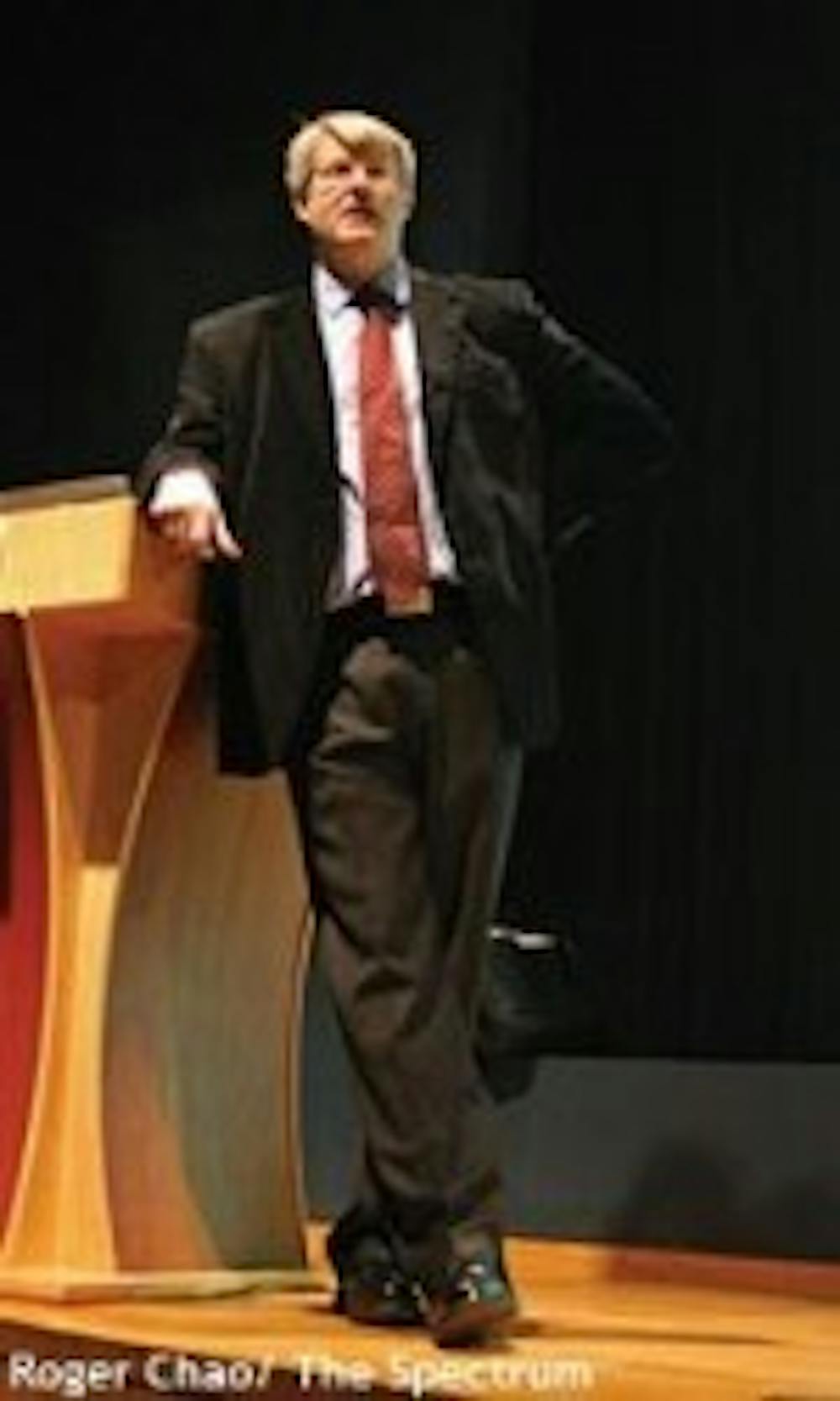
Mark G. Frank, Ph.D., a UB communication professor, has studied the inner workings of a liar, which he presented in his lecture "Detecting Deception in an Age of Terrorism" this past Saturday as part of the Cutting Edge Lecture Series.
During the lecture, Frank cleared up several myths about detecting a lie. For example, many people believe that signs of lying are when a person doesn't look someone in the eye, touches their nose, bites or licks their lips, folds their arms, looks up and to the left, or uses formal denials. Frank explained that these behaviors do not necessarily make a person the deceiver in a situation.
He believes there must be a formal definition of a lie so researchers, and anyone else for that matter, can find successful ways to detect them.
"To lie is the deliberate attempt to mislead, without prior notification of the target," Frank said. "There are many forms of lying such as concealing, fabricating, distorting, dodging through incorrect inferences, and telling the truth falsely."
Cognitive and emotional clues can be used to pinpoint the deceiver. According to Frank, both of these systems are engaged when people lie.
"The cognitive clues such as contradictory statements, hesitations, speech errors, reduced illustrations, contradictory emblems and reduced detail, along with the emotional clues such as distress, fear, contempt, disgust and delight, can be seen in the deceiver," Frank said. "All of these reactions take extra mental effort on the deceiver's end, relative to their normal behavior since some people normally react slower or faster than others."
For example, during the OJ Simpson trial, Simpson was asked if he remembered cutting his finger. His response was that he remembered bleeding. This was a deliberate attempt to avoid committing to a detail and, in other words, lying, according to Frank.
The same was true for the majority of people who voluntarily participated in one of Frank's experiments. The volunteers were asked to go into a room with a briefcase that supposedly contained $50. They were told that if they could get away with lying about taking the $50 out of the briefcase, then they were allowed to keep the money. Of the five scenarios shown at the lecture, two people were truthful and three were caught lying.
Frank attributes these results to the fact that people think they are better at lying than they actually are.
"On average, people are 54 to 57 percent accurate at telling lies," Frank said. "The problem is that people think that they are much better."
During this experiment, some cognitive clues were present in the participants. For example, one participant said that "there was a simple decision to be made" while he nonverbally shrugged his shoulders about seven times. According to Frank, this was a direct indication that he was lying.
There are emotional clues as well, such as a wrinkled forehead - a typical sign of apprehension or the fear of getting caught, and a smile after lying - signifying the enjoyment that came from the lie.
Frank explained that there are a number of reasons why people choose to believe this deception, which could be why people believe they're better at lying than they actually are.
"The failure to obtain impeachable, corroborating evidence of the lie, and the [fact that the] target does not care are just a couple reasons why people believe their perpetrator," Frank said. "Moreover, some targets actually want to be misled. It is hard to believe that someone we know and love could deceive us."
When dealing with a terrorist, on the other hand, some of these clues might become harder to detect than on the average person, according to Frank. For example, suicide bombers, like the ones on the planes that struck the World Trade Center, are not subject to a standard fear of death so there is no fear in lying. In cases like these, some of the blatant emotional clues aren't present.
"In these types of situations, we need to change the way we think about security," Frank said.
Along with the human behavioral analysis scenarios, Frank is also in the process of developing new techniques to detect deception such as thermography heat to determine stress levels and precise tools to identify subtle features of a lie.
The series will continue on March 8 in the Screening Room of the Center for the Arts with a lecture titled "Treasures of the Spanish Main, or the Hidden Origins of American Societies" by Jos?(c) Buscaglia-Salgado, a professor in the Department of Romance Languages and Literatures. Lectures begin at 10:30 a.m. and are free.



