
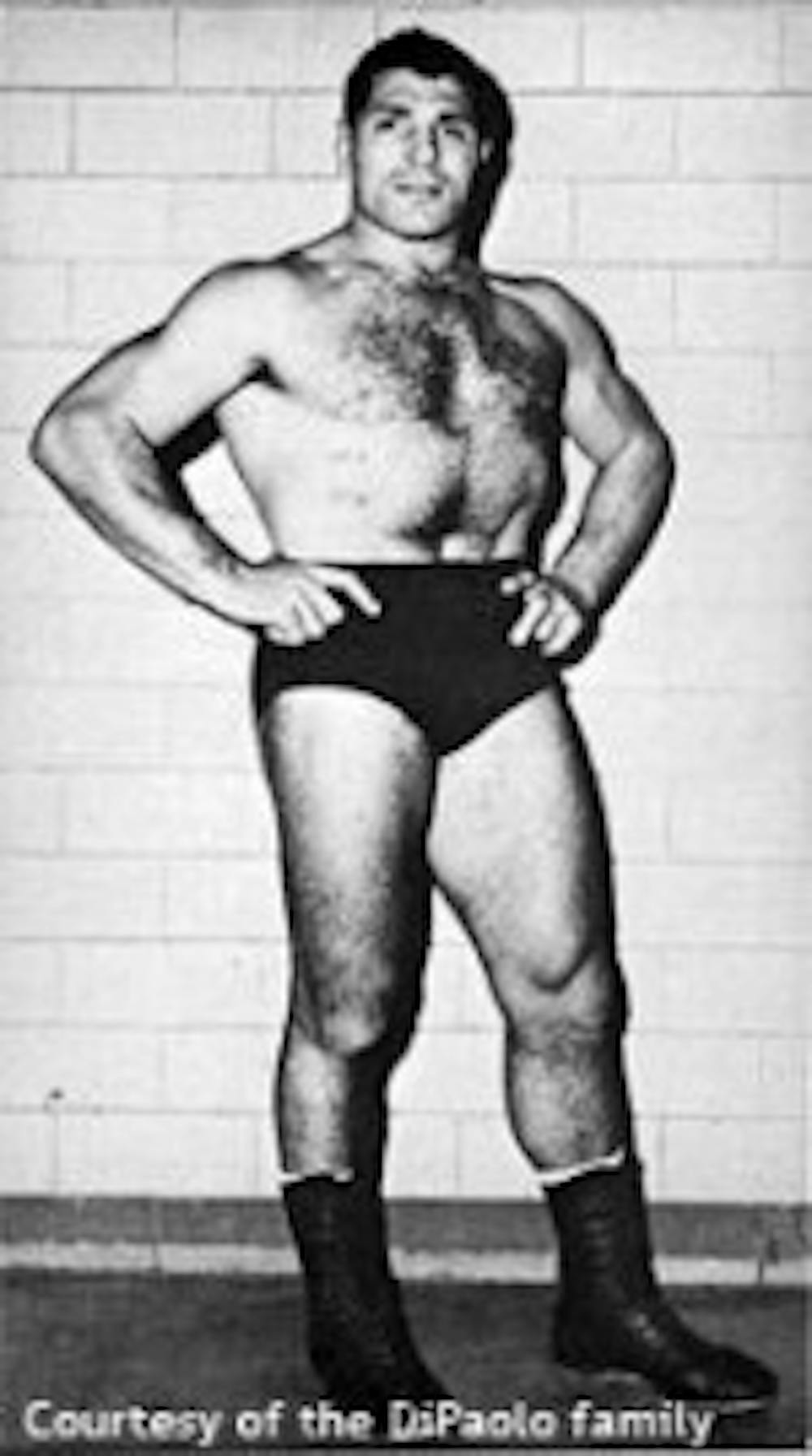
From the shores of Italy to the suburbs of Buffalo, legendary Hall of Fame wrestler Ilio DiPaolo has impacted the lives, health, and appetite of many across the world. After he was tragically killed when struck by a car in 1995, he has left a legacy that will live on for ages. The Spectrum recently sat down with the wrestler's son, Dennis, to talk about his father's life and legacy.
DiPaolo, born in Abruzzi, Italy in 1926, was not initially interested in wrestling, or sports in general. After contracting polio as a young child, DiPaolo needed to strengthen himself in order to live a semi-normal life.
"I remember hearing stories about how my grandparents had to carry him to and from school every day," Dennis said. "He would kick around a soccer ball in order to strengthen up and eventually would participate in track and field, boxing, and finally wrestling."
As he grew older, DiPaolo became an inspiration and a hero to those who lived in his small Italian town. Instead of kicking around a soccer ball, his new training technique was to tear trees out of the ground.
At the age of 18, DiPaolo was named the Italian Wrestling Champion after a victory in Milan. It was there where he decided that he needed to leave Italy in order to further his wrestling career.
In 1949, he traveled to Venezuela. A major event that furthered his career was when he met Tutz Mondt, then-promoter of New York's Madison Square Garden.
"At the time, in order to get to America, you had to go to Venezuela or Canada," Dennis said. "My father chose Venezuela. He signed a contract with Tutz Mondt that would allow him to wrestle in the United States."
While waiting for his papers to enter the U.S., DiPaolo traveled to the Dominican Republic as well as Cuba to better himself as he fought stronger opponents. In Haiti, DiPaolo defeated Amelio Agramonte, a heavily favored Cuban wrestler, in front of 21,000 fans.
DiPaolo's wrestling skills, particularly a Greco-Roman style, helped him throughout his matches. He also was known for his flying tackles, drop kicks, and his "Spinning Fireman's Carry" finish. One of his greatest boxing techniques was learned while also a member of the Italian Army.
His career led him across the world, from New York to Argentina, Montreal to Japan. Wrestling in front of thousands in some instances, DiPaolo preferred fighting for smaller crowds, where he could feel closer to his fans.
"He liked wrestling in small towns," Dennis said. "I remember as a kid, up in Welland, anyone who could touch my father's suitcase or helped him carry it in could get in for free. About 20 children would help and he would say 'Take care of my boy over there.' I remember that a lot about the small towns, with all the kids. He really enjoyed wrestling in those venues, where it would be almost one on one with the people."
As he visited many cities across the world, DiPaolo finally found his future home in Buffalo. He chose the area because of the people, and the sense of family that the area gave him.
"When he first came here, the Italian population embraced him," Dennis said. "When he would get out of his car at the arena, the people would swarm around him screaming 'Ilio, Ilio!' After matches, he would go to the homes of others, drink wine, and eat food with them. This is where he felt home the most, in Buffalo...people still remember him. It's remarkable."
His career flourished as he continued to be victorious in his matches. In Canada, DiPaolo won the Canadian Wrestling Championship with fellow tag-team member Whipper Watson.
A pivotal moment in his career was when he traveled to Japan in 1963. DiPaolo wrestled for 40 straight days, and in the end won the All-Asia Championship with Buddy Hoston against Mr. Togo and Ricki Dozene. Even after winning multiple championships, it was not enough for DiPaolo; he aimed for the World Championship.
"My father's greatest moment was when he went to fight Lou Thesz for the World Title," Dennis said. "It was a highlight of his career."
In his final matches of his career, DiPaolo visited Toronto to fight Pat O'Conner for the World Championship, and then Winnipeg to face Thesz for the World Title. Both matches ended in a one-hour draw, but many felt DiPaolo would lose.
In 1965, after a nagging ankle injury, DiPaolo realized his wrestling career was over, and he returned home to Buffalo. It was here where he realized his new passion: the food industry.
"As an athlete, it's always hardest to decide what time to get out," Dennis said. "He had bad legs, and he realized he needed to get out. He decided he wanted to open a restaurant so he'd never be hungry again, looking back to when he was a child. Moving on, when he had the opportunity to open a restaurant/pizzeria, he did."
It was because of this vision that DiPaolo opened Ilio DiPaolo's Restaurant and Ringside Lounge. For nearly 30 years, DiPaolo would grace the dining room of the restaurant, greeting fans and customers with a handshake and a happy smile, like Rocky Balboa would grace his restaurant. He was great with people, but if you crossed him the wrong way, you were likely to soon to be a victim like those who he wrestled in the ring.
"That's how wrestlers were - you'd have a trucker here that would say some things, and my dad would have to bring him in the back," Dennis said. "True story: he once told me, 'Hey Dennis, get a dime.' And I said, 'Why?' And he said, 'You're gonna need it to call an ambulance when I get done with him.'"
His relationship with his fans and the people in the Western New York community was like no other. His restaurant, a haven to Buffalo Bills players and famous wrestlers, gave a connection that was similar to Ilio's one-on-one relationship with his fans in the ring.
In 1995, while he was crossing the street with his wife, a car slammed into DiPaolo and hurled him 30 feet into the air. His body hit parked car and he died instantly. At the time, Buffalo news stations broke their regular programming to report the tragedy. At his wake, 3,000 people were in attendance, signing their name into his memory guest book. The line to pay their respect was over two hours long, showing how much DiPaolo was loved by those around him.
Looking back on his life and legacy today, DiPaolo graced the hearts of thousands around the world. His statue currently graces his hometown of Abruzzi and his pictures and videos grace the restaurant he once called home. His son feels that the legacy left by DiPaolo is one that everyone embraces - friendship.
"His legacy is that he always cared for other people," Dennis said. "Someone once said, 'Big hands, big heart.' He was an imposing figure when you met him, but once you got to know him, he was your friend for life."



