
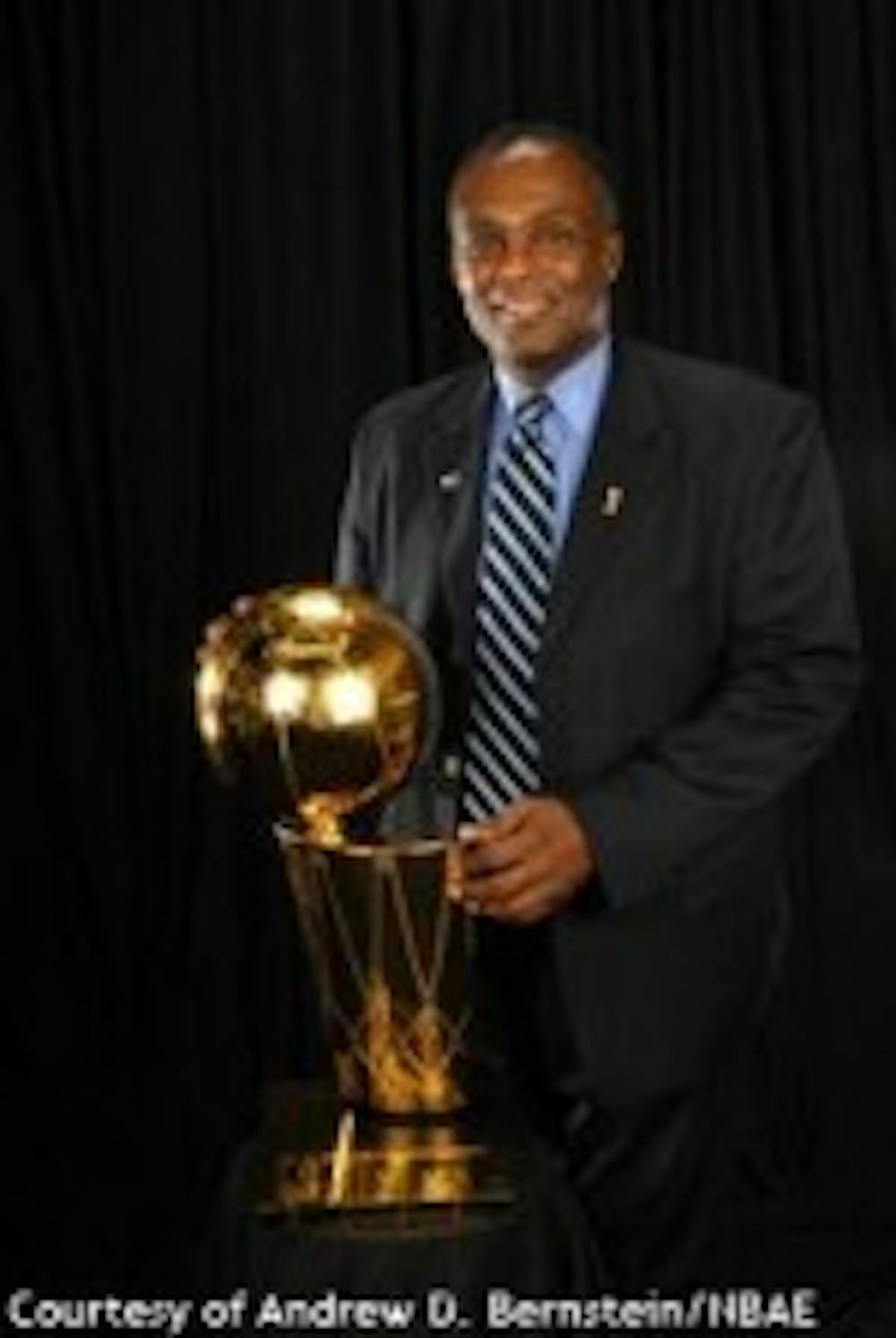
Bernard Tolbert, the senior vice president of security for the National Basketball Association, is a man with the responsibility of protecting hundreds of thousands of people very day. Ranging from players to fans, employees to members of the media, the UB alumnus' sole responsibility is security at all league arenas, including any that host special games or events.
When Tolbert was a student at UB, he never realized his future career would consist of anything involving national levels of security, especially with the NBA.
"I never realized I would work with security, not at all," Tolbert said. "Coming to UB I wanted to be a civil engineer, and bounced around like most people do at that age. I had no idea I'd be doing this."
Tolbert became a Special Agent in the Federal Bureau of Investigation in both New York City and his hometown of Buffalo in 1980. After nearly 20 years at the FBI, Tolbert was appointed the Special Agent in Charge of the Buffalo Division. While this honor meant the world to him, it was one of the catches during this time that defined his career - helping find James Kopp, murderer of Amherst's Dr. Barnett Slepian.
"I had so many good experiences with the Bureau," Tolbert said. "Early on in my career, I had a lot of success with catching bank robbers. I think the case that stands out was the Barnett Slepian shooting. James Kopp, the shooter, was a Top Ten fugitive. To catch someone on the list is gratifying, and certainly something that sticks with you."
In March 2001, Tolbert retired from the FBI, after receiving a phone call from Coca-Cola. The job was the next step in his path towards the NBA.
"I got a call from Coca-Cola and they said they heard about me and wanted me to work in their security department," Tolbert said. "At that time, I was ready to retire and did everything I planned on doing. I figured the timing was good so I went to Coca-Cola."
While Tolbert said that working for Coca-Cola job was a great experience, it did not last long. While he was there, Tolbert received a phone call that would change his life forever - a phone call from the National Basketball Association.
"One day, I got a call from a head hunter saying, 'I have the best sports job in the country and I want to talk to you about it,'" Tolbert said. "I figured he was the head of security for the NFL. At that time, I was leaving Coca-Cola to come back to Buffalo to be Senior Vice President at HSBC Bank, and I told him, 'I'm leaving for a new job, give me a week and I'll call you.' He said no, and that he wants to talk to me now, and I was on a plane the next day to New York."
On August 19, 2002, Tolbert joined the league and succeeded Horace Balmer, who stepped down from his post as head of security. The lives of every single person involved with the NBA are left in the head of security's hands. Tolbert feels he can handle the job because of his drive to work.
"I'm a workaholic," Tolbert said. "I learned a long time ago. My mother told me 'If you're gonna be something, be the best.' It stuck with me. To this day, it's important to me to make sure I give everything I have to give. I enjoy it because there is a challenge. The challenge has to be there."
Having such a job at the NBA has allowed Tolbert to see many highs, while at the same time, many lows. In Tolbert's eyes, Ron Artest's brawl with a fan in 2004 sticks out like a sore thumb.
"That was a very dark moment for the NBA," Tolbert said. "Looking at what happened, we realized that we need to change things we did. As a result of that, we made a Fan Code of Conduct that is at all of our arenas. It is mentioned over the PA system once before the game and once in the second half. That Fan Code of Conduct states that every fan will be held to a standard. We came up with a new alcohol policy as well. We've limited the number of drinks people could have, we ID people, and we cut off serving at the fourth quarter."
While the code of conduct and alcohol stipulations are steps in the right direction, they are not the only decisions made by Tolbert to right the situation that the Artest brawl caused. In addition, Tolbert felt that a court layout needed to be updated.
"We also made some changes physically with the layout, so security in the arena keeps fans from going at the players," Tolbert said. "We then implemented a way to keep players from the fans. This was all done because of the brawl at the Palace."
With the Artest situation being one of the most negative aspects of Tolbert's job, he feels that there are many good things to come from working with such a prestigious organization.
"The biggest plus for me personally would be the traveling I've been able to do, the arenas I've seen, and working with a great group of people," Tolbert said. "Getting a chance to travel around the world with the NBA, working in every corner of the globe, it's amazing. I've been in South American countries, Asia...I feel I've gained a lot because of the experience. Another cool thing is having a player walk up to me and give me a hug. It's really neat."
Even while traveling across the world, Tolbert feels that no place can compare to his hometown of Buffalo.
"I don't want to sound corny, but Buffalo is just, to me, the place to be," Tolbert said. "The people in Buffalo are simply amazing, the winters are long, but you got great people. Buffalo is forever a part of me. I tell people the day I leave the NBA, I'm out of New York, I'm gone - I'm going back to Buffalo."
With unimaginable amounts of pressure on Tolbert's shoulders, Tolbert feels the need to give back to the community as much as possible. He started working with the Cradle Beach Camp 49 years ago, and he's still active with the camp today. Cradle Beach Camp is a Western New York summer camp that helps children with physical, emotional, and social developmental disabilities. In addition, Tolbert annually sends clothing to less fortunate children in the Buffalo area.
"Giving back to the community is very important to me," Tolbert said. "If I can just, in a small way, do something to make it better for someone else, it's the right thing to do. I just sent probably, in the past two days, about eight big boxes of clothing and toys from the NBA to kids in Buffalo. Granted, the stuff might have slight damage of defects, but it's brand new with the tags and everything."
At the end of the day, Tolbert says that he works at his dream job. While he never thought civil engineering would lead to the National Basketball Association, he feels that through hard work and passion anyone's dreams can come true.
"You have to pay your dues," Tolbert said. "Some think that when they get out of school, they get a glamorous, well-paid job. You can't be afraid to start somewhere and make your presence known, or get your foot through the door. If you're a hard worker and willing to put in the time and effort, there's no limit in what you can do."



