
After Guy Ritchie (the bloke behind Snatch) and a slew of less impressive copycats, the hitman/gangster genre that Quentin Tarantino brought to the forefront of America cinema is not just tired, but shot to death.
Who knew it would be a tourist city in Belgium to revive it? In Bruges lingers in the darkest scenes of Pulp Fiction, in a world where contract killers are thicker than any thief, while not necessarily as tough as any nail. The comedic and tragic film was written and directed by longtime playwright and first time feature filmmaker Martin McDonagh.
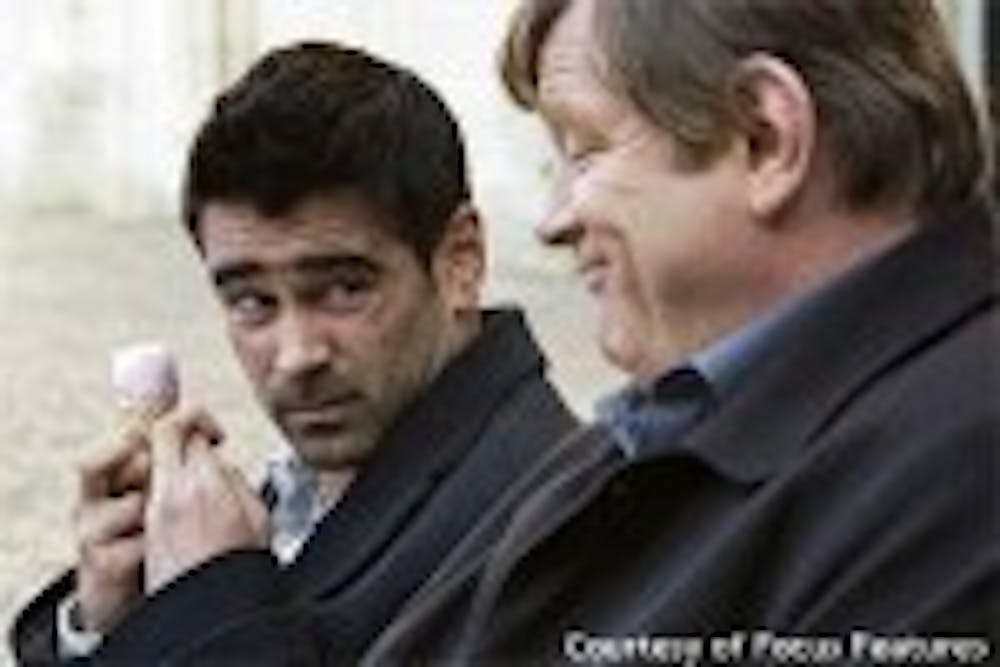
Living up to this description are the film's two leads, Ray (Colin Farrell, Cassandra's Dream) and Ken (Brendan Gleeson, Beowulf), two hit men with flaws as apparent as an exit wound.
After the pair take out a priest in a London church (one of the film's' most disturbing scenes), their psychopathically paranoid boss Harry (Ralph Fiennes, Harry Potter and the Order of the Phoenix) orders them to flee to the Belgium city of Bruges for a couple of weeks.
Unfortunately for Farrell's Ray, the hit doesn't go off without a bit of collateral damage, resulting in the film's interesting conflict.
At surface level, the movie entertains throughout. The film works as a dark farce existing in a moral calamity, a common theme in many of McDonagh's award-winning plays.
And while the deeper meanings in the film appear disjointed and slightly flawed by the film's end, they all work together to make Bruges a "hitman" film all its own.
Farrell, at first irritating as the whiny Ray, falls into his character quickly, playing off of Gleeson's Ken with undeniable chemistry and playfulness. After a few years full of big misses (S.W.A.T, Daredevil, Alexander, Ask the Dust) and small hits (A Home at the End of the World, The New World), the Irish Farrell is slowly beginning to reestablish himself as an actor to watch; he proves his worth here amongst accomplished greats Fiennes and Gleeson.
While offering up far less gunplay and bloodlust than one would expect from the film's premise and misguiding, action-packed trailer, In Bruges finds a pace that is far from slow. The editing is patient - a refreshing change from the quick cuts action films have recently been built on (think The Kingdom and Cloverfield).
McDonagh builds his film instead on dialogue and symbolism, allowing his characters to develop through their words and reactions, making the inevitable gunplay much more important and energetic for both the players and the viewers.
As for the metaphor within, be sure to pay attention to the "art gallery scene" in order to fully understand the meaning and foreshadowing intended. McDonagh isn't afraid to incorporate his brainpower into a film as ridiculous as In Bruges. And while there are twists, turns and coincidences within the narrative that may role some eyes, lest not the viewer forget the amount of unrealistic situations Travolta's Vincent and Jackson's Jules dealt with.
This is a world parallel to ours, where guns go off in streets and cops don't exist, dwarfs do coke lines and spout predictions of a "blacks vs. whites" racist world war (yea, that part is in there) and one hit man argues with another hit man over how one should turn to get a better shot at him.
Experience In Bruges at the Dipson Amherst 3, across from UB South Campus.



