
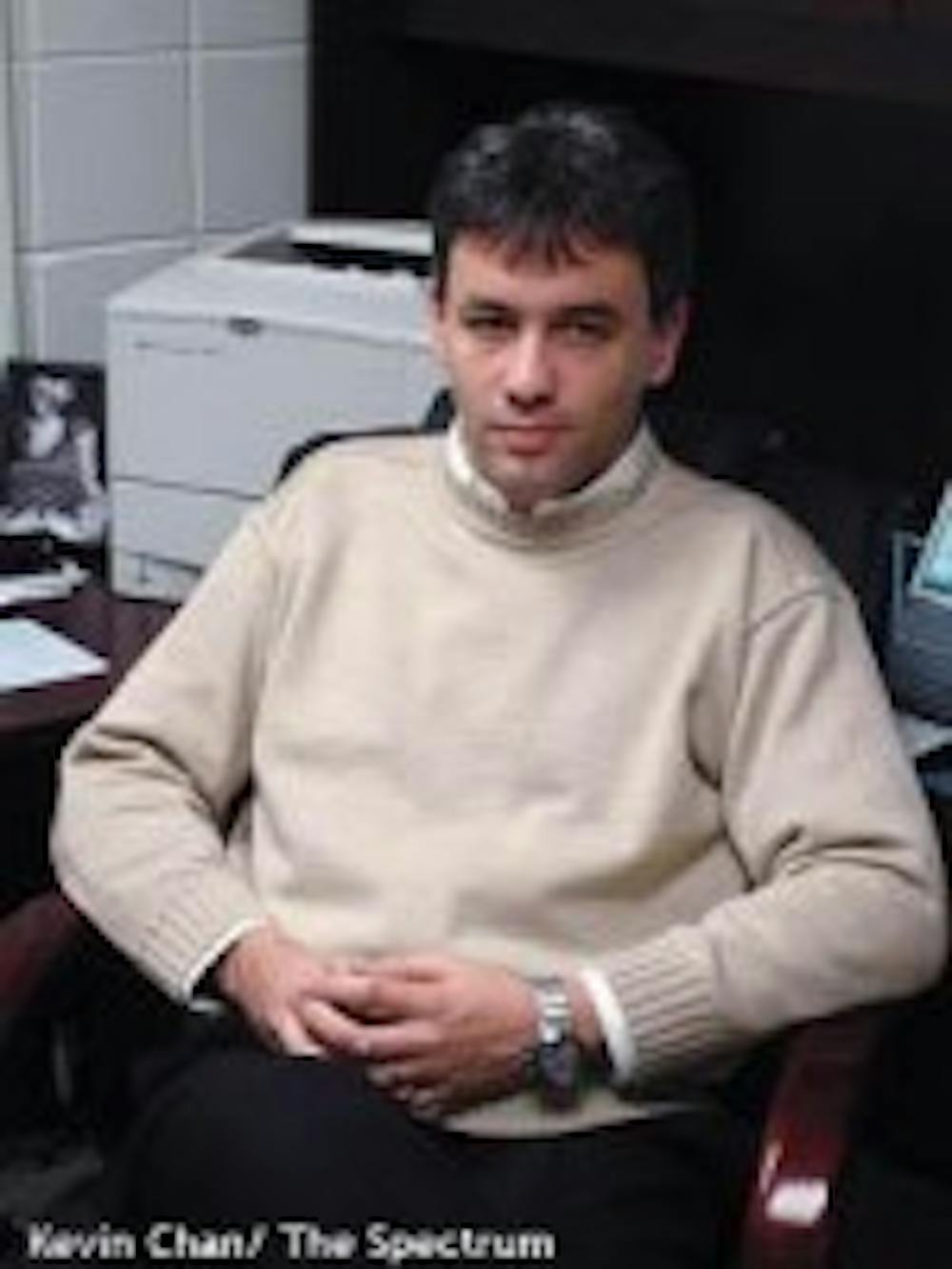
Rome, Italy native and wireless sensor network expert Tommaso Melodia joined the UB faculty as an assistant professor in the Department of Electrical Engineering this semester.
Since his arrival in the United States in 2004, Melodia has researched and received a doctorate degree in electrical and computer engineering at the Georgia Institute of Technology in Atlanta. He also earned degrees at the University of Rome.
Melodia said he chose to come to UB because of the engineering department's strength and the opportunity to conduct telecommunications research.
"It is a nice environment - the University is growing," he said. "The engineering department has great plans."
Melodia has worked to start the Wireless Networks and Embedded Systems Lab since arriving at UB.
"I'm working on establishing the lab and doing some theoretical (and) some applied research on these topics," he said.
Melodia explained that wireless sensor networks involve using small sensors to gather information about an environment and communicating that information wirelessly with each other.
"It involves creating a network of small, inexpensive devices that would gather information about the physical environment and report on it (and) achieve a dense sampling of the environment and communicate via a wireless network," he said. "It would send information back to a place to be used by humans or by machines."
This technology could be applied to many uses in a variety of areas from golf courses to underwater pollution monitoring.
According to Melodia, a golf course could use the devices to monitor the humidity levels of the turf with underground sensors.
"When the humidity is too high, it would activate an underground ventilation system, based on the information from the sensors," he said.
He explained that this type of technology could also be used as a cheaper and smaller alternative for video surveillance.
Current video cameras used for security are large and expensive, sometimes costing thousands of dollars. With a wireless sensor network, devices will be smaller, allowing for a more panoramic perspective of observation. The networks would also consume less energy than the existing cameras that must be plugged into a power source.
"It would be battery-powered and designed in such a way as to communicate without consuming much energy," Melodia said.
He added that this type of technology could even eventually be used to create automated systems for surveillance that would track intruders and communicate wirelessly with robots that could pursue the intruder, though he noted that this type of application is far in the future.
Melodia also taught an undergraduate course this semester on signal analysis and transform methods. The course is primarily a math course that covers the basics of systems and telecommunications.
So far, his experience at UB has been a positive one.
"I have enjoyed it a lot. Some of the students seem to understand what's going on very well," he said. "There are good opportunities here."
However, the transition to Buffalo life has taken some time for Melodia. He moved to Buffalo early this semester, and his wife Violetta and their new daughter, who was born one week before he left Atlanta, joined him later.
"There has been a lot of adjusting to do. I was flying back and forth from Atlanta the first couple of weeks," he said.
Melodia and his family will continue to adjust to their new city throughout their first snowy winter.
"We have never lived in a place where it would snow a lot," he said. "It's been great, though getting worse the last few days."



