
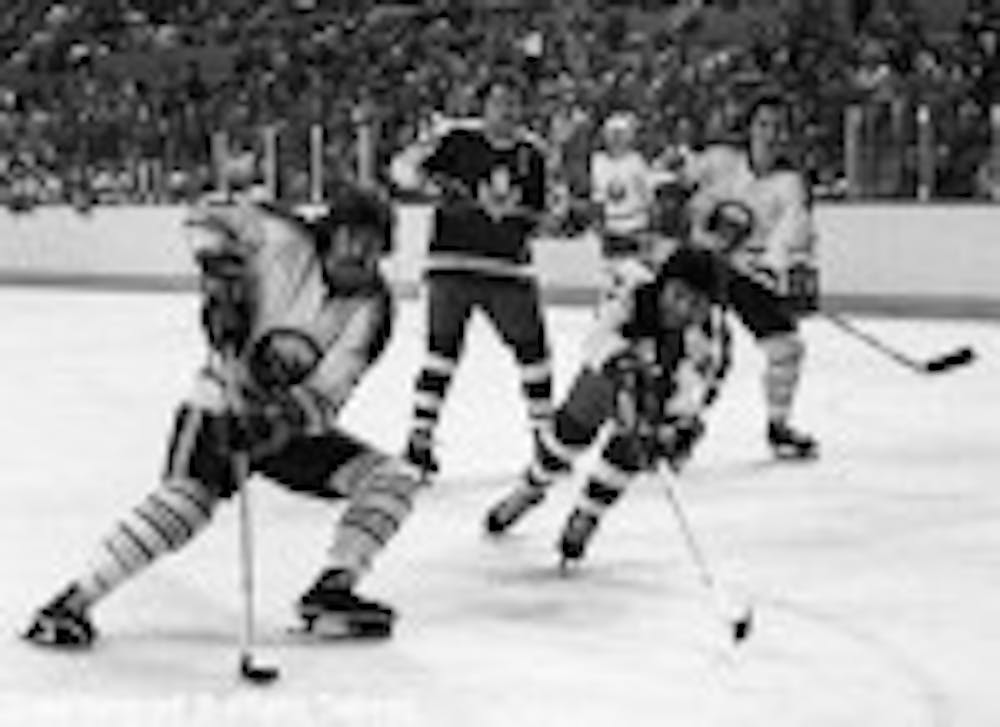
Editor's Note: This is the first of a two-part series.
Rick Martin, a Buffalo Sabres legend, still holds team records for most career hat tricks and most fifty-goal seasons. Martin, part of the Sabres famed French Connection, graciously sat down with the Spectrum to talk about his career.
Spectrum (SPC): You scored many of your goals as a winger via slap shot from the point, why don't we see that more often in today's game?
Rick Martin (RM): The style has changed a little bit. There's no red line now so the plays are developing a little differently...A lot of plays are with guys going up on the rush going more three on twos, two on ones when they do a reverse. We used to be forced to look for openings so a lot of times when I saw an opening I'd just go and I'd wind up one on one, and, well I could score...I worked on my shot every day and I felt I could score from inside the blue line, and I'd feel the same way today. The equipment is a little bigger, and the goalies, the equipment is a lot bigger actually. It's more the material than the equipment itself. It's really light, and it stays dry, so the guys can go three periods and the equipment is bone dry. When we played, the goalies used to have the leather pads, and by the third period they were soaking wet, and the pads would get really heavy.
SPC: Do you feel that you need the mentality that 'I'm going to score when I get to the blue line' in order to be a great goal scorer?
RM: Absolutely. For me, when I hit the blue line, I was looking to go to the net and I was looking to score. That was basically what was on my mind. Most of the guys back when I played who scored goals wanted to score goals and they went for the net that was their mission.
SPC: Do you regret coming back early from the knee injury?
RM: I didn't have corrective surgery right away; it was done about three and a half months after the injury. I tried to play in between, so today it wouldn't have happened. It would have been diagnosed right away, it was just too bad. If I would have seen the doctor that I saw who happened to be in Toronto when I had the surgery, Bob Jackson was his name, he performed 12,000 knee surgeries up until then, so he knew what he was looking at. We didn't have a doctor who performed that type of surgery, so it was just too bad.
SPC: What was it like to play on a wing for Gilbert Perreault?
RM: We actually played together in juniors and he roomed at my house before he came to Buffalo. The hardest thing about playing with Gilbert was not watching him because you'd go 'how the hell did he do that?' He was a great skater, he could take the puck from one end to the other, so we were very heavily checked, contrary to what they say about today's game, where there's no checking in the game right now. I wish it was like that when I played because I would have played a long time, and it's a lot less wear and tear on your body.
SPC: Everyone remembers the 1980 miracle on ice, but your Sabres team defeated the Russians first, in 1976. How special was that win for you and the team?
RM: At the time, they were beating everyone. They had two teams touring the NHL and they were making everyone look bad. We watched a game they played against Philadelphia a couple nights before and Philadelphia embarrassed us because they literally just chopped them, spearing...it was just really dirty hockey, even worse than when we played in the NHL because we would at least fight back. You had the Cold War going on, the Communists, and a lot of guys were Canadians, so we set out to show the Russians that we could skate with them and that we could out score them, and we did.
SPC: How was it playing for those physical Flyers teams?
RM: It wasn't so much the physicality, it was the cheap shots. You'd be standing around and someone would spear you in the back, they'd skate by and spear you, they'd butt-end you, they'd do dirty stuff. Not the stuff you didn't see, the hits don't hurt. It's when a guy hits you in the back of the head with a stick that hurts. It was all the cheap shots that happened away from the play that'd wear you down. I think the Flyers bluffed their way to two Stanley Cups because they won a lot during the regular season because they'd get an easy two points because a lot of teams would be like 'Give them the two points, we want to walk out of here alive, we don't want to get killed. We're gonna play them twice this year, screw it. You can have the two points, I'm not gonna get my players hurt.' That's why a lot of teams suddenly got a lot of muscle men, to offset what the Flyers did. There the ones responsible for changing the way the game had been played. It was mostly intimidation and a lot of cheap shots.
SPC: What do you remember from the fog game?
RM: It was kind of weird. If the puck was coming from the other end of the ice, you definitely didn't pick it up until the last minute. It was hard. That helped play in Philadelphia's hands a lot more than ours because we were a skating team. They wanted to slow us down, well no better way to do that then have to go out every two or three minutes with a towel to get the fog off the ice. It was pretty frustrating.
SPC: How long did it take for you to mesh well with Perreault and Robert?
RM: It clicked the very first time we played - the very first game. We played five or seven games after the trade deadline when they got Rene (Robert) and they put us together and it just clicked. We scored a bunch of goals and it just got better and better. The only problem playing on a line like that is the other teams didn't try to play against us, they'd just shoot the puck down the ice so we'd have to go back and skate all the way back up the ice. We were very heavily checked. Every night when we played a certain team, I knew we'd get their checking line. The guys complain 'there's too much interference and holding these days'...If they would have played the way we played, my stick was in the other guy's hands more than it was in my own hands. They used to grab my stick, grab your jersey; they used to interfere with you all the time. I'd like to see the amount of penalties they'd have gotten if I played these days.
SPC: Who named you guys 'The French Connection?'
RM: It was a gentleman named Lee Cappola, that used to do all the signboards at the top that said, 'goal scored' and stuff like that. The one night after we scored our fifth goal he put 'The French Connection strikes again', and it was a headline in the paper the next morning, and it has stuck forever since.
SPC: Do you think that name added to the mystique of your line throughout the years?
RM: To this day, when we go somewhere, we still do some autograph signings, when we go somewhere, we go there as the French Connection. I'll be out of town somewhere at an airport and someone will say 'Oh, Rick played hockey for the Sabres.' 'Who?' 'Rick Martin, he was on a line called the French Connect-' 'Oh, the French Connection!' They know the French Connection better than they know us individually. It's a great feeling, I guess, having people like the way we played knowing our line like that.
SPC: A lot of people remember the hit you took that started the push for helmets. What do you think about that?
RM: It was a play I was standing at the side of the net, against the New York Rangers. I was looking for a rebound, there was a shot from the point, the puck went around the net, started going back away. I started skating away, and the guy hooked me from behind around my neck, and he kicked my feet out from under me. The guy's name was Dave Farrish, and I landed right on my head. It was a very, very cheap shot. Today, the guy probably would be suspended for a year, if not life, I was out for two weeks, I had a concussion. I played two weeks later, today, probably not for a year because of the concussion syndrome. The very next day, everybody on our team put a helmet on, and the film got around the league, and everyone started wearing helmets.
SPC: If you didn't have to leave the league, do you think you'd be in the hall of fame?
RM: I had 384 goals in 690 games. If I would have played 1,000 games, I would have hit 500 goals. I was scoring with a 60 percent scoring ratio and averaged 44 goals per season. The problem is my career was cut short. They usually like to see more longevity. I wish I could have played for 17 years. If you look at me today I'm still in good shape. I was in great shape when I stopped playing; I had a lot of years left. I was 29 when I got hurt and sometimes you don't always get to do what you want to do, which is too bad. When I stopped playing I had the lawsuit with the Sabres and the NHL, which is a mark against me. I have no regrets, but I do with I could play 1,000 games or 1,500 games. All of the guys from my draft year that played, played about 15 to 21 seasons. It was frustrating how it ended.



