
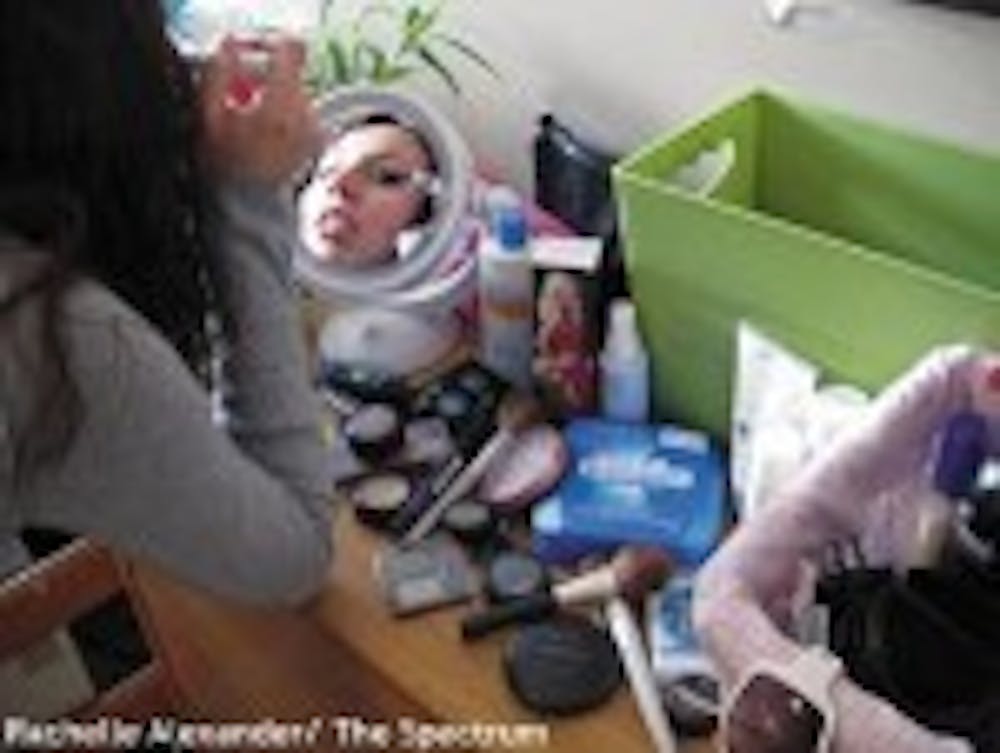
American culture places a great deal of importance on appearance of the human body, especially for young adults. The pressure to look flawless consumes youths and college students alike.
For many UB students, media and society apply pressure to look like one of MTV's reality show stars or to resemble the latest pop icon, which can prove to be too harsh on their body image and self-esteem.
Students say it's important not to let the media affect their self-image.
"Seeing beautiful women in magazines and on television does make me feel a little self-conscious," said Nicole Stranges, a sophomore communications major. "To me, being beautiful is being comfortable in your own skin and being confident inside and out."
According to Stranges, younger guys and girls shouldn't have to worry about how they look every day. Instead they should focus on more important things, like their schoolwork. It's okay to be yourself and carry your own style, but it's important to be comfortable during the day, Stranges said.
Media outlets tend to portray both men and women as flawless and perfect. Being thin is especially important for women, who are also expected to have large breasts, small hips and no "extra" weight on them. Men are expected to be muscular and to portray the typical "tall, dark and handsome" stereotype.
However, some media sources are changing this typical portrayal of women. Television shows such as America's Next Top Model, for example, incorporate women of every skin color and ethnicity, as well as plus-size models into their competitions.
According to Sharon Mitchell, director of Counseling Services, the changing idea of a "beautiful" person can help young adults see their own beauty and find their own identity. Mitchell feels that the media still places unrealistic expectations on women to defy time and aging, as well as the natural physical developments that many women experience.
"A 50 year old is expected to look like a 20 year old. A woman who just gave birth is glorified for returning to her pre-pregnancy weight in the shortest amount of time possible or for looking like she's never been pregnant in the first place," Mitchell said.
According to Mitchell, as a society Americans focus too much on appearances. Six percent of the students who utilize Counseling Services don't like how they look, are concerned about their weight and have an unhealthy relationship with food.
"We get the message, particularly for women, that we should be able to maintain a youthful look throughout our entire lifetime," Mitchell said.
According to Mitchell, the pressure to remain youthful and thin is the cause of many women having poor self-esteem, a negative body image and developing eating disorders. It is important for students to understand that the most important features of other people are not their physical characteristics, Mitchell said.
"How we look is ever-changing; that is the natural course of things," Mitchell said. "Unattainable societal standards can't harm you unless you buy into them."
Mitchell also feels that students should try to view themselves as a whole person who has much more to offer than being a pretty face or a hot body.
"You may be focusing on appearance because it is easier to tackle than the other aspects of your life such as relationship conflicts, figuring out what makes you happy, figuring out your place in the world," Mitchell said.
Students, according to Mitchell, should try to view themselves as a whole person rather than focusing on certain parts of themselves that they don't like.
"You are more than the sum of your body parts," said Mitchell. "Not only do women have to worry about their image today, society and the media have started to come down harshly on men as well. There is more of an ideal image for males today."
Men suffer from unrealistic stereotypes too, explained Mitchell. Males are severely pressured to keep up with the societal image of a guy with a "ripped body."
"A man is supposed to be tall, have broad shoulders, a muscular chest and biceps, strong facial features and a full head of hair," said Mitchell. "We are led to believe that the way we look says something about our personality and social desirability as a friend, leader, worker, etc."
More and more of our society is not only seeing low self-esteem and unrealistic body image problems coming from women, but these problems are also increasing in the male gender as well, Mitchell stated.
According to the American Society of Plastic Surgeons, there were nearly 11 million plastic surgery procedures in 2006. The top five surgeries were breast augmentation, nose reshaping (rhinoplasty), liposuction, eyelid surgery and tummy tuck. Of the 11 million procedures performed, one million of these plastic surgeries were performed on men.
"In my professional experience, people (whose) whole self-esteem is based primarily on their appearance don't reach a point where they are happy with the way they look," Mitchell said. "That is because they are constantly fighting against the natural changes that occur in the body as one ages. And since their new appearance was achieved using drastic measures, they are constantly afraid of re-gaining the weight or being unattractive despite all the changes."
Jennica Conklin, a junior communications and sociology major, feels that the typical stereotypes of the perfect body beget low self-esteem and feelings of inadequacies for young adults. Young men and women are taught to strive for this flawless yet nearly unattainable image, dealing with devastating blows to their perception of their body image when they fall short.
"Advertisements constantly use models with the ideal body type: tall and thin," Conklin said. "This makes things seem more appealing because this is what is stereotyped as beautiful."
Above all, it's most important for students to realize that even if this perfect body image is somehow attained, true happiness must come from being satisfied with the entire package of who you are, not just the appearance of your exterior.
"It's unfortunate what society has come to, but when people feel better about how they look, they are ultimately happier," Conklin said.



