
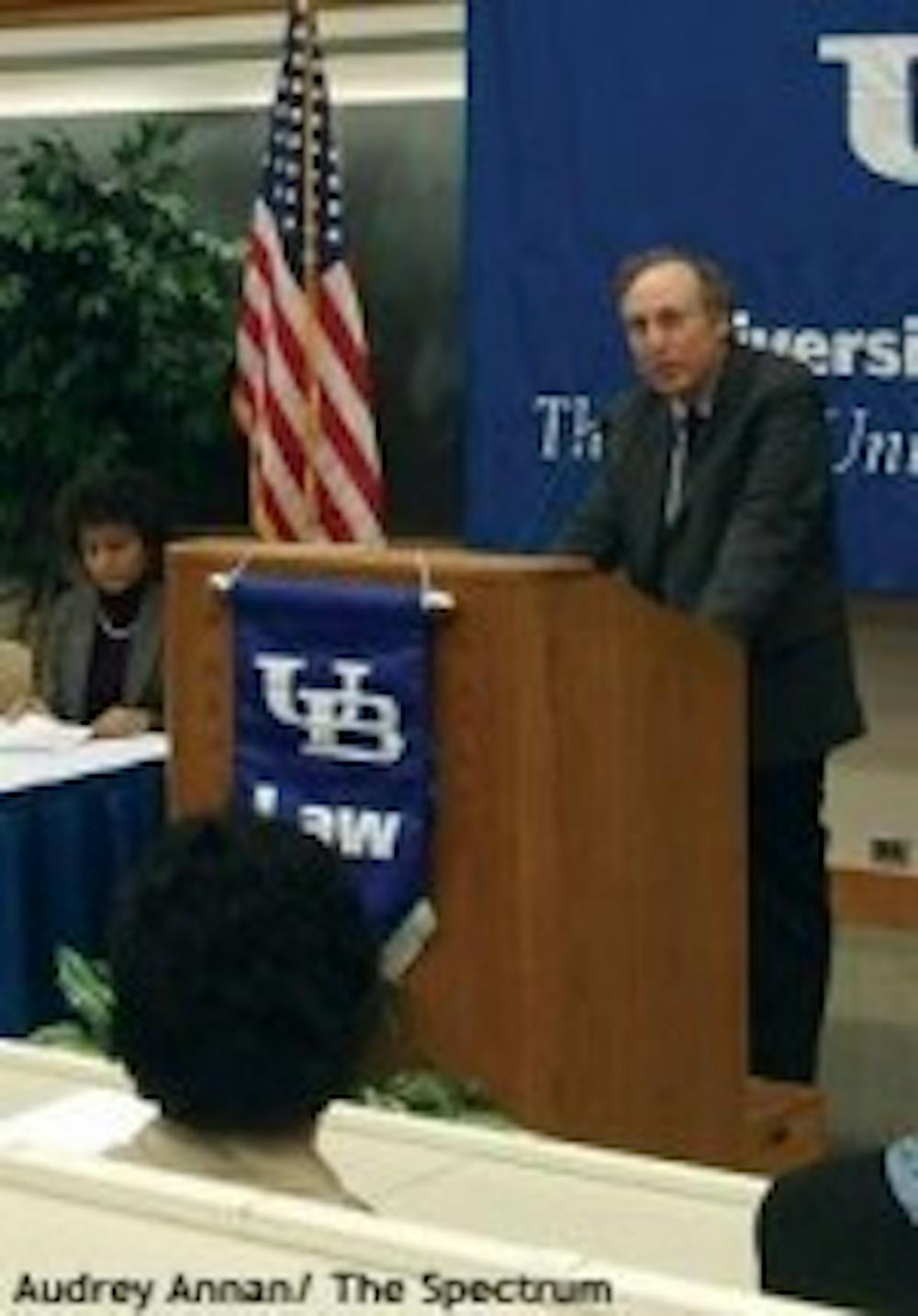
Irene Zubaida Khan, Asian and Muslim Secretary General of Amnesty International, spoke to a diverse group of students, faculty and alumni this past Thursday as part of UB Law School's annual Mitchell Lecture Series.
Having lead missions in most every region of the world, Khan spoke about how fear is used to create power for a select few and restrict the rights of many worldwide. Khan began her lecture, entitled "The Rule of Law and the Politics of Fear: Human Rights in the 21st Century," with a story about her trips to the Pakistani and Afghan borders.
"Fear severely restricts the ability to reason," Khan said. "The biggest threat to human rights and law is fear."
According to Khan, both governments and individuals use fear as a way to intimidate and force others into compliance, which commonly results in terrorism.
"Terrorism is the gravest of human rights abuses," she said.
Khan also discussed fear's role in the War on Terror.
"If indeed this is a war on terror, then the main casualty of the war has been the law," she said.
According to Khan, in an attempt to rid the world of terrorism, the US has put itself outside the realm of international law. US actions have become incompatible with the human rights framework outlined by Amnesty International. Khan cited the use of inhumane interrogation techniques and the refusal of prisoner-of-war status for certain individuals as examples.
"What was once a war crime in US law is no longer so," she said. "The US has tried to redefine torture."
Khan believes that the US has essentially created a double standard for itself, using the fight on terrorism as an excuse for violating international laws. This diagnosis interested Jodi-Kay Williams, a second-year law student.
"I liked her rhetoric on the war on terror," she said. "I think she honed in on that double standard."
The protection of human rights is a basic part of law, and those rights must not be sacrificed in the name of a fight on terrorism, according to Khan. People must promote good governments, the rule of law, human rights, free press and embracing women and the poor worldwide.
"The biggest sign of hope comes from civil society," Khan said. "I believe human rights activists are hope mongers."
The lecture concluded with a question-and-answer session in which the audience asked for Khan's insights on everything from illegal immigrants to women's rights worldwide.
Gloria Almeida, a UB alumnus, was inspired by Khan's presence and her message.
"She spoke about the power of the individual - that we all have to get involved," she said. "She is a very provocative woman."



