
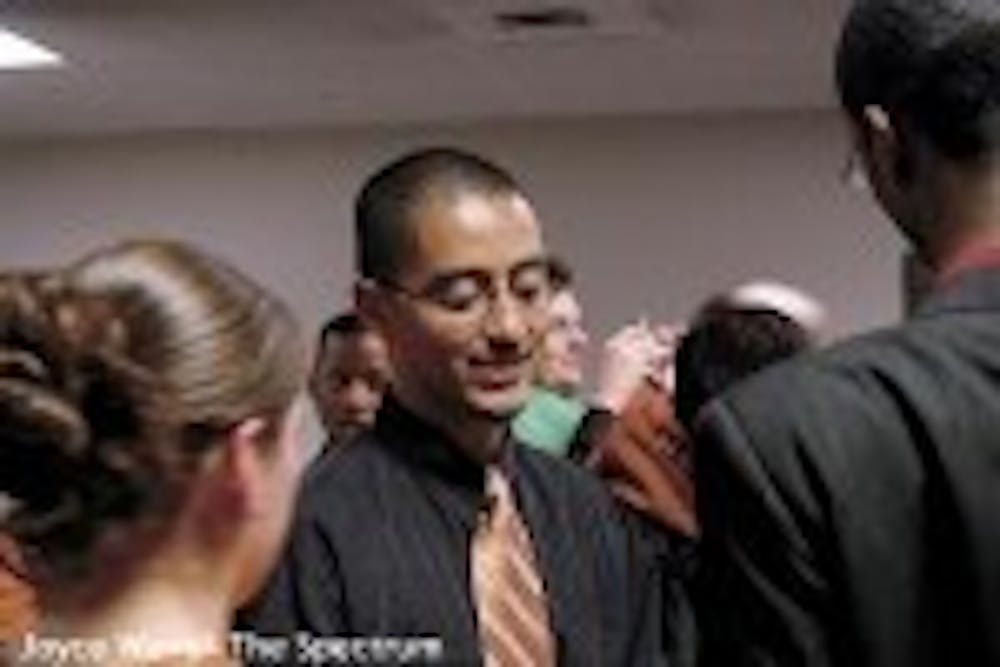
Charges filed against SUNY Student Association delegate and recent SA president-hopeful Christopher Mendoza for allegedly giving alcohol to a minor were dropped by the Student-wide Judiciary on Tuesday.
Mendoza, who was charged with unlawful dealing with a child one day before polls opened in SA elections, was "not surprised" by the decision.
"I wasn't distributing alcohol to any minors," he said. "The SWJ agreed that the story added up."
At the Office of Judicial Affairs and Student Advocacy, Director Liz Lidano is prohibited from releasing information related to any specific student, and was not able to discuss Mendoza's case. Instead, she described the process by which a student is charged by the Student-wide Judiciary and how the charges are dropped.
A police report is obtained after any incident involving University Police, according to Lidano, and if it indicates any immediate danger to students or other community members on campus, the student is temporarily suspended from campus.
"We only do it until we can make sure there's no danger to students," Lidano said.
When this happened to Mendoza, he became ineligible to run for president in accordance with university rules and regulations. He was removed from the ballot until late Tuesday afternoon - the first day of the three-day-long election.
"That one day I lost, I can't get back," Mendoza said.
After being suspended from campus, many students are immediately allowed to return when the SWJ observes no immediate danger or threat to students.
"Occasionally the student can appeal the charges right there on the spot with university police," said Lidano, explaining that charges can sometimes be dropped prior to dealing with the Student-wide Judiciary. "Most students go through the traditional process, though."
That process prioritizes taking responsibility for one's actions, Lidano explained.
If charged, a student appears before the Student-wide Judiciary and discusses their side of the story. The justices decide whether financial restitution is required, and whether community service or other sanctions are necessary.
Mendoza appeared before a graduate student justice, explained his side of the story, and was cleared that day. He has been ruled to be in good academic standing and no longer in violation of campus regulations.
"I think this system was fair and understanding," he said. "It might not work that way for everybody, but it worked for me."
When asked about the first day's results on the election process, Mendoza was confident that the race would have gone differently. "I'm not going to say I would have won the election, but it definitely would have been close."
He doesn't plan on appealing the results of the election.
"I just don't think the student body wants another ordeal," Mendoza said.


