
This is the second part of a two part series on the job of coaching college athletics.
Coaching college athletics is a yearlong job. It is not all game planning, Armani suits, and American Express commercials.
"All too often, kids are looking at it as a profession, and they only see the glamour and the glitz on television," said Buffalo men's basketball head coach Reggie Witherspoon. "They don't understand the work and the service that is required of them."
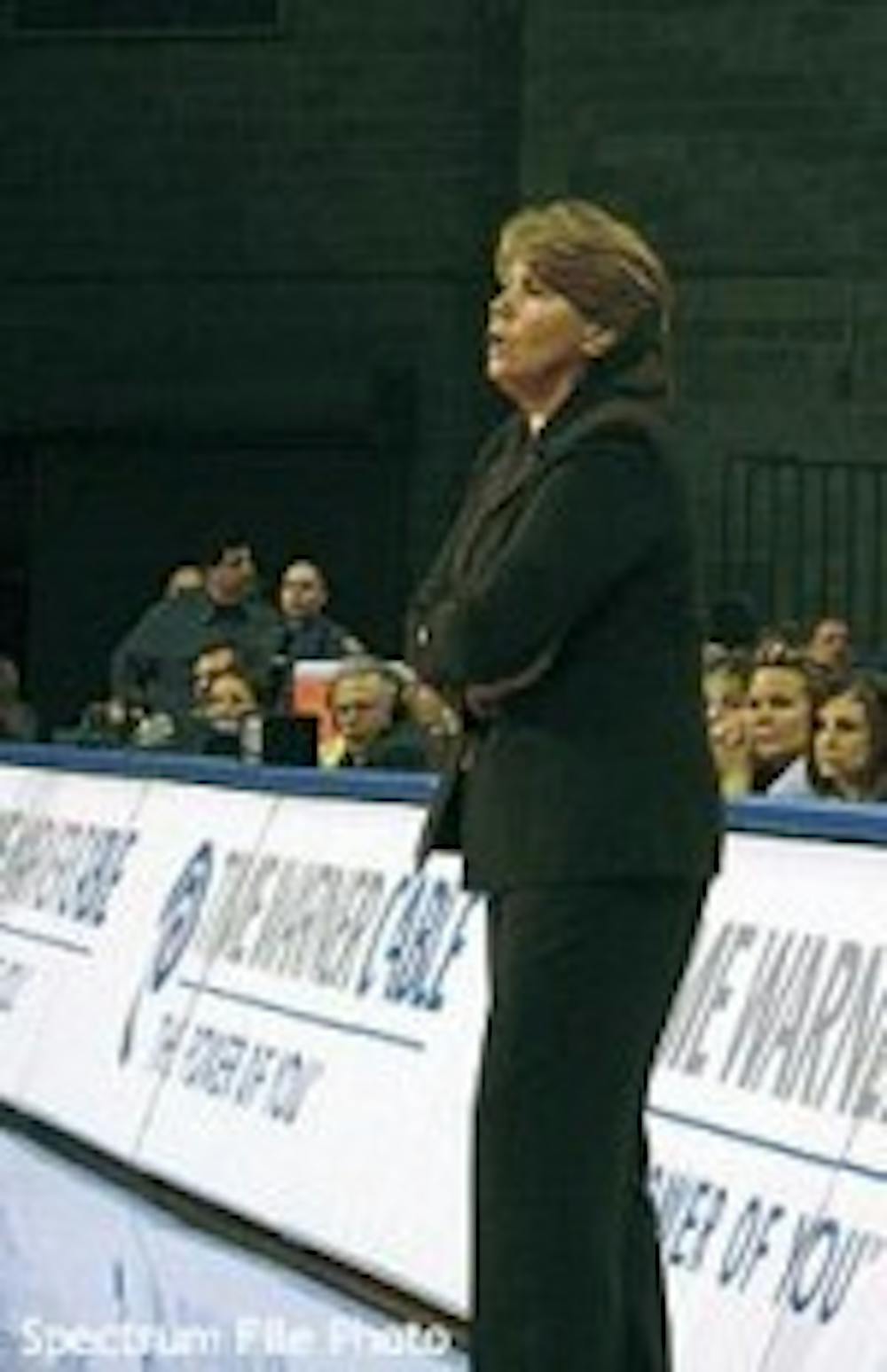
Buffalo Women's basketball head coach Linda Hill-MacDonald agrees that there is a lot of effort that goes into coaching of which people may not be aware.
"It is more that just going out for three hours a day and blowing a whistle and teaching some skills," Hill-MacDonald said. "There is so much involved behind the scenes. It's a very difficult way to make a living."
College coaches don't have time to relax when their season ends. They are constantly busy planning for the future.
"There isn't an off-season with coaches," said Buffalo women's tennis head coach Kathy Twist. "You're always recruiting throughout the entire year. You are planning your trips one to two years in advance. You are always looking ahead and also evaluating what you have."
Coaches at Buffalo have the difficult task of influencing athletes to choose Buffalo over other universities. Witherspoon often stresses the combination of athletics as well as education in his recruiting pitch. Coaches also attempt to show prospective athletes what they have heard about Buffalo may not be entirely accurate.
"It's a lot of hard work," Witherspoon said. "We get on the telephone. We write letters. We evaluate them at every opportunity."
Staying current is important for Hill-MacDonald, as she had to keep up with technology for recruiting.
"We are very busy with the class of 2008 right now, writing notes and texting," Hill-MacDonald said. "You are also evaluating underclass players...for the class of 2009 and 2010."
How does a coach convince a recruit to choose Buffalo over all other schools? Witherspoon works hard to get them to visit the campus. He feels that most recruits might have incorrect assumptions about Buffalo.
"We try to get them interested in visiting." Witherspoon said. "Typically, the vision that they have of our university is not accurate so we have to try to get them on campus to visit."
Once a recruit is on campus, coaches can show the facilities that Buffalo has to offer and persuade them. UB Stadium, which was completed in 1993, was built for the purpose of attracting Division I athletes.
In 2005, Sportexe momentum artificial surface was installed on the football field to upgrade the facility. The main gymnasium in Alumni Arena also underwent renovations in the same year.
Work is still being done to make sure that Buffalo has the amenities that student-athletes want. Currently, the Robert G. and Carol L. Morris Sports Performance Center is under construction and set to open in the fall. It will allow larger teams to train in a 6,000 square foot facility that the Athletics department is referring to as "state-of-the-art."
Sometimes, a campus visit is not possible in that instance coaches rely on phone conversations and videotape to evaluate the player. Twist is unable to meet most of her players before signing them. Of the nine players on the team, only two are American born.
"I don't see many of them until they come off the plane," Twist said. "It's a risk that both of us take. I admire the athletes and parents that send them over to a person you don't know in a place you don't know. That takes a lot of trust."
According to Twist, Athletics Director Warde Manuel hopes to allow her to visit the areas she recruits from in the near future.
"We would like to take a trip there," Twist said. "It's a lot easier to see the player instead of doing videotapes and phone interviews."
Despite all the hard work, coaches agree that they love their jobs. They get to come to work and teach a game that they love to young people. Who wouldn't want that?



